
· career · 7 min read
The Technical Assessment: Beyond the Code-Soft Skills that Matter
Technical interviews at Amazon evaluate more than code. Learn how to surface communication, teamwork, and structured problem-solving across system design, coding, and behavioral rounds-and align them with Amazon's Leadership Principles.
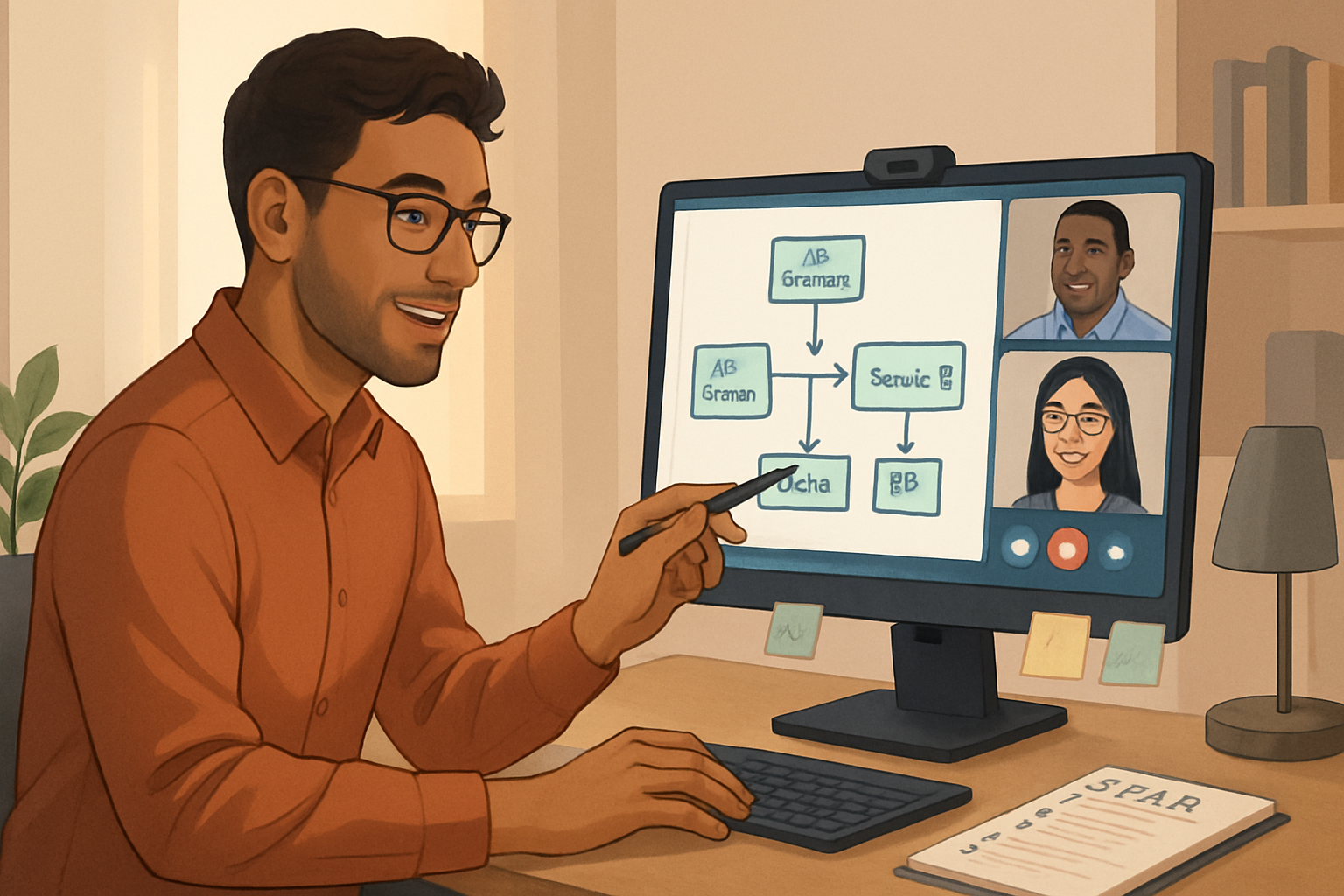
What you’ll get from this article
You can pass technical screens and still lose the job. But when you combine strong engineering with clear communication, collaborative instincts, and structured problem-solving, you move from “good candidate” to “clear hire.” Read on to learn exactly how to show those soft skills during Amazon’s technical assessment phases-what to say, how to say it, and real examples that map to Amazon’s Leadership Principles.
Why soft skills matter in technical assessments
Companies like Amazon hire for long-term impact. They want engineers who can do the work and who will work well with others as problems scale and ambiguity grows. That means the interviewers evaluate: clarity of thought, collaboration, leadership (even without title), and how you handle trade-offs. These are soft skills. They influence decisions as much as your ability to write bug-free code.
Amazon explicitly centers hiring around its Leadership Principles. Interviewers expect you to surface behaviors that map to principles like Customer Obsession, Ownership, Dive Deep, and Bias for Action. If you can tell concise stories that demonstrate those principles, you make it easy for the interviewer to say “yes.” See Amazon’s Leadership Principles here: https://www.amazon.jobs/en/principles
Where soft skills appear in the technical loop
- Phone screen / coding round: clarity under pressure. Can you explain your approach before coding? Do you solicit constraints? Do you test and communicate trade-offs?
- System design: architecture is language-heavy. You must translate requirements into components, trade-offs, and metrics.
- Pair-programming / live coding with an interviewer: collaboration on display. Do you ask for, accept, and incorporate feedback in real time?
- Behavioral interview: direct evaluation of teamwork, influence, conflict resolution, and ownership.
How to structure your soft-skill answers: frameworks that work
- STAR for behavioral stories: Situation, Task, Action, Result. Keep it crisp. Tie the Result to measurable outcomes where possible.
- Problem framing for design/coding: Ask clarifying questions → State assumptions → Propose high-level approach → Drill down to specifics → Summarize trade-offs and next steps.
- Think-aloud for live coding: narrate, not monologue. Tell what you’re thinking, why you choose a data structure, and what could go wrong.
For a deep technical design resource, the System Design Primer is excellent: https://github.com/donnemartin/system-design-primer
Practical scripts and phrases to use
Use short, explicit sentences to create rhythm and clarity. Mix short and long sentences for emphasis.
Clarifying questions (before coding/design):
- “Who are the users and what problem are we solving for them?”
- “Do you expect real-time low-latency responses or eventual consistency?”
- “What scale should I design for? QPS, data size?”
Framing your approach:
- “Here’s my high-level plan: 1) model the data, 2) define APIs, 3) service boundaries, 4) scaling considerations. I’ll drill into data modeling first unless you want a different focus.”
When you’re stuck:
- “I’m thinking about two options. Option A is simpler but has these trade-offs. Option B handles scale better but adds complexity. Which trade-off would you prefer I optimize for?”
During pair-programming:
- “I’ll write a small test first to lock down behavior. Want to review the test expectations with me?”
- “Do you have a preference for an iterative or all-at-once approach here?”
Wrapping a behavioral story:
- “So the result was X: we decreased latency by 35% and the team rolled the change to production within two sprints. Key learning: communicate trade-offs and get alignment early.”
Sample behavioral answers mapped to Amazon Leadership Principles
Example 1 - Ownership (STAR)
- Situation: Our service had intermittent outages during peak traffic.
- Task: I was assigned to find the root cause and reduce downtime.
- Action: I ran postmortems, traced a bottleneck to a single shared cache, proposed sharding with sticky routing, and wrote the rollout plan. I coordinated with SRE and product to schedule a staged deployment.
- Result: Downtime dropped by 80% and mean time to recovery improved by 60%.
Concise wrap: “I owned diagnosis, solution, and rollout. The change reduced outages 80%-and I documented the rollout playbook so the team could replicate it.” This surfaces Ownership, Dive Deep, and Deliver Results.
Example 2 - Earn Trust / Dive Deep
- Situation: A cross-functional project stalled because teams disagreed on measurement.
- Task: Align teams on a single success metric and move forward.
- Action: I organized a short workshop, presented three data-backed options, and mapped downstream impacts. I listened actively and revised metrics based on feedback.
- Result: Teams signed off in one meeting and we shipped the feature on schedule.
Tip: quantify impact when you can. Numbers make results real.
How to show teamwork and collaboration during technical rounds
- Use inclusive language: “let’s” and “we” instead of “I” when describing collaborative work.
- Credit teammates proactively: “My teammate added a critical test that caught a bug before production.” Interviewers are looking for humility and the ability to work with others.
- When given hints or corrections: thank the interviewer, incorporate feedback, and explain why you changed direction. That demonstrates coachability.
- If the interviewer disagrees, pause and ask: “Help me understand your perspective-what would you prefer I change?” This models constructive conflict resolution.
Demonstrating problem-solving in system design
Structure your design conversation. Here’s a short checklist you can say out loud:
- Requirements (functional and non-functional).
- Constraints and assumptions.
- High-level architecture and components.
- Data model and API sketch.
- Bottlenecks and scaling plan.
- Trade-offs and alternatives.
- Monitoring, error handling, and rollout strategy.
Example mini-flow (notifications service):
- Requirements: deliver notifications to users within 1s, support 10k QPS, retries for failures.
- Constraints: must be cost-efficient and support multiple channels (email, push).
- High-level: ingestion API → routing layer → channel workers → persistence for retries.
- Trade-offs: synchronous delivery simplifies correctness but costs latency; async pipeline increases durability but requires idempotency.
- Monitoring: per-channel success rates, queue backpressure metrics, consumer lag.
Narrating this structure shows you can think holistically and communicate a path forward.
Live coding: narration and testing win the day
- Say your plan before writing code. A short plan or outline or pseudocode reassures the interviewer.
- Start with a simple test case. Implement the simplest correct solution, then iterate.
- Explain complexity (time/space) at natural pause points.
- When you refactor, explain why-readability, performance, or edge cases.
These habits make your thought process visible, which is precisely what interviewers evaluate.
Quick checklist to practice before the interview
- Prepare 6–8 STAR stories tied to Leadership Principles. Include metrics.
- Do mock interviews (coding + system design + behavioral) with a friend or coach.
- Record yourself explaining a design for 7–10 minutes. Refine for clarity and pace.
- Code with narration for live coding practice. Get comfortable saying what you think.
- Practice active listening: repeat back requirements and ask 2 clarifying questions before starting.
Common mistakes and how to avoid them
- Mistake: Not asking clarifying questions.
- Fix: Always ask at least two targeted questions before starting.
- Mistake: Talking in monologues without confirming alignment.
- Fix: Pause frequently to check in-”Does that match what you’re looking for?”
- Mistake: Forgetting to quantify impact in behavioral stories.
- Fix: Add numbers: percentage improvements, time saved, cost reduced, users affected.
- Mistake: Reacting defensively to hints.
- Fix: Treat hints as collaboration. Thank, incorporate, and explain changes.
Final quick practice drills (15–20 minutes each)
- Drill 1: Pick a Leadership Principle. Tell a STAR story focused on that principle in 2 minutes.
- Drill 2: System design lightning: design a URL shortener in 15 minutes and identify the main bottleneck.
- Drill 3: Pair-programing simulation: share screen with a peer and narrate solving a simple algorithm while accepting two interruptions.
Closing-the one thing to remember
Technical skill gets you invited. Soft skills get you hired. Be explicit about trade-offs. Be collaborative in your language. Quantify outcomes when you can. And always connect your stories and designs back to impact for customers and the team. That alignment-that ability to communicate technical choices in human terms-is what separates a candidate who can write code from an engineer who can lead lasting outcomes.
References
- Amazon Leadership Principles: https://www.amazon.jobs/en/principles
- System Design Primer (GitHub): https://github.com/donnemartin/system-design-primer
- STAR method overview (Indeed): https://www.indeed.com/career-advice/interviewing/how-to-use-the-star-interview-response-technique