· career · 6 min read
Beyond Code: The Impact of Soft Skills in Frontend Development Interviews
Front-end interviews increasingly evaluate more than technical chops. Learn which soft skills matter most, hear anonymized insights from hiring leaders, and get concrete strategies and sample answers to showcase your interpersonal strengths in interviews.

By the end of this article you’ll know which soft skills hiring teams actually care about, how they assess them during frontend interviews, and-most importantly-how to show those skills in ways that land offers.
Why this matters now
Front-end development is about much more than HTML, CSS, and JavaScript. Today’s role sits at the intersection of engineering, design, and product. You’ll communicate with designers, negotiate with backend teams, and translate fuzzy product goals into usable UI. Skills that used to be “nice-to-have” are now decision factors. Short answer: being a great coder helps you pass screens. Being a great communicator and collaborator wins the job.
Why hiring teams care
- Products are cross-functional. Engineers must influence without authority.
- User experience depends on empathy and communication.
- Remote and hybrid work amplify the need for clear written and verbal skills.
Data and industry context
- LinkedIn and other talent reports have repeatedly listed communication and collaboration among the most in-demand skills for technical hires. See LinkedIn’s coverage of soft skills trends here.
- The Stack Overflow Developer Survey highlights that developers spend significant time on communication and collaboration, not just coding. Browse annual trends here.
- The value of behavioral interviewing and soft-skill assessment is well-documented in HR research, e.g. Harvard Business Review.
Top soft skills for frontend interviews - and why they matter
Communication (verbal + written) Why: You explain trade-offs, write docs, and communicate complex UI issues to non-engineers. What good looks like: Clear summaries, structured explanations, and concise PR descriptions.
Collaboration and teamwork Why: Frontend work requires working with designers, product managers, QA, and backend engineers. What good looks like: Sharing ownership, seeking feedback early, and closing the loop after handoffs.
Empathy and user focus Why: Frontend decisions affect real users. Empathy guides accessibility, error states, and flows. What good looks like: Advocating for accessibility and thinking through edge cases that help users succeed.
Problem-solving and critical thinking Why: Hiring teams want people who can break down ambiguous requests and engineer pragmatic solutions. What good looks like: Asking clarifying questions, proposing trade-offs, and iterating quickly.
Adaptability and learning agility Why: Frameworks, tooling, and product priorities change fast. What good looks like: Rapidly adopting new tools and reworking implementations when priorities shift.
Conflict resolution and influence Why: You’ll disagree with designers or PMs. How you handle it matters. What good looks like: Arguing from data and experiments rather than ego.
How interviewers actually evaluate soft skills
- Behavioral interviews: Questions like “Tell me about a time when…” probe past behavior and decision-making. Interviewers look for structure, ownership, and outcomes.
- Pair programming: Reveals communication style, patience, and how you think aloud.
- System/design interviews: Show your ability to negotiate trade-offs and communicate constraints.
- Take-home tasks and PR reviews: Give insight into documentation, clarity of thought, and the ability to anticipate reviewer questions.
- Culture-fit and values interviews: Assess alignment with collaboration norms and company values.
Anonymized interview excerpts: what hiring leaders told us
Note: The following are anonymized excerpts from conversations with hiring managers, senior engineers, and design leads across multiple companies.
Hiring Manager - Senior Frontend Engineering Manager (anonymized) “Technical skill is the entry ticket. Communication is what differentiates senior candidates. I want someone who can explain why they made a tradeoff in two sentences, then expand into details if asked. That few-seconds summary is rare and incredibly valuable.”
Senior Frontend Engineer (anonymized) “In pair programming I watch for curiosity. Do they ask thoughtful questions, or do they only react? Also, how they receive feedback. If they change course based on a small suggestion - that’s huge.”
Design Lead (anonymized) “Empathy stands out. Candidates who talk about who the feature is for, not just the technical bits, are remembered. They often suggest accessibility improvements we hadn’t thought of.”
How to showcase soft skills - practical tactics
- Use the STAR framework for behavioral answers
- Situation - Briefly set context.
- Task - Explain what you needed to do.
- Action - Describe what you actually did.
- Result - Quantify or qualify the outcome.
Example: “Tell me about a time you had to defend a technical decision.”
- Situation: Our product shipped a release with a 30% regression in slow environments.
- Task: I needed to propose a fix that didn’t delay the overall roadmap.
- Action: I ran a lightweight experiment, measured the regression, proposed a one-week phased fix with a feature flag, and documented rollback criteria.
- Result: The fix reduced load times by 45% in slow environments and shipped without blocking additional features.
- Talk through your thinking during pair programming
- Narrate trade-offs.
- Invite the interviewer to critique your approach.
- Ask clarifying questions before assuming requirements.
- Treat take-home projects as communication exercises
- Ship with a short README that explains design decisions, known limitations, and next steps.
- Include tests and accessibility notes.
- Provide clear setup instructions and a short video walkthrough if time allows.
- Use your portfolio and PRs as social proof
- Link to well-commented PRs that show review conversations.
- Highlight issues you opened and the discussions that followed.
- If you contributed to design systems, show how you negotiated changes across teams.
- Prepare concise examples for common behavioral prompts
- “A time you missed a deadline”
- “A time you disagreed with a teammate”
- “How you handle feedback”
- Demonstrate empathy and product sense
- Ask about users during interviews.
- Suggest edge-case tests and accessibility checks proactively.
Sample answers and micro-techniques
- Micro-technique: The 15-second summary
- Start long answers with a 15-second headline: “I owned the front-end for X feature; it had a performance bug that impacted Y users; I implemented a lazy-loading strategy and improved p95 by 40%.”
- Then expand.
- Sample STAR answer: “A time you disagreed with design”
- Situation: We had a modal for an important confirmation that designers wanted to show as a large overlay.
- Task: Ensure conversion while not degrading mobile UX.
- Action: I prototyped two versions-overlay and inline confirmation-ran a short A/B test with internal metrics and accessibility checks, and presented results.
- Result: The inline version improved mobile conversion by 12% and reduced reported accessibility issues.
- Pair-programming etiquette checklist
- Ask before taking control of the keyboard.
- Narrate your thought process.
- Offer options, not directives.
- When stuck, summarize and propose a next step.
Common mistakes candidates make (and how to avoid them)
- Over-focusing on code: Remember the “why.” Explain user impact and trade-offs.
- Rambling answers: Use structure (STAR) and lead with a headline.
- Defensive posture: Accept and incorporate feedback; show learning.
- Silence under pressure: Ask clarifying questions; interviewers prefer engaged thinkers.
A short prep plan (30 days)
Week 1: Collect stories. Pick 6-8 STAR examples that cover ownership, conflict, failure, and cross-functional work. Week 2: Practice pair-programming with a peer. Focus on narration and collaboration. Week 3: Polish portfolio and README for take-homes. Update PR links and write clear PR descriptions. Week 4: Mock interviews and feedback loop. Record yourself answering behavioral questions; iterate.
Final thoughts - the strategic edge
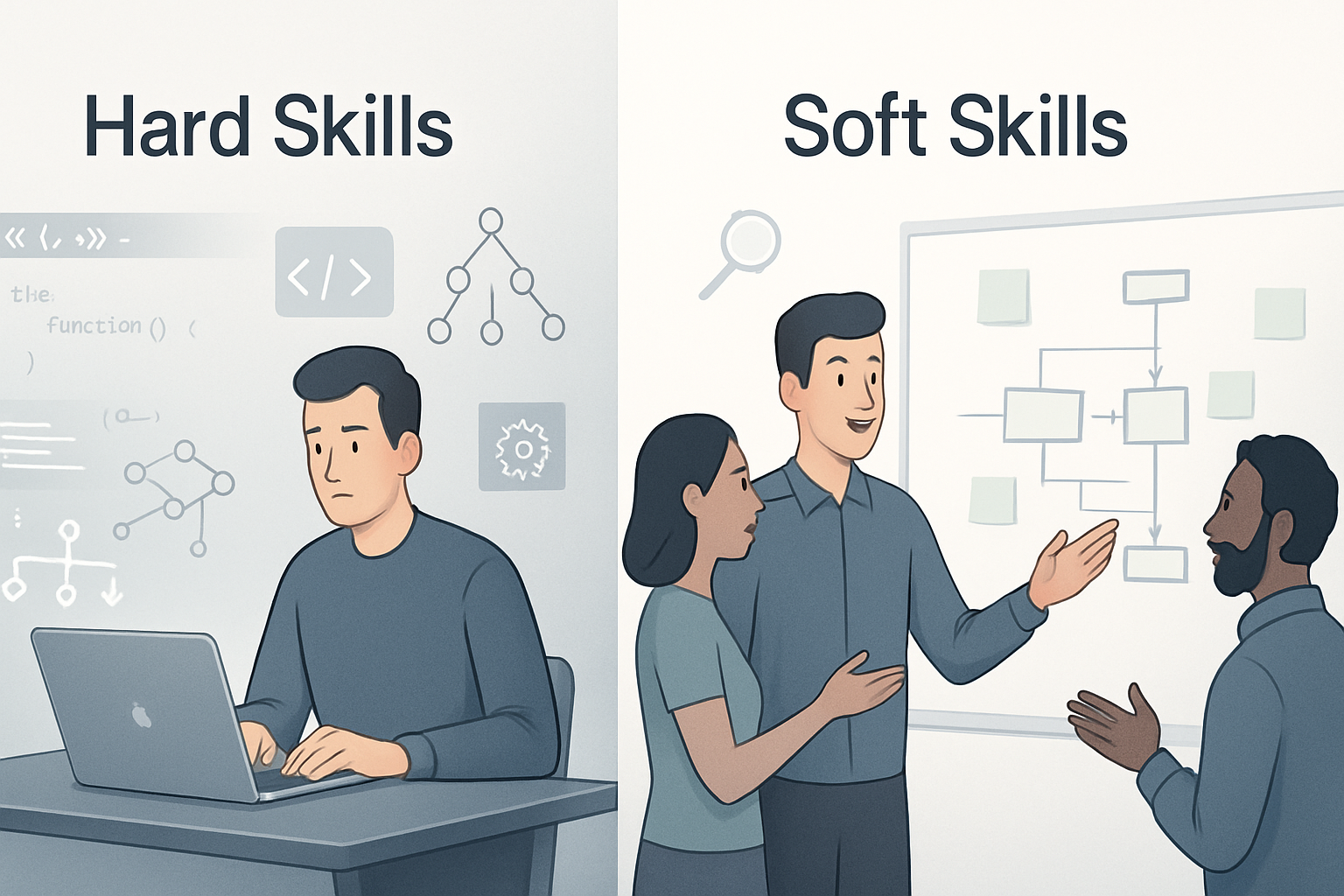
Your code proves you can build. Your soft skills prove you can ship with others. The difference between an offer and a “thanks for coming” is almost always about how well you fit into a team rhythm: how you explain trade-offs, how you fold in feedback, and whether you center users in your work.
Walk into interviews prepared to demonstrate both competence and collaboration. Start with a crisp headline. Tell structured stories. Be curious out loud. Influence with empathy.
Do that, and you’ll not only pass screens - you’ll join teams that trust you to lead the product experience.
In short: code opens the door; soft skills keep it open.