
· career · 6 min read
Soft Skills vs. Hard Skills: The Apple Engineer Interview Dilemma
Learn how to balance technical excellence and interpersonal savvy to ace Apple engineering interviews. Practical examples, sample answers, and a step-by-step prep plan to demonstrate both hard and soft skills convincingly.
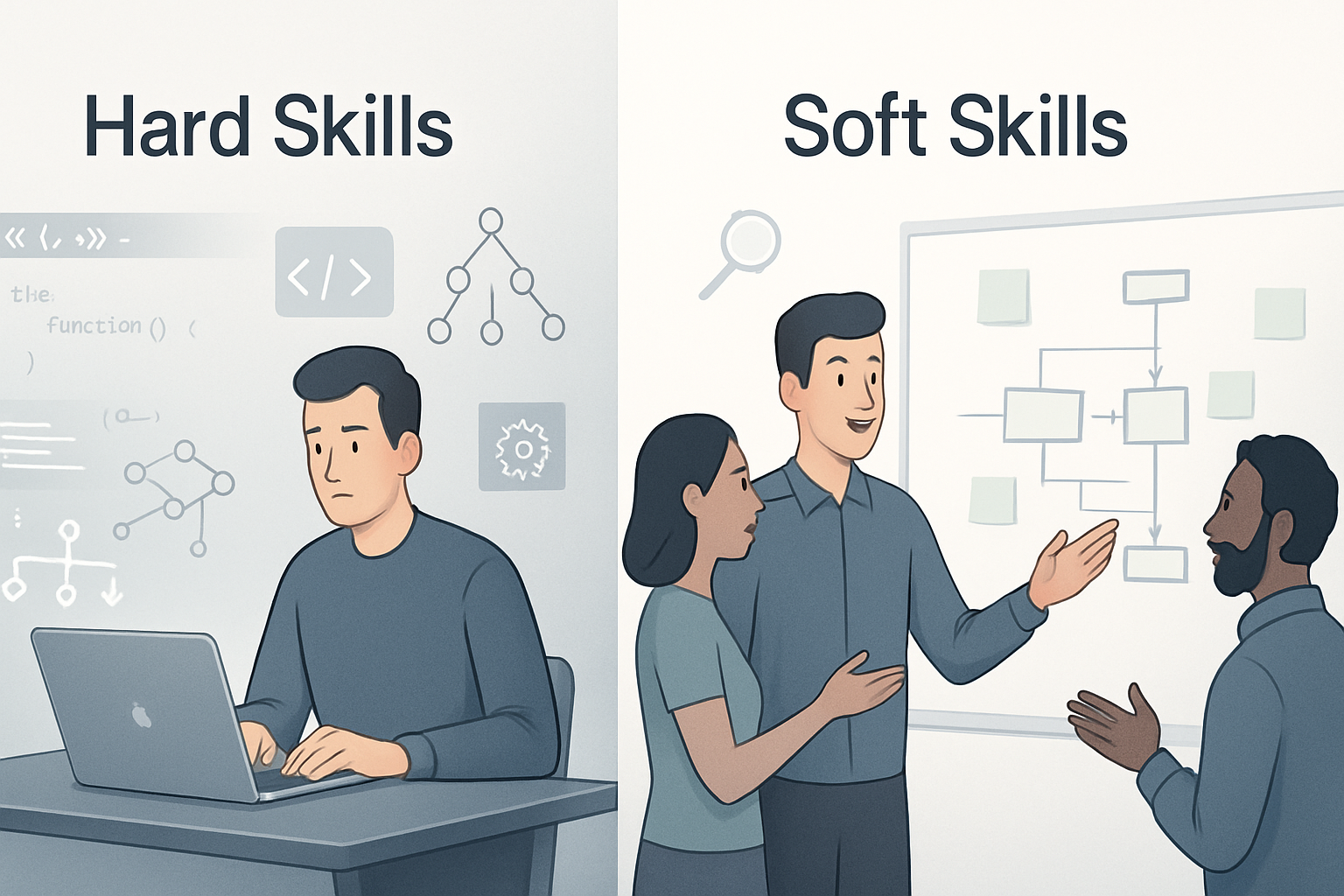
Outcome first: if you can show Apple interviewers clear technical mastery while communicating decisions, trade-offs and collaboration, you dramatically raise your chance of an offer. You’ll leave interviews not only proving you can build systems, but showing you can lead, adapt, and ship in a team-exactly what Apple hires for.
Why this balance matters at Apple (and everywhere great engineering happens)
Apple hires for product impact, not just puzzle-solving speed. The company looks for engineers who can design robust, maintainable systems and also influence product direction, cross-functional teams, and quality. Technical excellence gets you in the room. Soft skills get you ownership of the product and a seat at the table.
Short sentence. Big result: technical skill proves you can do the work; soft skill proves you can make the work matter.
What interviewers are actually looking for
- Hard skills (measurable): algorithmic problem solving, data structures, system design, coding correctness, debugging, platform-specific knowledge (iOS, macOS kernel nuances, hardware interfaces for embedded roles). See common Apple interview topics on LeetCode company discussions.
- Soft skills (observable): clear communication, thoughtful trade-offs, ownership, humility, mentoring, conflict resolution, and product sense. Apple emphasizes craftsmanship and collaboration over lone-wolf brilliance; that’s reflected in interview rubrics and candidate feedback on sites like Glassdoor.
Both are weighted. For senior roles the soft-skill bar rises: you must influence cross-functional decisions and drive execution across teams. For entry-level roles, hard skills may dominate, but showing collaboration and a learning mindset creates differentiation.
How to demonstrate both during each stage of the Apple interview
High-level rule: never leave thought processes to inference. Make them explicit.
Phone / Screen (coding) - show process as much as solution
What to do:
- Ask clarifying questions before coding (input sizes, constraints, edge cases).
- State complexity and target bounds: “I’m aiming for O(n) time, O(1) extra space.” Short sentence for clarity.
- Talk through options out loud, then commit: choose one approach and explain why.
Soft + hard in action (example):
- Interviewer: “Design an algorithm to deduplicate a list while preserving order.”
- Strong response: “Do you expect the items are hashable and can fit in memory? If yes, I’d maintain a hash set and iterate once, add unseen elements to the output-O(n) time, O(n) space. If memory is constrained, we’d need a disk-based dedupe or sorting with stable tie-breaking-costly for preserving original order. Which constraints should I optimize for?”
Why this works: you show technical trade-offs and invite collaboration-both soft and hard skills.
Onsite / System design - lead and collaborate
What to do:
- Start with requirements (functional and non‑functional). Clarify scale, latency, durability.
- Sketch high-level components and data flows.
- Discuss trade-offs (consistency vs. availability, caching strategies, partitioning, operational concerns).
- Use metrics and constraints: “We expect 100k QPS, 99.99% availability, 50ms p95 latency. To meet this I’d…”
Sample snippet of language that signals leadership:
- “We should plan for graceful degradation: if the recommendation service is down, fall back to a cached popular list to preserve core UX. I’ll add a circuit breaker and health-check flow so downstream teams can avoid cascading failures.”
This shows you can design systems and think about ownership, reliability, and cross-team impact.
Behavioral interviews - use STAR, but make it measurable
Apple interviewers want impact and craft. The STAR (Situation, Task, Action, Result) format is helpful-especially when you put numbers on the Result.
Example answer showing both soft and hard skills:
- Situation: “At my previous company we had a service with 5s median latency and frequent timeouts impacting a key product.”
- Task: “I was asked to reduce latency and improve reliability before the holiday release.”
- Action: “I led a cross-functional debugging effort: instrumented key code paths, implemented span-level tracing to identify hotspots, refactored a lock-heavy component to an optimistic concurrency model, and added an LRU cache for expensive DB calls. I coordinated with QA for a canary rollout.”
- Result: “Latency dropped from 5s to 150ms median and error rates fell 10x; release shipped on time and avoided revenue loss. The refactor reduced on-call pages for that service by 80%.”
Why this works: concrete metrics (150ms, 10x) show technical outcomes; leading a cross-functional effort shows soft skills.
Concrete phrases and behaviors that score well
Say these (but be genuine):
- “Let me restate the problem to make sure I’m aligned…”
- “I’m going to outline two approaches and why I’d choose the second because…”
- “I’m assuming X; if X is not true we can pivot to Y.”
- “How does this interact with the team’s ship cadence and monitoring standards?”
Nonverbal/behavioral cues matter: concise diagrams, controlled pacing, listening and pausing to allow interviewers to interject, and thanking the interviewer for clarifying questions.
Sample mini‑case: demonstrating both in a coding question
Problem: Reverse a linked list in groups of k.
Bad approach: Start coding immediately, no clarifying questions, no discussion of edge cases.
Good approach:
- Clarify: “Is k always > 0? What about the last group if its size < k-should it stay as-is?”
- Discuss options: iterative vs recursive, in-place vs creating new lists. Note stack depth for recursion issues.
- Announce complexity: “We can do O(n) time, O(1) extra space iteratively.”
- Write clean code and narrate each step.
- Test with examples out loud (k=1, k=n, k>n).
This demonstrates technical correctness plus communication, testing rigor, and production awareness.
How to prepare: a 6-week plan that balances both skill sets
Week 1–2: Foundation (hard)
- LeetCode problems: medium-to-hard arrays, strings, trees. Focus on clarity and optimal solutions.
- Read system design primers; sketch 5 designs end-to-end (e.g., notification system, file storage).
Week 3–4: Communication drills (soft + hard)
- Conduct mock interviews with peers. Practice thinking aloud, explaining trade-offs, and asking clarifying questions.
- Prepare 8–10 STAR stories tied to measurable outcomes (performance, reliability, cost, team growth).
Week 5: Role-specific depth
- Deep-dive into platform specifics (e.g., profiler tools for macOS/iOS, concurrency models, or hardware test benches depending on role).
- Build or read one small project end-to-end to talk about architecture and shipping trade-offs.
Week 6: Polish and rehearsal
- Do timed full interview simulations (phone + system design + behavioral).
- Refine language to be concise and impactful. Practice opening lines and closing summaries for each interview.
Role and level nuances
- Entry-level engineers: prioritize correctness and clarity. Show curiosity and a learning mindset.
- Mid-level engineers: show ownership, code quality, and mentorship examples.
- Senior staff: emphasize cross-team influence, product sense, and trade-offs that balance long-term technical health with shipping speed.
Final checklist to use during interviews
- Asked clarifying questions? ✅
- Stated assumptions explicitly? ✅
- Explained time and space complexity? ✅
- Discussed trade-offs and failure modes? ✅
- Measured or quantified results in behavioral answers? ✅
- Asked product/engineering questions back? ✅
Short pause. Then the strongest point: the interview is not a test of how smart you are in isolation-it’s a staged demonstration of how you will communicate, decide, and ship with others. If you prioritize showing both what you know and how you work, you transform technical answers into engineering leadership.
Useful resources and reading
- Apple Careers: https://www.apple.com/careers/ - official company view on roles and values.
- Glassdoor Apple interview questions and candidate feedback: https://www.glassdoor.com/Interview/Apple-Interview-Questions-E1138.htm
- LeetCode company discussion for Apple: https://leetcode.com/discuss/company/Apple/
- STAR interview method: https://www.indeed.com/career-advice/interviewing/how-to-use-star-method