· career · 6 min read
From Algorithms to Behavior: Balancing Technical Skills and Soft Skills for Meta
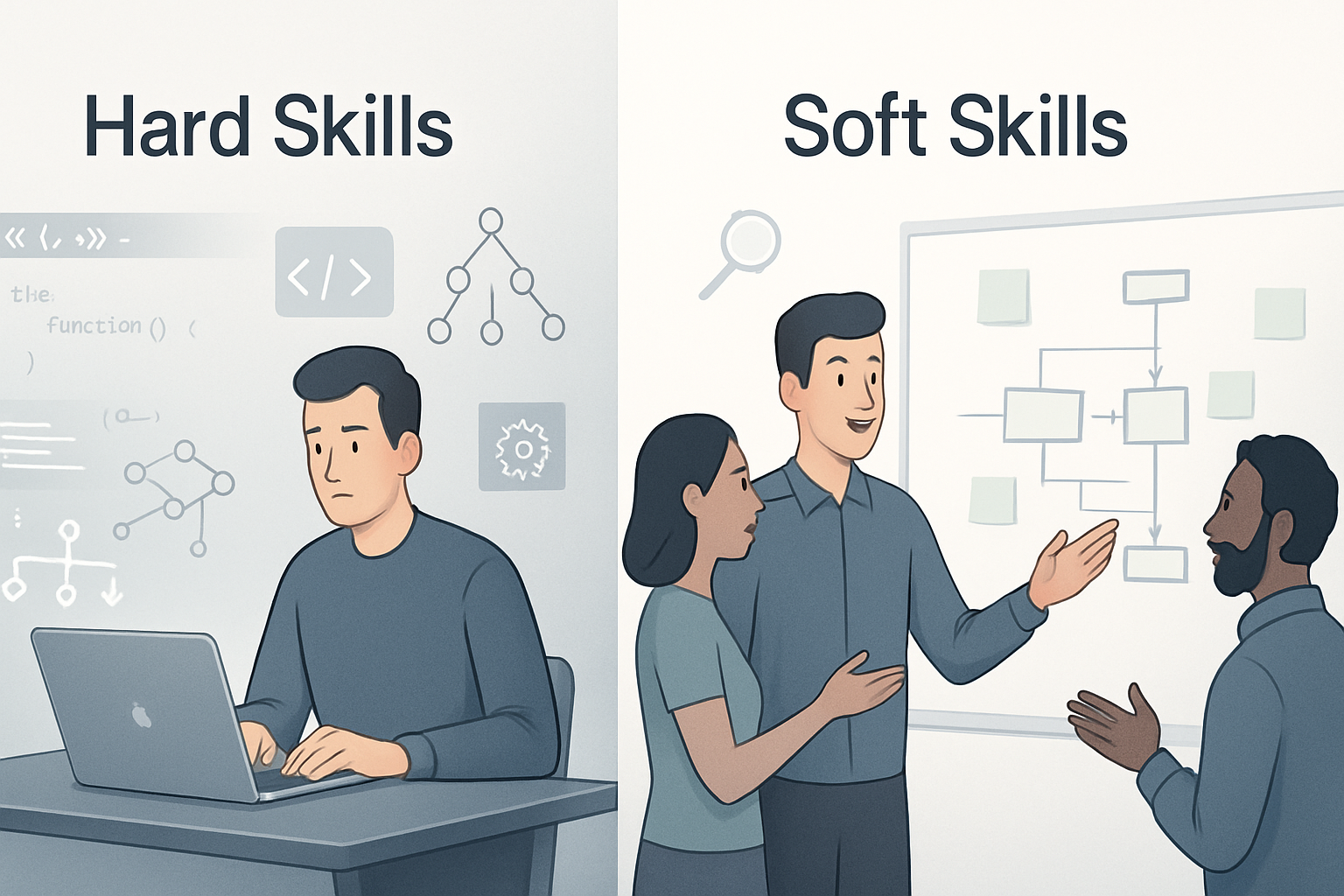
Meta values engineers who write great code and work effectively with others. This article explains why soft skills matter in Meta interviews and gives concrete, practiceable strategies to demonstrate teamwork, adaptability, and problem-solving during technical rounds.

Outcome first: you can walk into a Meta interview and leave the room having shown both deep technical chops and the human skills that make those chops useful. Nail that balance, and you don’t just solve problems - you make solutions that stick.
Why soft skills matter at Meta (and what they look like)
Meta hires people who build for scale and who can build with others. Technical excellence gets you to the table. Soft skills get you across the room and keep the project alive afterwards.
What does Meta mean by soft skills in practice?
- Teamwork: working across product, design, data science, infra - not just owning code.
- Adaptability: responding to ambiguous product directions, shipping iteratively, learning new stacks quickly.
- Problem-solving with context: choosing pragmatic trade-offs, surfacing risks, and aligning stakeholders.
These are not “nice-to-haves.” They determine whether your code ships, whether it survives real-world load, and whether your design is adopted by a product team.
(If you want data on why soft skills are increasingly central in the workplace, see the World Economic Forum’s Future of Jobs report.)
How Meta interviewers evaluate soft skills
Interviewers look for signals during both explicit behavioral interviews and technical rounds. Expect soft-skill evaluation to be woven into everything you do.
- Behavioral interviews: direct questions about leadership, conflict, and cross-team work.
- System-design interviews: how you communicate trade-offs, elicit requirements, and incorporate product/user constraints.
- Coding interviews: clarity in thought, how you incorporate feedback, and how you test and iterate your solution.
Interviewers log evidence against competencies such as collaboration, ownership, learning velocity, and impact. They want concrete examples - not general statements.
A framework to prepare: map stories to competencies
Create a compact story bank. Build 6–8 stories that you can adapt to many questions. For each story use the STAR model (Situation, Task, Action, Result) and tag it with the competency it shows.
Essential story types to prepare:
- Cross-functional collaboration (teamwork)
- Pivot under uncertainty (adaptability)
- Root-cause diagnosis of a production issue (problem-solving)
- Mentoring or code review that improved outcomes (leadership)
- A failure and what you learned (humility + growth)
- Driving a trade-off decision with measurable impact (impact orientation)
Reference: a practical guide to the STAR method is helpful when practicing answers: https://www.themuse.com/advice/star-interview-method
Story templates and a short exemplar
Template (one-liner opener): “In [context], I was responsible for [your role]. The challenge was [problem]. I did [concise action, 2–3 steps], which resulted in [quantified outcome].”
Example (teamwork + impact):
- Situation: Our service was missing latency SLOs after a feature launch.
- Task: I led an urgent cross-team triage with infra and product to restore SLOs.
- Action: I set a 60-minute triage agenda, isolated slow endpoints via sampling, proposed a two-step fix (short-term caching + a longer-term refactor), and coordinated a canary rollout.
- Result: Latency returned below SLO in 8 hours; the canary avoided user-visible regressions; team adopted the refactor in the next sprint, reducing similar incidents by 40%.
Why this works: clear ownership, concrete actions, cross-team coordination, and measurable impact.
Show teamwork inside technical interviews
You can demonstrate collaboration even in a whiteboard coding round. Small behaviors signal big things.
- Ask clarifying questions before you start. It shows empathy and alignment.
- Narrate trade-offs: “This approach optimizes write throughput but increases memory; if product needs tail latency, we should…”
- Invite feedback and act on it: when the interviewer hints, say “good point, I’ll incorporate that” and then actually incorporate it. That shows coachability.
- Credit others: if you borrow an idea or pattern, attribute it: “We can use a debounce similar to X, which a teammate introduced on project Y.”
These small conversational moves prove you don’t silo yourself.
Show adaptability during ambiguity
Meta works on ambiguous, fast-moving problems. Interviewers reward structured approaches to ambiguity.
- Break the problem into assumptions and prioritize them. Say: “I’ll assume A, B, C. If A is false, we can pivot to…”
- Use incremental delivery: propose an MVP or canary. Explain how to monitor and iterate.
- Surface learning velocity: mention what you would prototype in a day versus a quarter and why.
When you’re asked about a tech you don’t know, be honest, then show a plan: “I haven’t used X extensively, but I’d learn it by doing A, relying on B, and mocking C to validate behavior.” That beats bluffing.
Demonstrate problem-solving: structure, hypotheses, trade-offs
Problem-solving at Meta is not just about the right endpoint - it’s about the path you took.
- Lead with a high-level approach first. Say the plan, then dive into details. Interviewers want to follow your map.
- Propose and evaluate alternatives. Explicitly compare latency, cost, complexity, and developer ergonomics.
- Use metrics: mention SLOs, throughput, cost-per-request, or time-to-recover as decision levers.
- If debugging a scenario, show root-cause thinking: logs → metrics → reproduce → fix → validate.
This shows you think like an owner.
Behavioral dos and don’ts (concise)
Do:
- Use STAR.
- Quantify results.
- Be succinct; finish answers in 1–2 minutes, then offer to expand.
- Show humility: own what you learned.
Don’t:
- Over-claim ownership on team achievements.
- Ramble without structure.
- Deflect when asked to dive deeper - interviewers test depth on purpose.
Practice drills that move the needle
- Build a story bank and rehearse it until you can state the core in 30 seconds.
- Do mock interviews with peers and ask for direct feedback on collaboration cues.
- Record and time your answers. Aim for crispness with optional expansion.
- Run through system-design prompts and explicitly practice stakeholder framing (product, privacy, infra).
What to do during the onsite (or virtual) day
- Be present: make small confirmations like “Do you want me to whiteboard this or code first?”
- When given a hint, treat it as collaboration rather than correction.
- Ask 2–3 smart questions at the end that surface business trade-offs or team culture.
- Close strongly: briefly recap one story you think best shows your fit and ask if they’d like details.
Quick checklist before interview day
- 6–8 STAR stories written and tagged by competency.
- 2 system-design templates practiced (one backend scale, one product-oriented).
- 1 short story about a failure and what you learned.
- Mock interviews (at least 2) with feedback.
- Resume bullet points aligned to your stories.
Final thought - technical skill opens the door. Soft skills decide whether you’re the person they want on the team.
Bring strong algorithms and systems knowledge. Bring them with humility, curiosity, and a bias toward collaboration. That combination doesn’t just solve interview problems. It builds products people rely on.
References
- Meta Careers: https://www.metacareers.com/
- STAR interview method: https://www.themuse.com/advice/star-interview-method
- World Economic Forum - The Future of Jobs Report (soft skills trends): https://www.weforum.org/reports/the-future-of-jobs-report-2020