· frameworks · 7 min read
Hapi vs. Express: Why Hapi.js Might Be the Unsung Hero of Node.js Frameworks
A practical comparison of Hapi.js and Express that highlights Hapi's built-in validation, powerful plugin system, and design-for-scale advantages - and when you should pick it over Express.
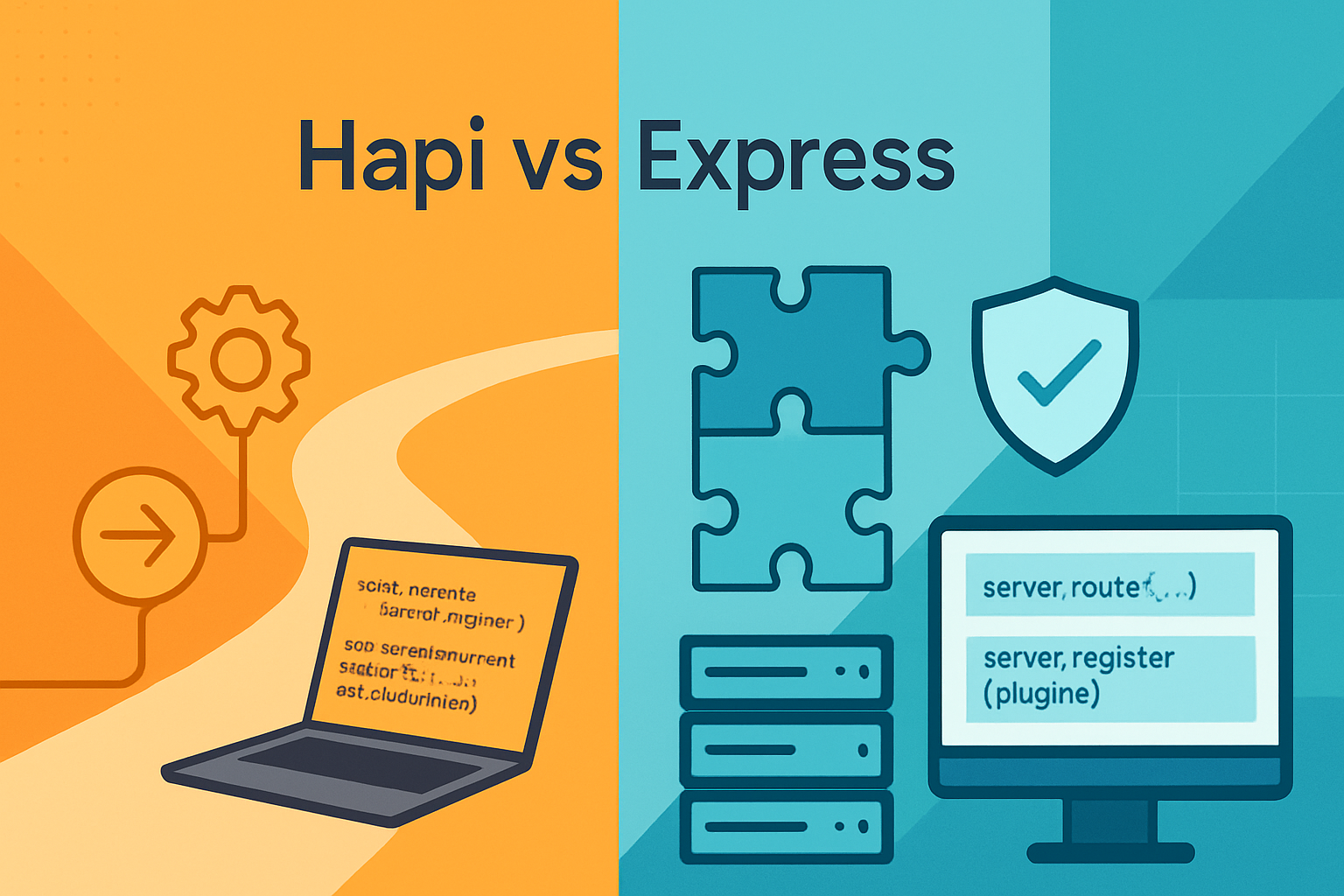
Outcome: By the end of this article you’ll know exactly when Hapi.js is the better choice for a Node.js project, how its built‑in features save development time and bugs, and how to map common Express patterns to Hapi idioms so you can make a confident framework choice.
The short version - what you’ll get from this article
- A clear comparison of Hapi and Express by design, not by popularity.
- Concrete examples showing Hapi’s built-in validation and plugin model versus equivalent Express patterns.
- Practical guidance: when to favor Hapi and when Express remains the faster, lower‑overhead choice.
Read on if you’re choosing a framework for an API, a microservice, or a team project where maintainability and correctness matter.
First impressions: philosophy and ergonomics
Express is famously minimal. It gives you request and response objects, some routing helpers, and a middleware pipeline. Small surface. Fast to learn. Huge ecosystem. Lightweight by design. See the official docs: Express.
Hapi, by contrast, is opinionated about structure. It provides first‑class route configuration, explicit lifecycle hooks, a plugin-centric architecture, and a strong focus on predictable behavior out of the box. It also bundles patterns you would otherwise assemble from third‑party libraries. Read the framework docs: Hapi.
Which philosophy do you need? If you want minimal friction and a tiny surface area, Express wins. If you want structure, validation, and encapsulation as first-class concepts, Hapi starts to look very appealing.
Feature-by-feature comparison
Routing and configuration
Express: routes are functions attached to the app or an Express.Router. Configuration is implicit. Middleware order matters and is easy to get wrong.
Hapi: routes are declarative objects with an
optionsblock where you attach validation, authentication strategies, caching, and response rules at the route level. This moves configuration next to the route and reduces accidental side effects.
Why it matters: colocated route configuration reduces cognitive load when reviewing or modifying endpoints. You don’t have to chase middleware order to find where validation or auth is applied.
Input validation - built in vs. bolt‑on
Hapi routes expose a validate section that integrates directly into the request lifecycle. You can validate payload, params, query, and headers with a schema and decide how validation failures should be handled.
Code example (Hapi):
// Hapi example
const Hapi = require('@hapi/hapi');
const Joi = require('joi');

const server = Hapi.server({ port: 3000 });

server.route({
  method: 'POST',
  path: '/users',
  options: {
    validate: {
      payload: Joi.object({
        name: Joi.string().min(1).required(),
        email: Joi.string().email().required(),
      }),
      failAction: (request, h, err) => {
        throw err;
      },
    },
  },
  handler: (request, h) => {
    // validation already done
    return { status: 'ok', data: request.payload };
  },
});

await server.start();
Express doesn’t include validation in the core. You either validate manually inside handlers or attach middleware (for example with express-validator or use celebrate to reuse Joi). That works fine - but it’s additional wiring and a different mental model.
Code example (Express):
// Express example
const express = require('express');
const Joi = require('joi');

const app = express();
app.use(express.json());

app.post('/users', (req, res) => {
  const schema = Joi.object({
    name: Joi.string().min(1).required(),
    email: Joi.string().email().required(),
  });

  const { error, value } = schema.validate(req.body);
  if (error) return res.status(400).json({ error: error.details });

  res.json({ status: 'ok', data: value });
});

app.listen(3000);
Bottom line: Hapi gives you validation as a first-class, declarative route option. Express requires assembling primitives.
(References: Joi docs - Joi)
Plugins and encapsulation
Hapi’s plugin system is where it truly differentiates. Plugins in Hapi can:
- Register routes, utilities, and decorations.
- Declare dependencies on other plugins.
- Create encapsulated state (plugin‑scoped behavior) or extend the server/request objects (decorations).
- Be configured with options at registration time.
This encourages building features as modular, testable units - an important property for large teams.
Express has middleware and routers that can be composed, but middleware is global (order dependent) and lacks the same dependency declaration and encapsulation semantics. With Express, similar modularity is achievable but requires conventions rather than built‑in enforcement.
Hapi plugin docs: https://hapi.dev/tutorials/plugins/
Errors, responses, and helpers
Hapi provides utilities like Boom for HTTP-friendly errors and a structured approach to response lifecycle management. The Hapi family page documents these utilities: https://hapi.dev/family/boom/
Express leaves these choices to you. Again, more freedom - and more choices for consistency to slip.
Auth, caching, and lifecycle control
Hapi supplies explicit hooks and patterns for authentication strategies and caching at the route level. You can declare route cache rules directly in options.cache. For complex auth (multiple strategies, scopes), Hapi’s built‑in support and declarative route configuration simplify reasoning about who can access what.
Express often relies on middleware libraries for auth and caching. They work well, but you need to wire them into routes or routers manually and keep track of order.
Observability and logging
Hapi’s ecosystem includes well-integrated logging and monitoring plugins that are designed to work with the framework’s lifecycle. Express has numerous logging libraries (Morgan, Winston, Pino), which are battle tested and flexible; but integration patterns differ by library rather than being part of the framework itself.
Performance - myth vs. reality
Raw throughput benchmarks sometimes show Express edging out Hapi by a small margin because Express does less by default. But the real cost in production is often not the framework overhead. It’s validation, DB calls, network I/O, and poorly structured middleware.
If you implement validation and error handling yourself in Express, you pay that cost anyway. Hapi moves those responsibilities into predictable hooks and often reduces duplicated validation code and validation mistakes - and that improves correctness more than it hurts raw throughput.
If absolute micro‑latency is your single metric (and you control every component), Express is slightly leaner. If maintainability, correctness, and security are priorities, Hapi’s structured approach often yields better long‑term performance by reducing bugs and rework.
Use cases - when to pick Hapi
- You’re building an API for an enterprise team and need explicit, testable semantics for validation, auth, and plugins.
- You want route‑level caching, response schemas, and validation colocated with routes.
- You aim for a plugin architecture where features are encapsulated and declarative dependencies matter.
- Security and predictable behavior are priorities - e.g., payment platforms, healthcare APIs, or internal services where consistent rules must be enforced.
Use cases - when to pick Express
- You’re building a small service or prototype and want minimum friction.
- You prefer assembling your own stack with your favorite middleware libraries.
- You need the broadest set of community packages or are working within ecosystems that assume Express (many tutorials, example projects, or middlewares are Express-first).
Migration and learning curve
If your team knows Express, Hapi is learnable. The mental shifts are:
- From middleware order to declarative options.
- From global middleware composition to plugin encapsulation and dependencies.
Those are not hard. They are different. For teams that value long‑term stability, the initial learning cost pays back quickly.
Concise checklist to choose between Hapi and Express
- Need structured, declarative route configuration? Pick Hapi.
- Need fast prototyping and minimal boilerplate? Pick Express.
- Building a large API with multiple teams and strict validation needs? Hapi is likely the better fit.
- Want maximum community-driven examples and middleware choices? Express wins.
Final verdict - why Hapi deserves more attention
Express is excellent and widely adopted. It’s the right tool in many situations.
Hapi is underrated because it is opinionated. That opinion - validation, plugins, and explicit route configuration - is exactly what saves time and bugs in medium‑to‑large codebases. Hapi reduces accidental complexity by moving critical concerns (validation, auth, caching, error handling) into first‑class, declarative patterns.
If your project will grow, if multiple developers will touch the code, or if correctness and security matter, Hapi isn’t just an alternative - it’s often the smarter, safer one. For those scenarios, Hapi is the unsung hero of Node.js frameworks.