· frameworks · 6 min read
The Great Debate: AdonisJS vs. Express - Which Framework Wins in 2023?
A practical, scenario-driven comparison of AdonisJS and Express in 2023: trade-offs, real-world performance considerations, developer experience, and which framework to pick for your project.
Outcome first: by the end of this piece you’ll know which framework to pick for the job you care about - the high-throughput API, the team-friendly enterprise app, the rapid prototype, or the long-lived full-stack product. You’ll get concrete trade-offs, what to expect in real-world performance, and action steps to validate the decision in your environment.
TL;DR - Quick verdict
- Use Express when you want minimalism, fine-grained control, and the smallest possible runtime overhead for HTTP services or microservices.
- Use AdonisJS when you want a batteries-included, opinionated framework that speeds development of full-featured apps (ORM, auth, validation, CLI, service provider system), at the cost of additional runtime and conceptual overhead.
Both are solid. The winner depends on your priorities: raw speed and small surface area (Express) vs developer productivity and convention (AdonisJS).
What they are, succinctly
Express: The de-facto minimal web framework for Node.js. Unopinionated, tiny surface area, vast middleware ecosystem. Official site: https://expressjs.com/
AdonisJS: A full-stack, opinionated Node.js framework inspired by Laravel. It bundles an ORM (Lucid), authentication, validation, task runner, and a clear application structure. Official site: https://adonisjs.com/
The core trade-offs (one-line summary)
- Express = minimal, add what you need. Fine for tiny APIs and microservices.
- Adonis = feature-rich, batteries included, better DX for larger apps and teams.
Real-world performance - what to expect
Hard numbers depend on app shape, I/O characteristics, and how you use the framework. But some reliable, general observations apply:
Minimal frameworks tend to have smaller request handling overhead. Express, being lightweight, typically adds less per-request latency than a full-stack framework that runs more middleware, lifecycle hooks, and DI resolution.
Feature-rich frameworks (AdonisJS) pay some runtime cost for their conveniences: IoC container lookups, ORM initialization, validation layers, and richer middleware pipelines. That cost is usually small compared to network and database latency for typical apps, but it becomes measurable in extreme throughput situations.
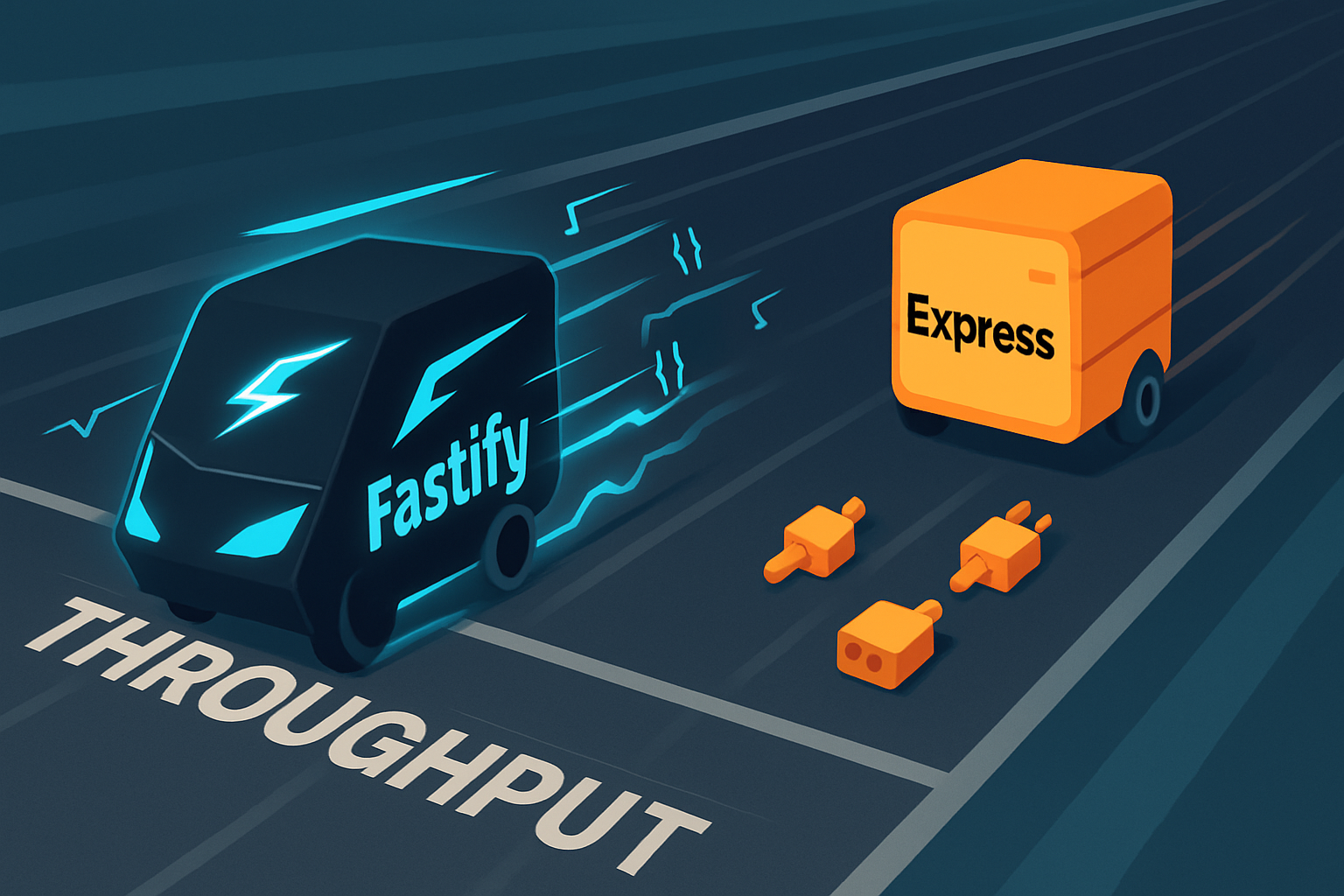
For raw HTTP request throughput, benchmark projects such as the TechEmpower Web Framework Benchmarks show that the fastest Node.js choices are frameworks built for minimal overhead (and some specialized servers). Express is commonly used as the baseline in community benchmarks; frameworks designed for speed (Fastify, uWebSockets.js) outperform Express in micro-benchmarks. See the official benchmark hub: https://www.techempower.com/benchmarks/
Important caveat: micro-benchmarks that test simple JSON responses primarily measure framework overhead. In most real apps, database calls, external services, and business logic dominate time spent. That means the practical impact of the framework on end-user latency is often smaller than developers expect.
Developer experience (DX) - the qualitative metrics that matter
Bootstrapping and conventions
- AdonisJS: Opinionated structure and CLI scaffolding get teams productive fast. Conventions reduce decision fatigue and enforce consistency across projects.
- Express: Minimal conventions. Great for experienced Node devs who want to assemble only the pieces they need.
Built-in features
- AdonisJS: ORM (Lucid), authentication, validation, job scheduling, mailing, and more out of the box. Reduces choice overload and integration effort for full apps.
- Express: No built-ins beyond routing and middleware stacking. You pick libraries for ORM (Sequelize, TypeORM, Prisma), validation (Joi, Zod), auth (Passport, custom), etc.
Learning curve
- AdonisJS: Higher initial learning curve because of the framework concepts (IoC, providers, lifecycle), but that cost is repaid as the app grows.
- Express: Quick to learn for small APIs. Complexity grows as you compose many libraries; architecture becomes your responsibility.
Maintainability and team scale
- AdonisJS: Opinionated architecture helps large teams maintain consistency and onboard new members faster.
- Express: Flexible but requires strong internal conventions and discipline to avoid a tangled codebase.
Ecosystem and support
- Express: Massive ecosystem, many middleware packages, and a long history. Community support and answers are abundant.
- AdonisJS: Smaller ecosystem but focused. The framework provides first-party tooling that reduces friction for common tasks.
Where each framework shines - scenario guide
Choose Express when:
- You need the smallest possible memory and CPU overhead for stateless microservices.
- You’re building tiny, single-purpose HTTP endpoints or proxy layers.
- You prefer to select each dependency yourself and keep the runtime lean.
- You’re integrating into an existing infrastructure that already defines patterns and tools.
Choose AdonisJS when:
- You’re building a feature-rich web app (admin panel, CMS, SaaS product) that benefits from ORM, auth, validation, and CLI tooling being consistent and integrated.
- Your team values conventions and a guided architecture (especially if your team likes Laravel-style patterns).
- You want faster initial development, fewer decisions about which third-party libraries to wire up, and consistent patterns across multiple apps.
Example cost-benefit comparisons
High-throughput, low-latency API (many small JSON endpoints)
- Express often has the edge: smaller per-request overhead and simpler middleware chains.
- If you need even more performance, consider Fastify or specialized servers.
CRUD-heavy SaaS with many moving parts (auth, RBAC, background jobs, mail)
- AdonisJS shines: fewer integration points to glue together, consistent idioms, and a richer default stack.
Prototyping an MVP with a small team
- AdonisJS can reduce friction - you get auth, ORM, and routing out of the box.
- Express can be faster if the prototype is intentionally tiny and you want absolute minimalism.
Measuring for your app - a pragmatic benchmarking checklist
- Define realistic workloads: include DB queries, caching, and external calls. Micro-benchmarks of static JSON are only the starting point.
- Use the same Node version and identical hardware/containers for each test. Differences in Node version can affect throughput and memory use.
- Benchmark end-to-end: measure request latency and throughput from your client side, and measure CPU and memory on the server.
- Profile hot paths: CPU profiles (e.g., 0x, Clinic.js) reveal whether framework overhead or your code dominates.
- Consider developer velocity cost: calculate time-to-feature for a real feature in both stacks - sometimes a small runtime cost is cheaper than weeks of integration work.
Real-world developer reports and community sentiment
- Many teams report faster development and fewer integration headaches with Adonis for full applications, thanks to the integrated toolset.
- Express remains the go-to for small services and when teams want complete control over dependencies and runtime behavior.
If you want to see Express performance in standardized micro-benchmarks, the TechEmpower Web Framework Benchmarks are a good reference: https://www.techempower.com/benchmarks/ . For a view of speed-focused Node frameworks and how they compare, look at Fastify’s benchmarks and documentation on performance: https://www.fastify.io/benchmarks/ .
Migration and interoperability considerations
- Express middleware is widely available. If you start with Express, it’s usually straightforward to add packages for ORM, validation, and auth.
- Moving from Express to AdonisJS (or vice versa) is non-trivial because Adonis prescribes app structure and lifecycle. Plan for refactoring if you switch.
Final recommendation - a decision flow
- Is raw throughput the top priority and will your endpoints be trivial (no DB calls)? Start with Express (or Fastify).
- Do you need a full-stack solution that minimizes wiring (ORM, auth, jobs, email)? Choose AdonisJS.
- Are you building many small microservices that must remain minimal and container-friendly? Express.
- Is team onboarding, consistent architecture, and fast feature development more important than squeezing out every bit of performance? AdonisJS.
Closing thoughts
There is no absolute winner. The right choice is the one that reduces cost, latency, and friction for your product and team. Express gives you control and minimal overhead. AdonisJS gives you conventions and productivity. Measure both under realistic load and choose the trade-off that aligns with your priorities.
References
- Express (official): https://expressjs.com/
- AdonisJS (official): https://adonisjs.com/
- TechEmpower Web Framework Benchmarks: https://www.techempower.com/benchmarks/
- Fastify (performance context and benchmarks): https://www.fastify.io/benchmarks/