· career · 8 min read
Beyond the Code: Soft Skills That Set You Apart in OpenAI Interviews
Technical skill gets you to the table. Soft skills win the conversation. Learn which interpersonal strengths OpenAI interviewers notice, how to demonstrate them in phone screens, technical loops and take-home tasks, and concrete story templates you can adapt today.

What you’ll get from this article
By the end of this piece you’ll know which soft skills matter most in OpenAI interviews, how interviewers look for them across screens and loops, and exactly how to practice and present those skills so you don’t just answer questions-you lead conversations. Walk in prepared. Walk out memorable.
Why soft skills matter at OpenAI (and why they should matter to you)
OpenAI hires people who will build systems that impact millions. Technical ability is necessary. But not sufficient. The product you ship depends on collaboration, clear thinking, and judgement. Interviewers are assessing whether you’ll communicate complex ideas, resolve team trade-offs, handle ambiguity, and steer work toward ethical outcomes.
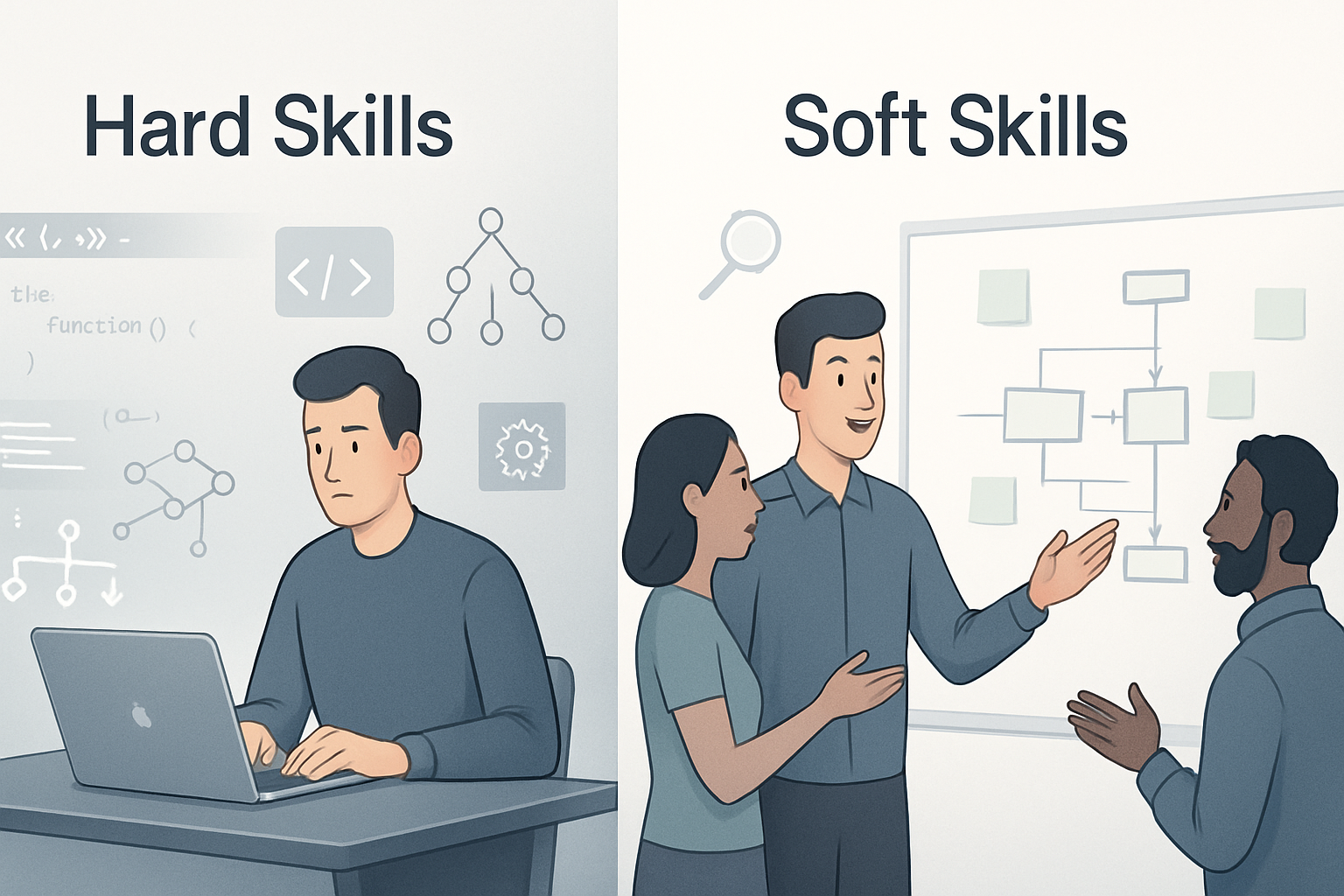
Put plainly: your code demonstrates what you can build. Your soft skills demonstrate how you’ll build it with others and for the world.
This is not peripheral. It’s central. It’s what separates strong candidates from those who simply check technical boxes.
References: see OpenAI’s careers page for role expectations and culture hints OpenAI Careers.
The core soft skills OpenAI interviewers are listening for
Below are the high-impact interpersonal skills interviewers expect. For each skill I explain why it matters and how it shows up in interviews.
- Communication: clarity, structure, empathy
- Why it matters: You’ll translate research and engineering trade-offs to teammates, PMs, or policy partners. Clear thinkers convince and align.
- How it shows up: clear verbal problem framing, succinct summaries of trade-offs, and thoughtful responses to follow-ups.
- Collaboration & teamwork
- Why it matters: OpenAI projects are cross-functional. You need to coordinate with researchers, engineers, ops, and policy.
- How it shows up: examples of resolving disagreements, integrating feedback, and elevating others’ work.
- Problem framing & critical thinking
- Why it matters: Many interviews evaluate how you structure ambiguous problems more than whether you know a specific library.
- How it shows up: restating problems, asking clarifying questions, decomposing large goals into measurable steps.
- Curiosity & learning agility
- Why it matters: AI moves fast. Candidates must learn new techniques, adapt, and update beliefs based on evidence.
- How it shows up: recent learning stories, mistakes that led to insights, experiments you initiated.
- Creativity & resourcefulness
- Why it matters: Novel challenges require fresh ideas, not just standard approaches.
- How it shows up: creative trade-off decisions, unexpected solutions in constraints, lateral thinking in design interviews.
- Ownership & humility
- Why it matters: You’ll be accountable for outcomes, but you’ll also receive critique and need to iterate.
- How it shows up: owning errors, describing corrective steps, crediting teammates.
- Ethical reasoning & judgment
- Why it matters: Tools from OpenAI affect society. Demonstrating that you weigh harms, biases, and long-term implications is essential.
- How it shows up: thoughtful responses to “how could this be misused?” and mitigation strategies.
- Resilience & adaptability
- Why it matters: Research and production both have dead ends. Recovering and iterating fast is a multiplier.
- How it shows up: stories where plans changed, but you delivered impact anyway.
For background on the growing importance of these skills in hiring, see this briefing from Harvard Business Review: It’s Time to Retire the Term “Soft Skills”.
How interviewers actually probe soft skills (by stage)
Interview processes often include phone screens, technical interviews, design loops, behavioral interviews, and take-home assignments. Here’s what to prioritize at each step.
1) Recruiter / phone screen
- What they want: signal you can communicate, prioritize, and fit the role.
- How to show it: give a 30–60 second story of your most relevant work-start with the outcome, then the approach. Ask two clarifying questions about the role or product. End by summarizing why you’re excited.
Example (30s): “At X, I led model infra for a safety rollout that reduced cost by 35% while maintaining latency SLAs. I framed the problem by measuring end-to-end latency, prioritized caching and batching, and coordinated with the infra and SRE teams to ship a staged rollout. I’m excited about this role because I enjoy projects with both research depth and production constraints.”
2) Technical loops (coding, design, pair-programming)
- What they want: clear thinking under pressure, ability to explain choices, and collaborative code hygiene.
- How to show it: narrate. Ask clarifying questions. Outline your approach before typing. For pair-programming, invite suggestions and check that assumptions match the interviewer’s.
During system design: weigh trade-offs aloud. Use structure-requirements, constraints, candidate designs, evaluation metrics, and failure modes.
3) Behavioral / leadership interviews
- What they want: reliable evidence you’ll behave as described on your resume.
- How to show it: use STAR (Situation, Task, Action, Result). Be specific. Quantify where possible. Reflect on what you learned.
For help on the STAR technique, see this practical guide: Indeed - STAR Method.
4) Take-home assignments & code reviews
- What they want: judgment, clarity, and the ability to communicate trade-offs in writing.
- How to show it: include a README that states assumptions, alternative approaches you considered, and known limitations. Add tests and small benchmarks. If you made a compromise for time, state it explicitly and explain how you’d improve it.
Behavioral story templates you can adapt
Below are concise, high-utility templates. Replace placeholders with concrete specifics.
- Conflict & resolution (shows collaboration + humility)
- Situation: Briefly set the stage-team, project, deadline.
- Task: What decision or conflict arose?
- Action: Steps you took to gather data, align stakeholders, and the compromise you proposed.
- Result: Quantified outcome and what you learned.
Example: “We had two competing architectures for inference. I ran a quick 48-hour benchmark comparing latency and cost, built a simple decision matrix, and led a short data-focused sync to present results. We chose the option that reduced latency by 18% and kept cost within budget. I learned to use small empirical checks to break deadlocks.”
- Ethical reasoning (shows judgement)
- Situation: Project with potential misuse or bias.
- Task: Identify the harm and who’s affected.
- Action: Mitigation plan: data checks, guardrails, eval metrics, or policy review.
- Result: How risk was reduced; what monitoring you set up.
- Learning & curiosity (shows growth mindset)
- Situation: New technique you needed for a project.
- Task: How you closed the gap quickly.
- Action: Learning steps, experiments, code prototypes, and how you applied new knowledge.
- Result: Impact (model accuracy, iteration speed, team adoption).
When you tell these, end with a one-line reflection. That’s the bit interviewers remember.
How to demonstrate soft skills during technical explanations
- Start with a one-sentence summary of intent. Then unpack. Short first. Then build.
- Use explicit structure: “I’ll cover goals, constraints, approach, trade-offs, and failure modes.”
- Ask for permission to proceed. That turns a monologue into a dialog.
- When you don’t know something, name the gap and propose a concrete next step. Silence about unknowns looks like overconfidence; framed curiosity looks like strong judgement.
Example phrasing: “I don’t have the benchmark data here. If we can run a 1-hour sample on staging, I’d expect to learn X; absent that, I’d prioritize option A because of Y.”
Remote interview cues: nonverbal signals that matter (even on camera)
- Look at the camera when summarizing; look at the screen when taking in details.
- Use short confirmations: “Got it.” “Makes sense.” “One sec.” These small signals keep the interviewer oriented.
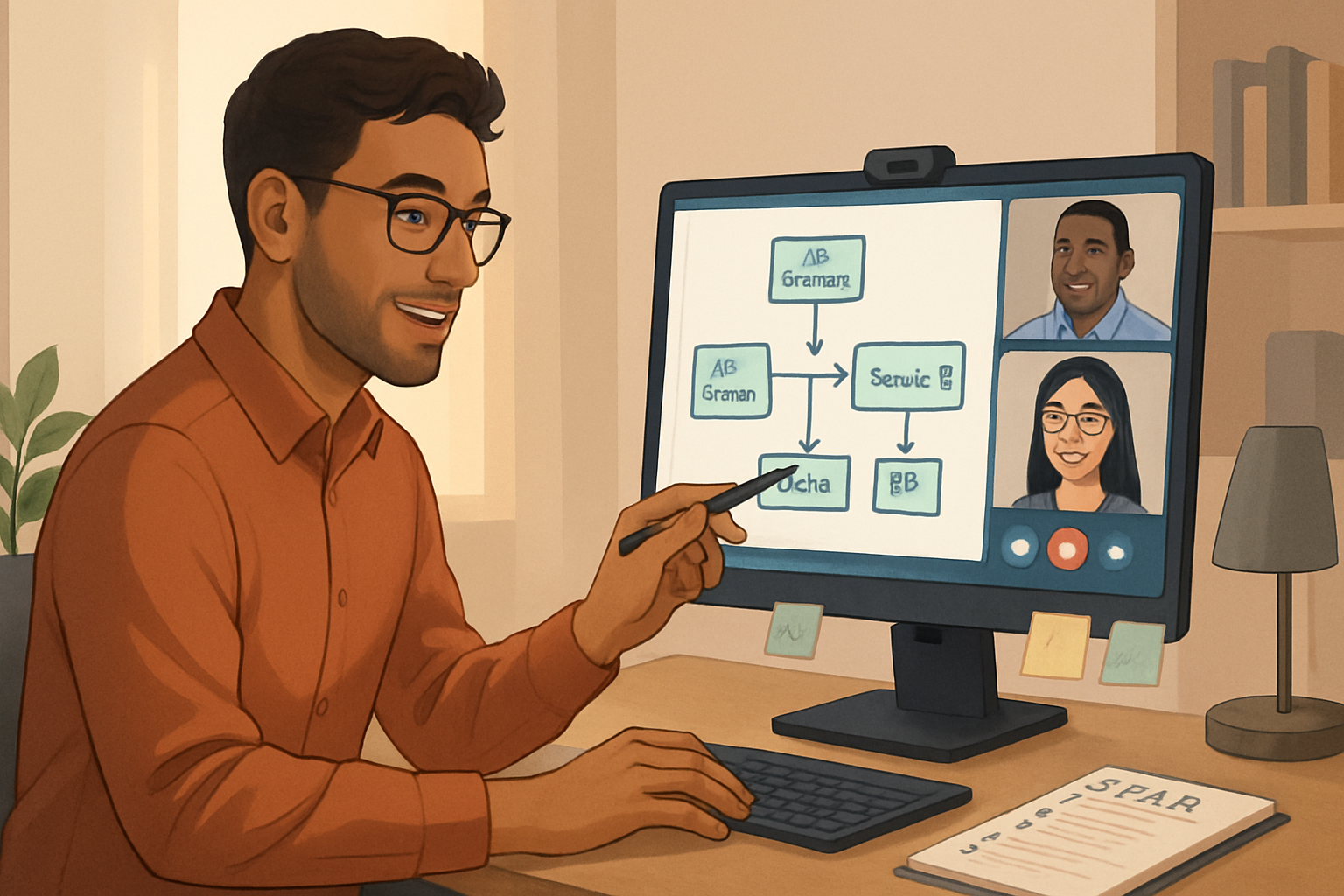
- When screen-sharing, highlight the line you’re editing or the block you’re describing.
- Manage your environment: clear background, good microphone, minimal interruptions.
Small things add up. They make interviewers feel heard.
Practical prep plan (two-week schedule)
Week 1 - stories, structure, and small practices
- Day 1–2: Write 6 concise STAR stories covering leadership, conflict, failure, impact, ethics, and learning.
- Day 3–4: Practice explaining one technical project in 60s, 5min, and 15min formats.
- Day 5–7: Do 3 mock interviews focused on communication (pair with a friend or coach). Record and watch one back.
Week 2 - technical rehearsals + refining interpersonal signals
- Day 8–10: Code challenges and system design sessions. Narrate your thinking aloud.
- Day 11: Create READMEs for any take-home or portfolio projects that explain trade-offs.
- Day 12–13: Behavioral loop mocks using your STAR stories. Ask for blunt feedback on tone and concision.
- Day 14: Light day-review notes, rest vocal cords, check equipment.
Quick scripts and sample lines you can borrow
- Clarifying question: “Before I jump in, can I confirm the key success metric you’d use for this problem?”
- If stuck: “I’m a bit stuck on X. I see two plausible directions: A and B. I’d pick A because… unless you’d prefer exploring B first.”
- Reflective finish: “In hindsight I’d have instrumented more early metrics, which would’ve shortened the feedback loop.”
Final checklist before any OpenAI interview
- You can state the impact of your top projects in one sentence.
- You have 6 STAR stories ready and practiced.
- Your explanations follow a clear structure: goals, constraints, approach, trade-offs, failure modes.
- Your take-home includes assumptions, alternatives, and known limitations.
- You can speak about ethical implications for your work without defensiveness.
- Your camera, mic, and environment are tested.
Closing: the single habit that amplifies everything
Technical strength opens the door. Soft skills decide whether you walk through it with confidence and leave the room better than you found it. Practice telling your story clearly. Practice listening even more. Those are the two behaviors that transform great coders into indispensable teammates.
If you do nothing else: prepare crisp stories that show judgement. Then use them to guide the conversation-not just to answer questions, but to shape them.
References
- OpenAI Careers: https://openai.com/careers
- Harvard Business Review - It’s Time to Retire the Term “Soft Skills”: https://hbr.org/2022/02/its-time-to-retire-the-term-soft-skills
- Indeed - STAR Interview Method: https://www.indeed.com/career-advice/interviewing/how-to-use-star-method