· deepdives · 6 min read
Ethics and Privacy in the Age of Push Notifications: Finding the Balance
Practical guidance for designing ethical, privacy-respecting Push API implementations that preserve user trust while delivering value - covering consent, data handling, encryption, measurement, and governance.
Intro: what you’ll get from this article
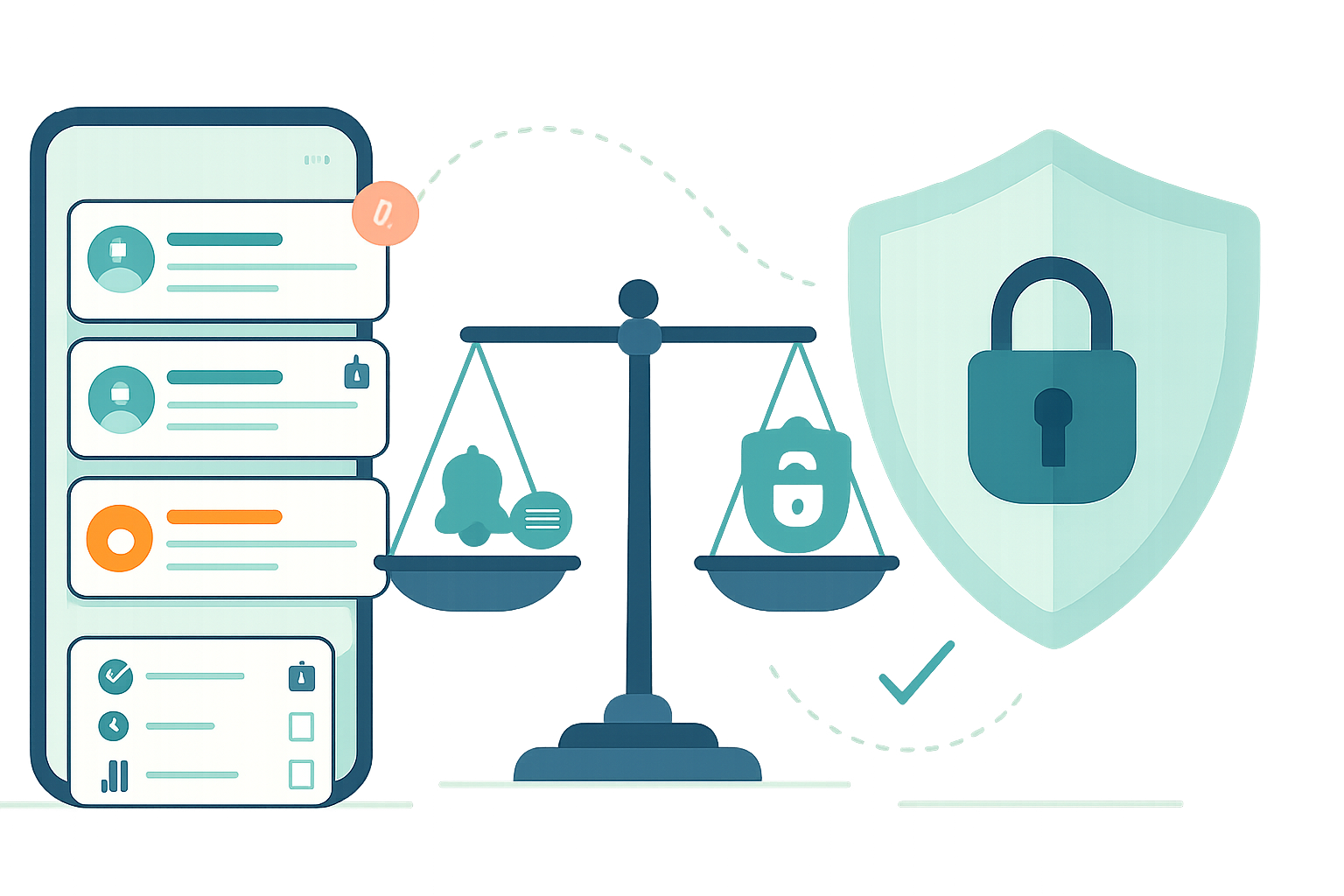
You will walk away with a clear, actionable framework for implementing Push API notifications that protect user privacy, meet legal expectations, and keep engagement high without eroding trust. Read on and you’ll know which technical controls to apply, what consent language works, how to measure responsibly, and how to govern push at scale.
Why this matters - fast
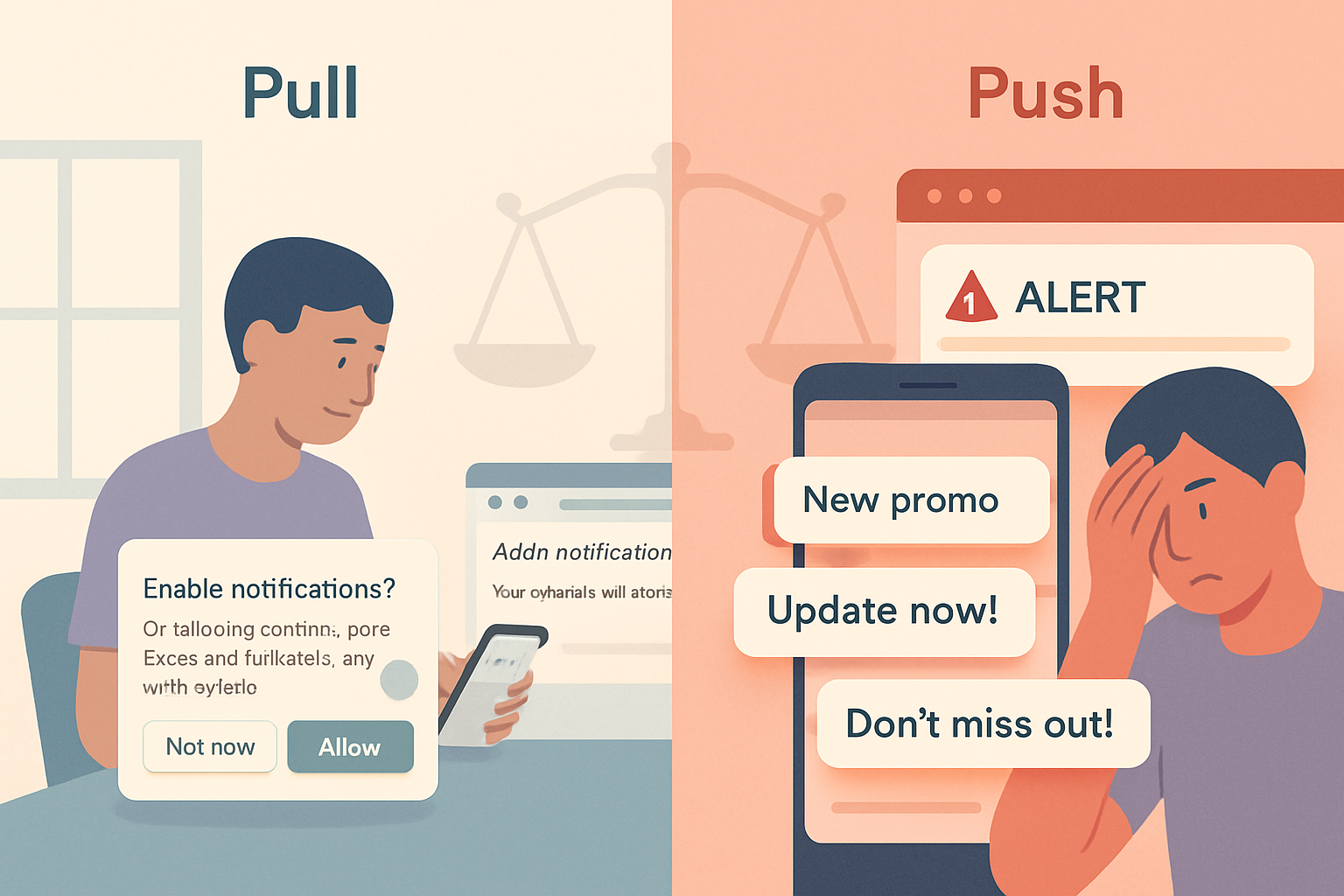
Push notifications are powerful. They re-engage users at near-instant speed. They also interrupt people in their most private spaces. Misuse erodes trust quickly. So the technical choices you make are moral choices. The product decisions you make are ethical ones. Get them right, and notifications become helpful. Get them wrong, and they become noise - or worse, a privacy liability.
Core ethical principles for push notifications
- Respect autonomy: Always obtain meaningful consent. Don’t trick, nudge, or bury the real decision.
- Minimize harm and data collection: Collect only what you need to deliver the notification.
- Be transparent: Explain why you request permission and what you’ll send.
- Give control: Easy opt-out, frequency controls, and granular preferences.
- Be accountable: Log consent, keep retention policies, and audit systems.
These principles map directly to engineering and product choices. Below are practical implementations.
Regulatory context you must know
- GDPR (Europe) - consent must be informed, specific, freely given, and revocable. See general guidance: https://gdpr.eu/.
- CCPA/CPRA (California) - gives consumers rights related to access, deletion, and opt-out of sale of personal information; think carefully if you’re using push data for profiling or targeted advertising: https://oag.ca.gov/privacy/ccpa.
Also consult platform rules and browser vendor guidance for the Push API and Web Push protocol: W3C Push API spec and MDN developer docs are good starting points: https://www.w3.org/TR/push-api/, https://developer.mozilla.org/en-US/docs/Web/API/Push_API. Google’s web fundamentals on push notifications includes important UX and technical recommendations: https://developers.google.com/web/fundamentals/push-notifications.
Designing consent and permission flows
Outcome-first intro copy works. Lead with value. Then ask for permission.
Bad: a browser prompt with no context. Good: a short pre-permission UI that explains the benefit, frequency, and examples.
Guidelines
- Use a lightweight pre-permission prompt (a banner, modal, or inline card) that explains: why you want permission, what types of notifications users will receive, and how often. Keep it < 2 short sentences.
- Offer granular choices when possible. “Order updates” vs “promotions” vs “news” lets users opt in only to what matters.
- Respect the browser-level prompt: don’t repeatedly re-prompt users who dismiss the native dialogue.
- Avoid dark patterns: don’t hide the opt-out, don’t pre-check boxes, don’t Auto-Subscribe.
Example UX microcopy
- Value-first: “We’ll send delivery updates and important account alerts - no promos. Allow notifications?”
- Granular: “Allow: Order updates ✓ | Promotional offers ☐ | Security alerts ✓”
Technical privacy controls and best practices
- Minimize data in the payload
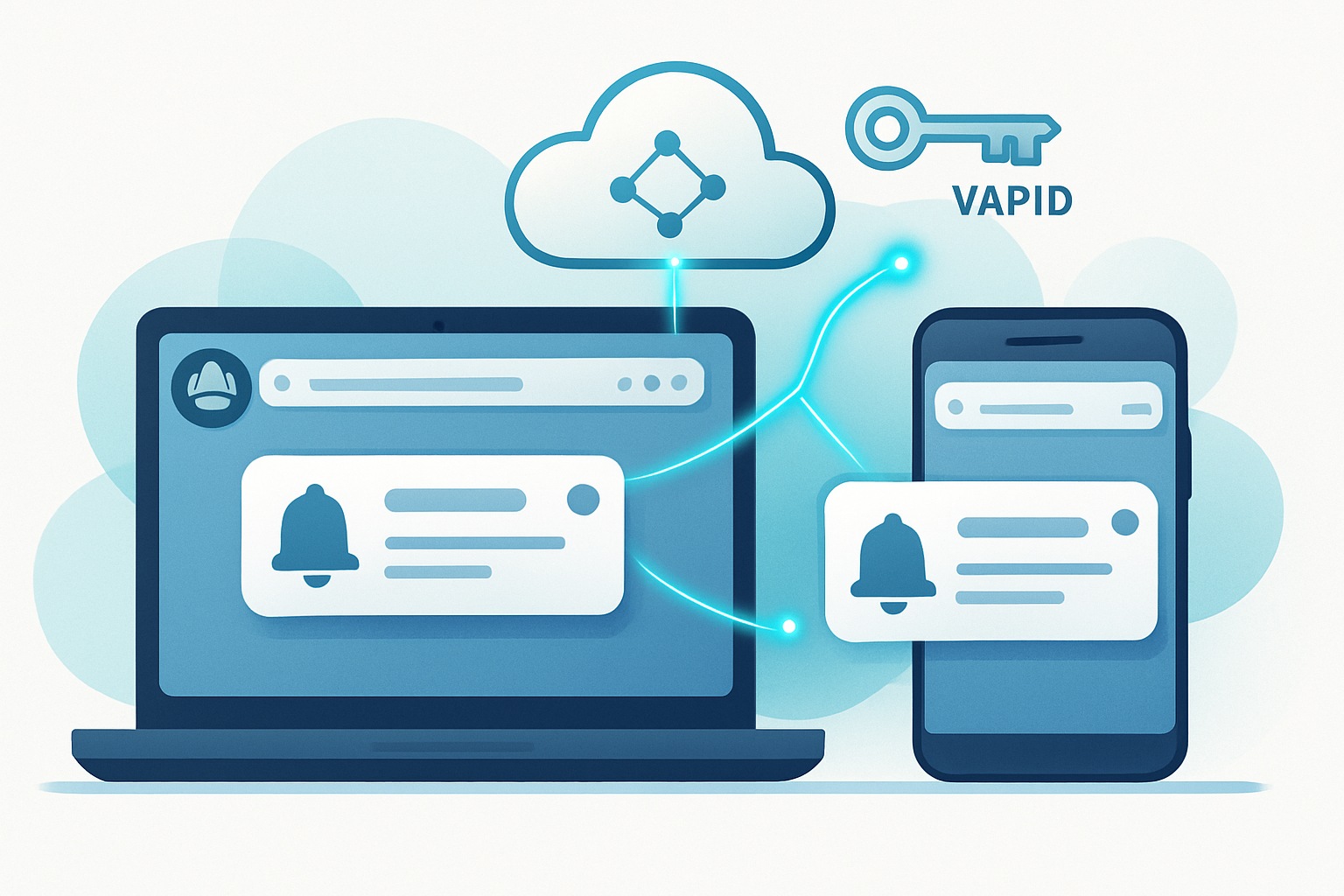
Never put personal data or secrets directly into push payloads. Push messages travel through push services (browser vendors’ servers) before reaching devices. Treat the push service as an untrusted intermediary for payloads.
- Send IDs or opaque tokens instead of raw PII. Resolve those server-side if the client pulls content after receiving a notification.
- If you must include content, encrypt it using the Web Push encryption scheme so only the intended client can decrypt it. See the Web Push protocol guidance for implementation details: https://developers.google.com/web/fundamentals/push-notifications/web-push-protocol.
- Use short-lived subscription tokens and rotate keys
- Rotate application server keys (VAPID) and access credentials periodically.
- Tie subscriptions to device identifiers rather than long-lived cross-device identifiers.
- Authentication and authorization
- Store subscriptions safely on your server behind strong access controls.
- Require server-side authentication to read subscriptions and to send targeted pushes.
- Encryption in transit and at rest
- Use TLS for all server-to-push-service and server-to-client communications.
- Encrypt sensitive fields at rest or avoid storing them.
- Logging, consent records, and retention
- Log consent actions with timestamp, UI shown, and text presented (or a stable copy of it) so you can demonstrate compliance.
- Implement deletion and retention policies: remove stale subscriptions and allow users to request deletion of related data.
Ethical segmentation and targeting
Segmentation is essential for relevance - but it can be abused.
- Avoid combining push data with other datasets to create intrusive profiles without explicit, informed consent.
- For sensitive categories (health, religion, sexual orientation, children), default to not targeting unless you have explicit opt-in and a lawful basis.
- Consider differential privacy or cohorting for analytics when possible, so you can measure effectiveness without creating individual profiles.
Measurement and analytics - do it respectfully
- Track high-level metrics: delivery rates, open rates, conversion funnels. Aggregate where possible.
- If you need user-level attribution, give users clear notice and an opt-in choice.
- Avoid persistent cross-site identifiers tied to push subscriptions; that invites tracking across contexts.
Respecting timing and boundaries
- Let users set quiet hours and frequency caps.
- Honor Do Not Disturb settings and device-level modes where available.
- Use throttling and back-off logic to avoid flooding users after many events.
Handling edge cases and failures
- If a subscription becomes invalid (user uninstalled app, revoked permission), remove it promptly to avoid unnecessary sends.
- Use exponential back-off for failed sends. Continual failures may indicate stale subscriptions.
- Be explicit about fallback channels and let users pick preferred channels (email, SMS, push).
Operational governance and policy
- Create a push-notification policy covering allowed use cases, forbidden targeting (sensitive topics), maximum frequency, and UX requirements for permission.
- Perform periodic privacy impact assessments (PIAs / DPIAs) when expanding push use or integrating with new data sources.
- Maintain an internal approval workflow for new notification types and targeting criteria.
Checklist: implementing ethical push (quick)
- Pre-permission UI that explains value and examples
- Granular opt-in categories
- No PII in push payloads; encrypt payloads if necessary
- Rotate VAPID/keys and short-lived tokens
- Strong server-side authentication and access controls
- Logs of consent and visible retention policy
- User controls for frequency, quiet hours, and opt-out
- Aggregated analytics by default; explicit opt-in for user-level tracking
- DPIA for risky or large-scale uses
- Governance policy and approval workflow
A short hypothetical: a better onboarding for e-commerce
Instead of immediately prompting for notifications during signup, show a short onboarding card:
- “Get delivery updates and exclusive one-time offers. Control what you get later.”
- Buttons: “Get delivery updates only” | “Decide later”
If the user chooses delivery updates, create a subscription scoped only to order events (no promotions). Store that preference and log consent. Send meaningful, concise messages (e.g., “Your package shipped - tracking #1234”) rather than marketing copy disguised as transactional content.
When things go wrong - accountability and remediation
- If you send an erroneous push batch or leak data, notify affected users promptly and explain remediation steps.
- Keep a runbook for incidents involving push systems: identification, containment, communication, and postmortem.
Resources and references
- W3C Push API spec: https://www.w3.org/TR/push-api/
- MDN: Push API overview and guidance: https://developer.mozilla.org/en-US/docs/Web/API/Push_API
- Google Web Fundamentals on Push Notifications and Web Push protocol: https://developers.google.com/web/fundamentals/push-notifications
- GDPR overview: https://gdpr.eu/
- California Consumer Privacy Act: https://oag.ca.gov/privacy/ccpa
Final thought - the ethical lever for sustainable engagement
Push notifications are not just a technical channel. They are a direct conversation with users. Treat that conversation with dignity. Build for clarity, choice, and minimal intrusion. Do that consistently, and your notifications will be welcomed - and your users will stay.