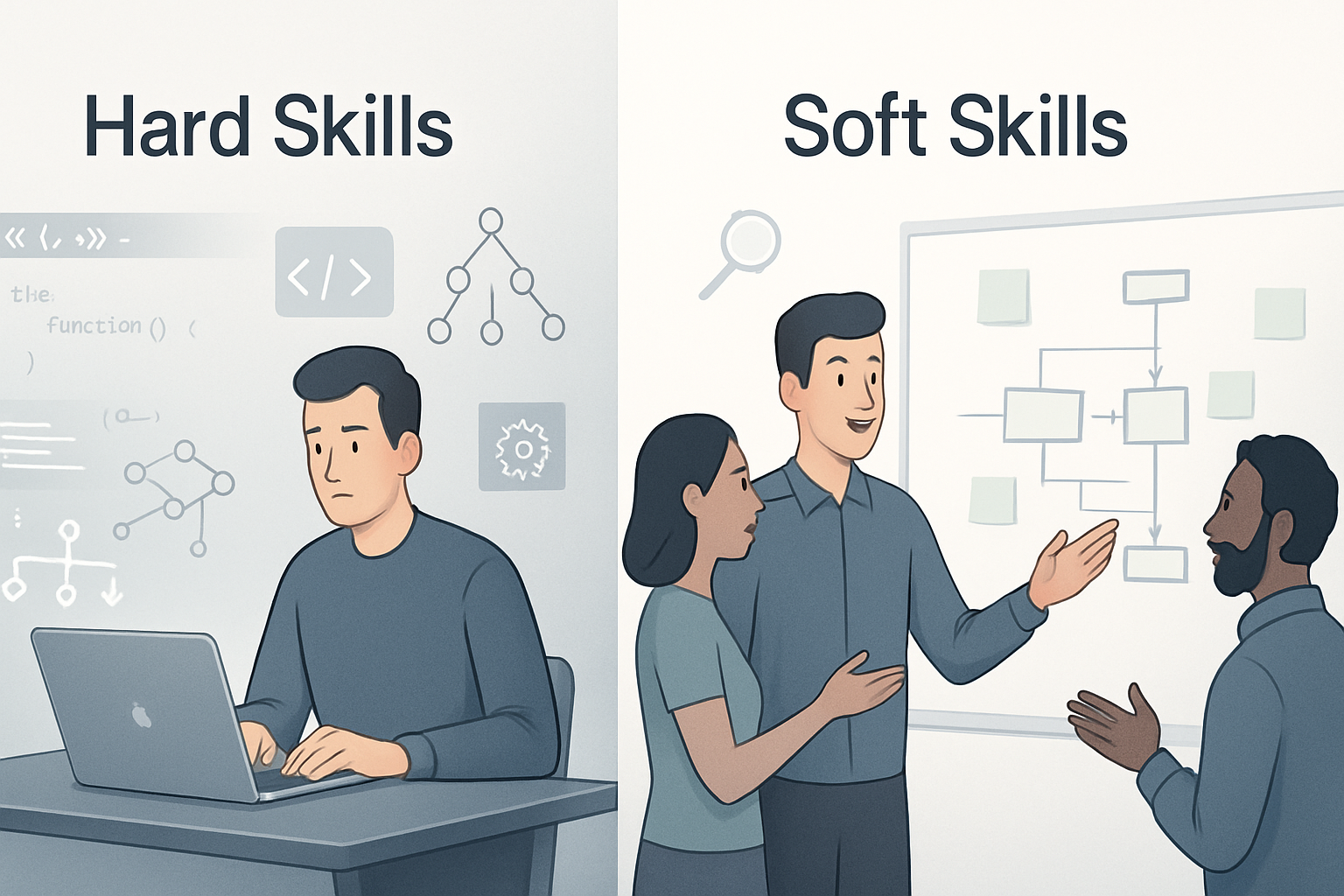
· career · 7 min read
Beyond Algorithms: The Hidden Skills Google Really Values
Technical mastery gets you to the door. The hidden skills-collaboration, curiosity, ownership, and emotional intelligence-open it. Learn what Google interviewers actually look for and how to demonstrate these traits, with concrete examples and a ready-to-use prep checklist.
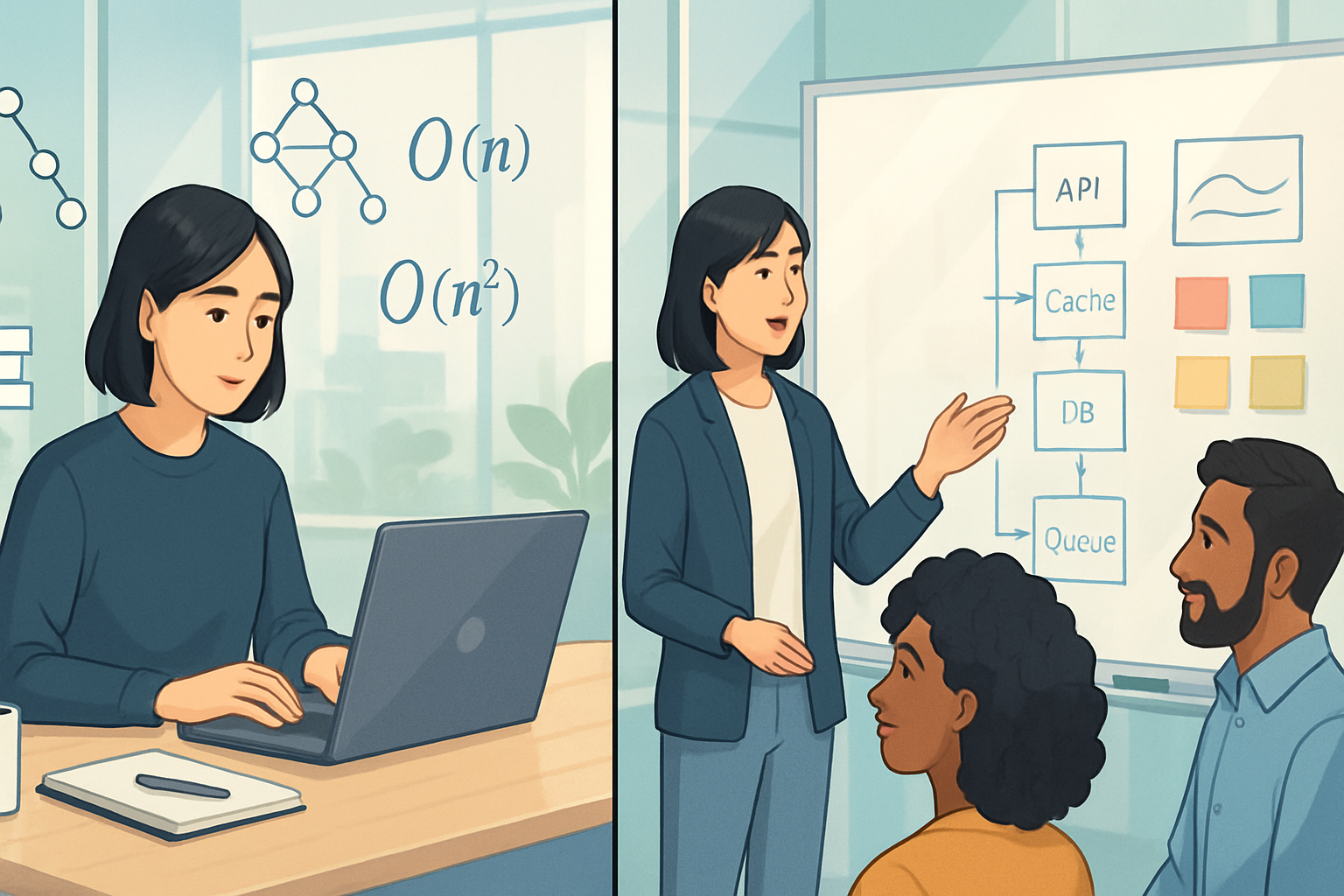
Introduction - what you’ll gain
You can master algorithms and still lose the job. But show the right non‑technical skills and you’ll stand out even in a sea of strong coders. Read this and you’ll know the specific behaviors Google interviewers look for, how to surface them in real interviews, and a practical prep plan to make those strengths obvious - fast.
Why Google cares about more than code
Google’s hiring process is structured to predict long‑term impact, not just short‑term problem solving. Interviewers evaluate whether you will collaborate well, learn rapidly, and lift others as the company scales. That’s why Google public materials and research into their management practices stress traits beyond technical fluency: clear communication, ownership, and the ability to influence and work across teams matter a lot Google Careers - How we hire and Google’s re:Work guides on structured interviewing explain why behavioral evidence matters when predicting future performance re:Work - Structured interviewing guide.
The core non‑technical skills Google really values
- Collaboration and teamwork: Can you work effectively across engineers, product, design, and stakeholders? Google prizes people who enable others and make cross‑functional outcomes possible.
- Communication clarity: Can you explain trade‑offs, keep a distributed team aligned, and write clear design documents? Clear thinkers who communicate well reduce costly rework.
- Ownership and bias for impact: Do you drive projects end‑to‑end and own outcomes, not just tasks? Interviewers look for a track record of shipping and improving systems.
- Learning agility and intellectual humility: Can you quickly learn new domains and revise beliefs when faced with data? Google rewards candidates who show evidence of deliberate learning and curiosity.
- Emotional intelligence (EQ): Are you aware of teammates’ perspectives, give/receive feedback well, and manage conflict constructively? EQ predicts success in large, matrixed organizations.
- Leadership (broadly defined): Leadership at Google is often about influence rather than title - mobilizing peers, mentoring juniors, and driving technical direction.
- Product sense and user empathy: Can you reason about users and prioritize work that moves metrics and user satisfaction?
- Judgment and trade‑off capability: When constraints collide, can you choose reasonable solutions and explain the why? This is crucial in system design and product decisions.
Evidence from former interviewers and engineers
Many former Google interviewers and engineers emphasize the same pattern: technical correctness gets you considered; behavior and impact get you hired. Laszlo Bock, former SVP of People Operations at Google, highlights that the interview process is intentionally designed to measure behaviors that predict future success - not just past coding ability - and that consistent evidence across multiple interviews carries weight Work Rules! (Laszlo Bock) - book overview.
Google’s re:Work guide and public hiring pages explain why structured behavioral interviewing reduces bias and predicts performance better than conversational interviews re:Work - Structured interviewing guide. Former interviewers who’ve written about their experiences repeatedly point to three repeatable signals that matter in hiring notes: concrete ownership, collaborative conflict resolution, and the ability to learn from failure (search interviews and blogs from ex‑Googlers for multiple first‑hand accounts).
How interviewers observe these skills during interviews
- Behavioral interviews: Interviewers ask for stories about past work. They look for specific outcomes, your role, the actions you took, and measurable impact.
- System design interviews: Beyond architecture, interviewers watch how you solicit requirements, incorporate others’ constraints, and make pragmatic trade‑offs.
- Pairing or collaborative coding: They evaluate how you communicate your thought process, take suggestions, and integrate feedback in real time.
- Cross‑functional instincts: Through product and behavioral questions, they assess whether you consider users, metrics, and team dynamics.
Concrete examples: what strong evidence looks like
Ownership: “I led the migration of our auth service from monolith to microservices. I coordinated three teams, wrote the rollout plan, and implemented a canary pipeline. After rollout, auth latency dropped 30% and incident rate fell by 40% - I owned the post‑mortems and the follow‑ups.” (shows scope, leadership, metrics)
Collaboration under conflict: “When two teams disagreed on API semantics, I organized a short working session, documented options, ran a quick prototype for each option, and we chose the path with the smallest change to clients; both teams agreed because we highlighted rollback plans and monitoring.” (shows facilitation, compromise, risk management)
Learning and humility: “We launched a feature that didn’t move retention. I led a data review, found the onboarding step was confusing, and proposed three small UX changes. After A/B testing, retention improved 12%. I wrote internal notes so other teams wouldn’t repeat the same mistake.” (shows diagnosis, iteration, knowledge sharing)
How to surface these skills in your interviews (practical tactics)
Use structured stories (STAR variant):
- Situation: Brief context.
- Task: What needed to be solved.
- Action: The concrete steps you took (focus here - be specific).
- Result: Measurable outcome and follow‑up.
- Reflection: What you learned and what you’d do differently.
Example snippet for an interview: “We had 60% test flakiness in nightly runs (S). I was asked to reduce CI instability (T). I introduced deterministic test fixtures and parallelized the slow path; I also added new dashboards to catch regressions (A). Flakiness fell to 8% within six weeks and CI time dropped 40% (R). I learned that small visibility tools can have outsized impact, so I now treat metrics-first when fixing infra problems (Ref).”
Quantify outcomes: Always attach metrics (percentage, latency, incidents reduced, revenue, user engagement) when possible.
Show collaborative behavior in technical answers: During design questions, explicitly ask about constraints and stakeholders, say how you’d involve product or ops, and mention rollout and monitoring plans.
Be explicit about ownership: Use verbs like “I led,” “I coordinated,” “I shipped,” and follow them with how you involved others.
Demonstrate learning and humility: When you describe failures, focus equally on what you learned and the concrete changes you made afterward.
Practice delivering stories succinctly: Interviewers appreciate crispness. Aim for 90–180 seconds per story for behavioral questions, longer for big projects.
Sample behavioral answers (templates you can adapt)
Ownership template: Situation - Task - Your specific actions (planning, coordination, technical work) - Quantified result - What you changed in process.
Conflict resolution template: Situation - Stakeholder positions - Steps you took to align (data, prototypes, meeting) - Outcome - How you prevented recurrence.
Learning from failure template: What went wrong - Root cause analysis - Your corrective actions - Measurable improvement - What you documented/shared.
Things you should avoid saying (and what to say instead)
Don’t say: “I fixed it quickly.” Say: “I implemented X, measured Y, and reduced Z by 30% in 6 weeks.”
Don’t say: “The other team was wrong.” Say: “There was a disagreement; here’s how I framed options and led a resolution that balanced risk and velocity.”
Don’t say: “I don’t have an example.” Say: pick a small example. Even a small, well‑measured contribution is better than none.
Prep checklist to make non-technical strengths obvious
- Collect 8–12 stories covering ownership, collaboration, failure & learning, leadership without authority, and impact.
- For each, write a one‑line headline and a 3–4 sentence STAR story with metrics.
- Practice telling each story aloud; time them.
- During mock interviews, ask peers to press on stakeholder interactions to ensure you surface collaboration and conflict handling.
- Prepare 3 questions to ask interviewers that show product and user empathy (e.g., “What metric defines success for this team?”). This signals you think in outcomes.
- Read Google’s public resources on interviewing to understand their structure Google Careers - How we hire and re:Work - Structured interviewing guide.
Final note - why this matters
Technical skill opens the interview. The hidden skills seal the hire. Interviewers at scale look for candidates who will make teams faster, reduce risk, and improve products over years - not just in a single coding round. If you can show consistent evidence of collaboration, ownership, learning, and clear communication, you won’t just pass interviews; you’ll prove you’ll thrive inside Google’s complex systems and culture.
References
- Google Careers - How we hire: https://careers.google.com/how-we-hire/interview/
- re:Work (Google) - Structured interviewing guide: https://rework.withgoogle.com/guides/hiring/5/
- Laszlo Bock, Work Rules! (book overview): https://books.google.com/books?id=Qk-5DwAAQBAJ