· frameworks · 8 min read
Express.js vs. Koa: A Deep Dive into Performance and Developer Experience
A practical, scenario-driven comparison of Express and Koa that shows where Express may fall short and gives concrete tips to squeeze maximum performance and developer ergonomics from Express-based services.
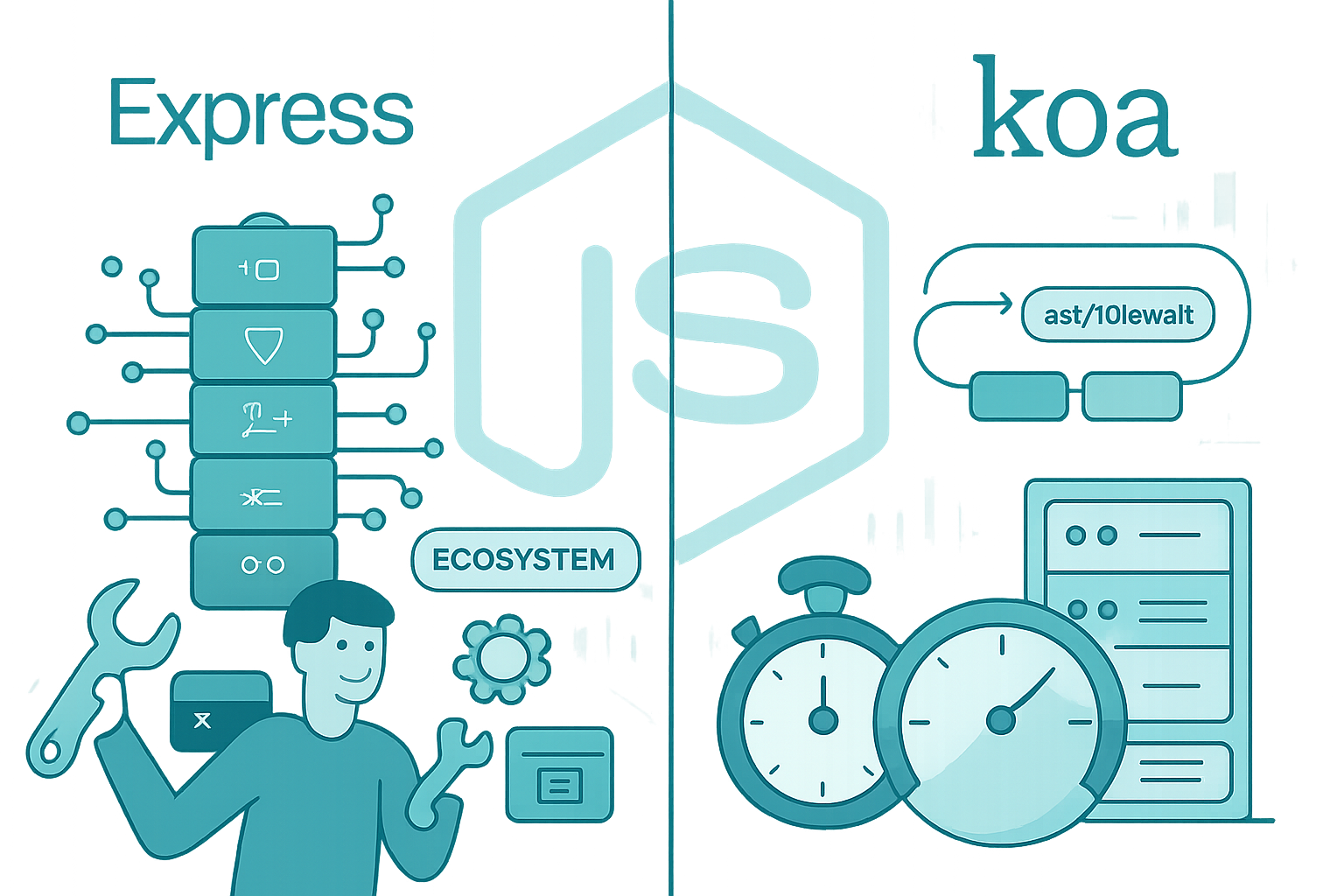
Outcome first: by the end of this article you’ll know when Koa’s design will give you a measurable advantage, where Express still wins, and-most importantly-how to tune Express to close the gap when it matters.
Why this matters. Framework choice affects latency, throughput, debugging time, and developer happiness. Pick wrong, and you pay in maintenance or scale costs. Pick right, and you ship faster and run cheaper.
Quick summary (decide fast)
- For greenfield projects that prioritize modern async middleware composition and minimal core, Koa is compelling.
- For broad ecosystem support, fast onboarding, and tooling, Express remains the pragmatic default.
- In raw throughput, differences are usually small; Node itself and your I/O patterns matter more. Use a profiler and real benchmarks.
Read on for concrete scenarios where Express may lag, measurable differences, code-level comparisons, and targeted optimizations that make Express perform like a champion.
Architectural differences at a glance
- Express is a mature, battle-tested framework with a huge ecosystem. It uses the familiar middleware pattern: functions that receive (req, res, next).
- Docs: https://expressjs.com
- Koa was created by the same team with two design goals: a smaller core and modern async flow via async/await and a single context object (ctx).
- Docs: https://koajs.com
Key conceptual distinction: Koa middleware uses an “upstream/downstream” flow because each middleware can await next() and run code after downstream middleware completes. That makes composition and centralized concerns (like response compression, logging around the full request) easy and elegant.
Express historically uses the chained next() callback model. You can approximate Koa’s upstream/downstream behavior with async functions in Express, but error-handling and some patterns require more care.
Where Express can fall behind (specific scenarios)
Below are concrete scenarios where Koa often has the edge, followed by why and how to mitigate these drawbacks in Express.
1) Complex middleware composition (logging, error handling, timing)
Why Koa shines: Its middleware model naturally supports logic before and after await next() which makes it trivial to implement things like request timing, error wrapping, and response transformations in one place.
Why Express can struggle: With chained next() calls, doing neat “around” logic requires careful placement of next() and try/catch, and can feel fragmented across middlewares.
Express fix: Use async handlers and a small wrapper to centralize errors/time. Example helper and middleware:
// asyncWrapper.js
module.exports = fn => (req, res, next) => {
  Promise.resolve(fn(req, res, next)).catch(next);
};

// timingMiddleware.js
const asyncWrapper = require('./asyncWrapper');
app.use(
  asyncWrapper(async (req, res, next) => {
    const start = Date.now();
    await next(); // if downstream returns a promise
    const ms = Date.now() - start;
    console.log(`${req.method} ${req.url} - ${ms}ms`);
  })
);
Tip: Add the express-async-errors package or use the wrapper above so thrown errors in async handlers are properly passed to Express error middleware.
2) High-concurrency async flows with tight resource control
Why Koa shines: Its minimal core and idiomatic async/await usage encourages small, promise-based handlers and middleware. Less synchronous work in the request path tends to reduce event-loop blocking.
Why Express can struggle: Old patterns and middleware that rely on callbacks or do sync work can block the event loop. Also, large monolithic middleware stacks executed per request will add CPU overhead.
Express fix: Audit middleware, prefer Promise-based libraries, and avoid synchronous APIs in the request path. Use async/await everywhere and wrap legacy callback APIs with util.promisify.
3) Streaming and backpressure handling
Why Koa shines: Setting ctx.body to a stream integrates naturally with Koa’s minimal response pipeline. The control feels clean.
Why Express can struggle: Streams work fine, but helper middleware that manipulates the response or reads the body may interfere if not built for streaming.
Express fix: Use native Node streams and avoid body-parsing middleware for streaming endpoints. Example serving a file stream:
const fs = require('fs');
app.get('/download', (req, res) => {
  const stream = fs.createReadStream('/path/large.file');
  res.setHeader('Content-Type', 'application/octet-stream');
  stream.pipe(res);
});
Tip: Put streaming routes before global body parsers or configure them to skip routes.
4) Small core, microservices, minimal overhead
Why Koa shines: Koa intentionally keeps the core tiny-fewer default features-so you only add what you need. That can yield slightly lower per-request overhead.
Why Express can struggle: Express historically bundled or normalized request/response behaviors and the ecosystem expects middleware. That convenience can add bytes and CPU.
Express fix: Create a minimal Express configuration for microservices. Don’t app.use() middleware you don’t need. Prefer small, focused middlewares. Or bootstrap Express manually on top of Node’s http module if you need extreme minimalism.
Real-world performance: don’t trust impressions, measure
Benchmarks such as the TechEmpower results show that framework-level differences are small compared to IO, templating, and database latency: the raw web framework is rarely your app’s main bottleneck. See the TechEmpower benchmarks: https://www.techempower.com/benchmarks/
If you care: benchmark your specific workloads (JSON APIs, streaming, database-heavy endpoints) using tools like autocannon, wrk, or Artillery. Example autocannon command:
npx autocannon -c 100 -d 20 http://localhost:3000/api/endpointMeasure latency and throughput at the same time you profile CPU and event-loop delays (node’s --trace-event tools, clinic.js, or 0x). Only optimize after profiling.
References: autocannon repo https://github.com/mcollina/autocannon
Concrete Express optimizations (do this first)
- Remove unused middleware
- Every
app.use()is work per request. Keep the stack lean.
- Every
- Use production-ready middleware
compression(gzip) andhelmetfor security are cheap wins. compression helmet
- Prefer async/await and Promises
- Replace legacy callback patterns in handlers with Promises.
- Handle async errors reliably
- Use express-async-errors or an async wrapper so you don’t leak unhandled rejections.
- Offload static assets and large files
- Use a CDN or reverse proxy (nginx) for static files. Let Express handle dynamic routes only.
- Use clustering or a process manager
- Use Node’s
clustermodule or PM2 to take advantage of multiple cores.
- Use Node’s
- Keep the event loop free
- Avoid sync filesystem or CPU-heavy work in the request path. Move heavy tasks to worker threads or background jobs.
- Prefer streaming for large responses
- Use Node streams and avoid buffering entire payloads in memory.
- Use HTTP/2 if beneficial
- Express doesn’t natively provide HTTP/2; you can layer Express over Node’s
http2or a reverse proxy to get multiplexing benefits.
- Express doesn’t natively provide HTTP/2; you can layer Express over Node’s
- Profile, then optimize hotspots
- Use
clinic.js, Chrome DevTools, or Node’s built-ins to find where time is spent.
Example: turning an Express app into a high-performance JSON API
Checklist and sample code:
- Use an async wrapper for handlers
- Minimal middleware (no body parser for GETs)
- JSON serialization: avoid expensive replacers
- Use HTTP keep-alive and appropriate timeouts
// server.js
const express = require('express');
require('express-async-errors'); // handles thrown async errors
const compression = require('compression');
const helmet = require('helmet');

const app = express();
app.use(helmet());
app.use(compression());
app.use(express.json({ limit: '100kb' })); // small, reasonable limit

app.get('/status', async (req, res) => {
  // quick health check, no DB
  res.json({ status: 'ok', timestamp: Date.now() });
});

// example of an optimized DB route
app.get('/items', async (req, res) => {
  const items = await db.fetchItems({ limit: 100 }); // keep DB efficient
  res.json(items);
});

app.use((err, req, res, next) => {
  console.error(err);
  res.status(500).json({ error: 'internal_error' });
});

app.listen(3000);
If you need extra performance: terminate TLS at a proxy (nginx), use keep-alive tuning, and tune Node’s threadpool size if you use fs or crypto operations heavily by setting UV_THREADPOOL_SIZE.
Developer experience: where Express still wins
- Familiar API: many developers know Express. Ramp-up time is lower.
- Ecosystem: middleware, tutorials, and examples are plentiful.
- Compatibility: many third-party libraries assume Express-style middleware.
Koa’s DX is modern and clean, but if your team has deep Express experience, migration costs may outweigh runtime benefits.
When to pick Koa instead
- You want a minimal core and modern async middleware composition.
- You plan to write many middleware that needs to execute logic both before and after downstream handlers (e.g., centralized response transformation, consistent timing/logging).
- You want to avoid the historical baggage of Express and start with a smaller, promise-first foundation.
When to stick with Express
- Rapid prototyping, team familiarity, and a rich ecosystem are priorities.
- You rely on middleware that only exists in or for Express.
- The measured bottleneck in production isn’t the framework but DB, network, or external services. In that case, Express is perfectly fine and easier to maintain.
Migration notes (if you’re considering switching)
- You can incrementally migrate routes to Koa by running microservices side-by-side behind a proxy.
- Evaluate middleware availability. Some Express middleware may have Koa equivalents; sometimes you must rewrite small adapters.
- Measure the work vs. benefit: migration is rarely free.
Final recommendations - pragmatic rules
- Measure first. Don’t switch frameworks to “be faster” without data.
- If you need cleaner async middleware composition and a minimal core, choose Koa.
- If you value ecosystem, team familiarity, and lots of off-the-shelf solutions, choose Express.
- If you pick Express but hit the scenarios above, apply the targeted optimizations: remove unused middleware, use async wrappers, stream intelligently, offload static assets, and profile.
A small note: often the practical question isn’t “Express or Koa?” but “How do we build the right abstractions and ops practices so our services scale and are maintainable?” The framework is one part of the puzzle. You still need good telemetry, CI, automated profiling, and sensible architecture.
References and further reading
- Express docs: https://expressjs.com
- Koa docs: https://koajs.com
- TechEmpower Framework Benchmarks: https://www.techempower.com/benchmarks/
- express-async-errors: https://www.npmjs.com/package/express-async-errors
- autocannon load testing: https://github.com/mcollina/autocannon