· tips · 5 min read
Unveiling the Secrets of the Optional Chaining Operator (?.)
Learn how the optional chaining operator (?.) simplifies deep property access, safe method calls, and array indexing - and when it can introduce subtle bugs. Practical examples, pitfalls, TypeScript tips, and browser support included.
Outcome: you’ll be able to read and write safe, concise code that navigates deep objects without a forest of conditionals. You’ll spot when optional chaining helps - and when it hides problems.
Why optional chaining matters (fast)
Deeply nested objects are common in real-world JavaScript: API responses, configuration trees, and DOM-like structures. Checking every level with if statements or && chains makes code verbose and error-prone.
Optional chaining (the ?. operator) gives you a terse, readable way to guard property access, element access, and function calls when parts of a path might be null or undefined.
Short. Clear. Less boilerplate.
The syntax and the basics
- Property access:
obj?.prop - Element access:
obj?.[expr] - Call expression:
obj?.method()(but see nuance below) - Safe method call:
obj?.method?.()
The operator short-circuits when the value to the left is null or undefined, returning undefined instead of throwing a TypeError.
Basic example - before and after
Before (classic guards):
if (user && user.settings && user.settings.theme) {
  console.log(user.settings.theme);
}
After (optional chaining):
console.log(user?.settings?.theme);If any property in the chain is null or undefined, user?.settings?.theme evaluates to undefined instead of throwing.
Element access (arrays and dynamic keys)
You can use bracket notation with ?.:
const firstTag = data?.tags?.[0];
const dynamic = obj?.[key];
This makes it easy to safely access array elements or computed keys.
Method calls - important subtlety
obj?.method() checks whether obj is nullish. If obj is null or undefined, the whole expression returns undefined and no call is attempted. However, if obj exists but method is undefined, attempting obj.method() still throws.
To safely call methods that might not exist, chain another ?. on the method itself:
obj?.method?.();Example:
// Safe call when either owner or method may be missing
settings?.save?.();
This handles both settings === null and settings.save === undefined safely.
What optional chaining does NOT do
- It does not guard against non-null values that are other falsy values (0,
'',false). Those are valid values and will be returned. - It cannot be used on the left-hand side of an assignment.
obj?.prop = 1is a syntax error. - It cannot be used with
newdirectly likenew obj?.Class()- you must writenew (obj?.Class)().
Examples of invalid/forbidden usage:
obj?.a = 1;          // SyntaxError
new obj?.Ctor();     // SyntaxError
Combining with nullish coalescing and logical OR
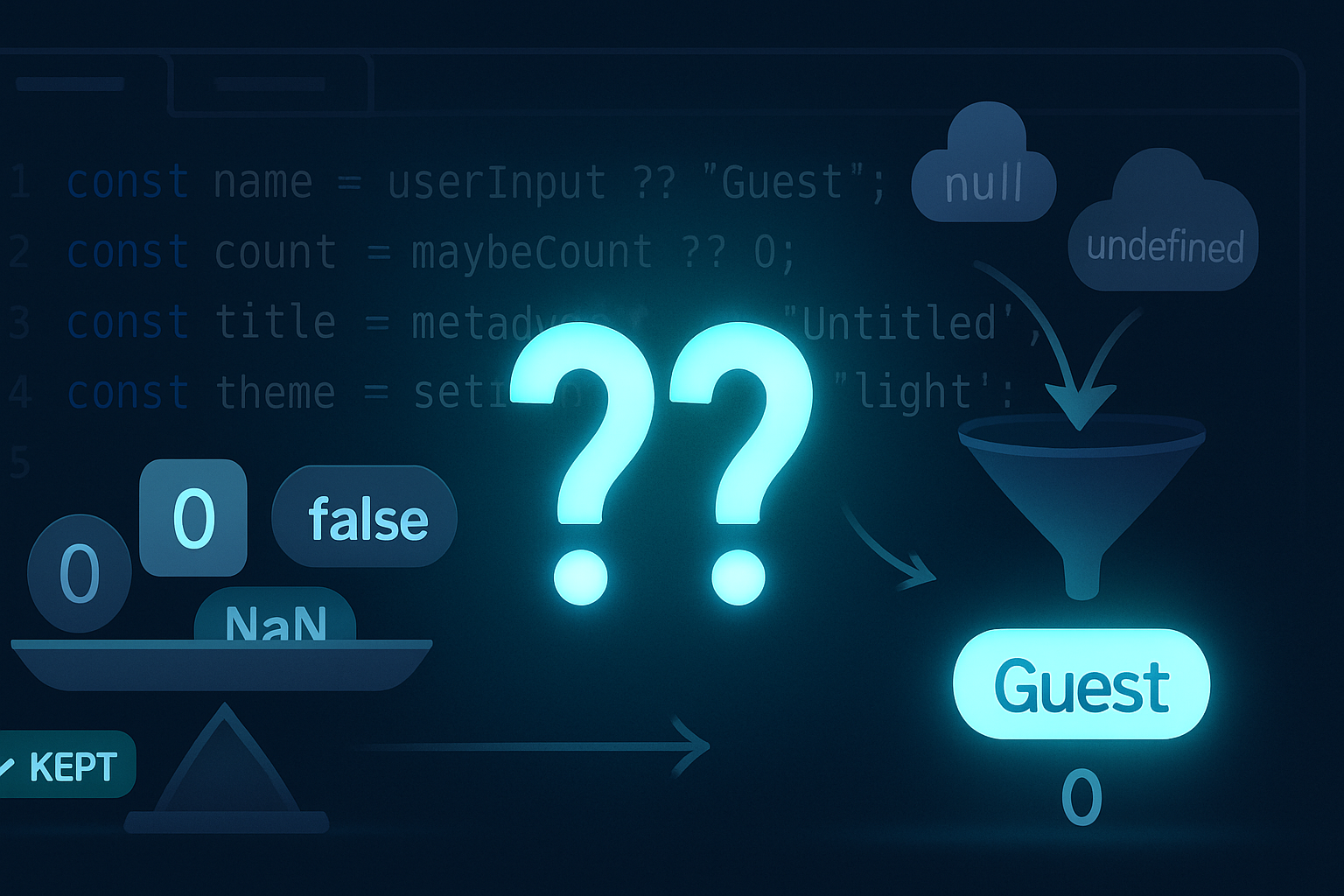
Optional chaining is often paired with a default value. Two common patterns:
- Nullish coalescing
??- checks onlynullorundefined. - Logical OR
||- treats many falsy values (0,'',false) as equivalent to missing.
Example:
// Use default if user or user.score is null/undefined
const score = user?.score ?? 0;

// Using || would coerce 0 to default as well
const scoreOr = user?.score || 10; // returns 10 when score is 0
Prefer ?? when 0, '', or false are legitimate values.
TypeScript and typings
In TypeScript, optional chaining preserves the union with undefined in the type. If obj?.prop might be undefined, the type reflects that - so the compiler forces you to handle it or assert non-null.
interface User {
  name: string;
  meta?: { role?: string };
}
const role = (user as User)?.meta?.role; // type: string | undefined
Use non-null assertion (!) only when you’re certain the value is present.
Performance and behavior notes
- Optional chaining is syntactic sugar: compilers (Babel/TypeScript) emit equivalent checks. It’s not a performance silver bullet, but it removes cognitive and maintenance cost.
- It short-circuits: further expressions to the right are not evaluated. That matters if those expressions have side effects.
Example:
// logs will not happen if user is nullish
user?.logAccess();
If user is null, user?.logAccess() does nothing and logAccess is never evaluated.
Browser / runtime support and transpilation
Optional chaining was standardized in ES2020 and is supported in modern environments. If you need to support older browsers, transpile with Babel or TypeScript. See compatibility resources:
- MDN: Optional chaining - https://developer.mozilla.org/en-US/docs/Web/JavaScript/Reference/Operators/Optional_chaining
- Can I Use: https://caniuse.com/mdn-javascript_operators_optional_chaining
- Babel plugin:
@babel/plugin-proposal-optional-chaining
If you ship code to older browsers, configure your build to transpile optional chaining into safe conditional checks.
Common pitfalls and how to avoid them
- Overusing it to silence bugs - Optional chaining can make missing data silent. Use it when missing data is expected, not when it masks a logic error.
- Assuming it guards method existence -
obj?.fn()does not protect againstfnbeing undefined unless you writeobj?.fn?.(). - Trying to assign through it -
obj?.a = 1is invalid. Use a safe conditional block instead. - Confusing
||and??for defaults - use??when0or''are valid values you don’t want to replace.
Practical recipes
- Safe read with default:
const street = user?.address?.street ?? 'Unknown street';- Safe call that might not exist:
user?.notify?.({ message: 'Hi' });- Safe index into array:
const first = response?.items?.[0];- Guarding for operations that must run only when present:
if (config?.feature?.enabled) {
  runFeature();
}
Checklist: when to use optional chaining
- Use it when an intermediate value may legitimately be
nullorundefined. - Prefer
??for defaults that should tolerate falsy-but-valid values. - Don’t use it to hide unexpected nulls - log or throw where missing data indicates a bug.
- Be explicit when calling methods that may not exist:
obj?.fn?.().
Quick reference (summary)
- Syntax:
obj?.prop,obj?.[expr],obj?.method(),obj?.method?.() - Not allowed on the left of
=or directly withnew. - Works with TypeScript and transpilers; check browser support if you need older environments.
Optional chaining makes deep access readable and safe without noise. Use it to simplify intent - and avoid using it to sweep real problems under the rug. The operator is small. Its impact on code clarity is large.
References
- MDN: Optional chaining - https://developer.mozilla.org/en-US/docs/Web/JavaScript/Reference/Operators/Optional_chaining
- MDN: Nullish coalescing (
??) - https://developer.mozilla.org/en-US/docs/Web/JavaScript/Reference/Operators/Nullish_coalescing_operator - Can I Use (compat): https://caniuse.com/mdn-javascript_operators_optional_chaining