· career · 7 min read
Mock Interviews: The Secret Weapon for JavaScript Engineers to Stand Out in a Competitive Job Market
Mock interviews are the fastest, most reliable way for JavaScript engineers to convert study time into interview performance. This article explains why they work, how to design high-pressure simulations that mirror real interviews, and step-by-step templates you can use to measure progress and beat the competition.
What you’ll walk away with
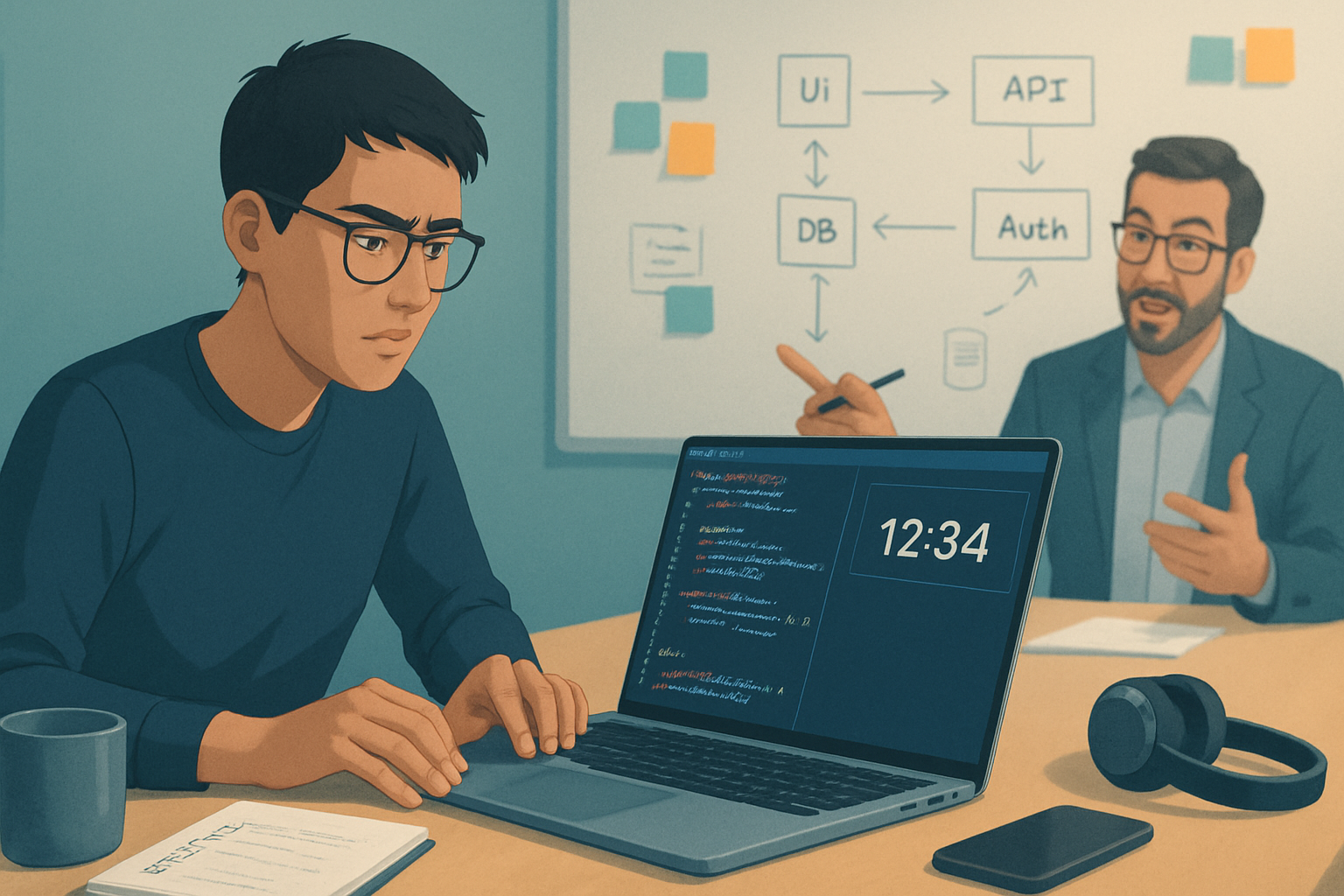
You can transform anxiety into confident, repeatable performance. Read this and you’ll get a practical playbook to set up mock interviews that recreate real pressure, identify the gaps that matter, and accelerate readiness for JavaScript roles - from frontend to full-stack to platform engineering.
Short version: studying algorithms alone won’t get you the job. Practicing under realistic constraints will.
Why mock interviews are the highest-leverage activity
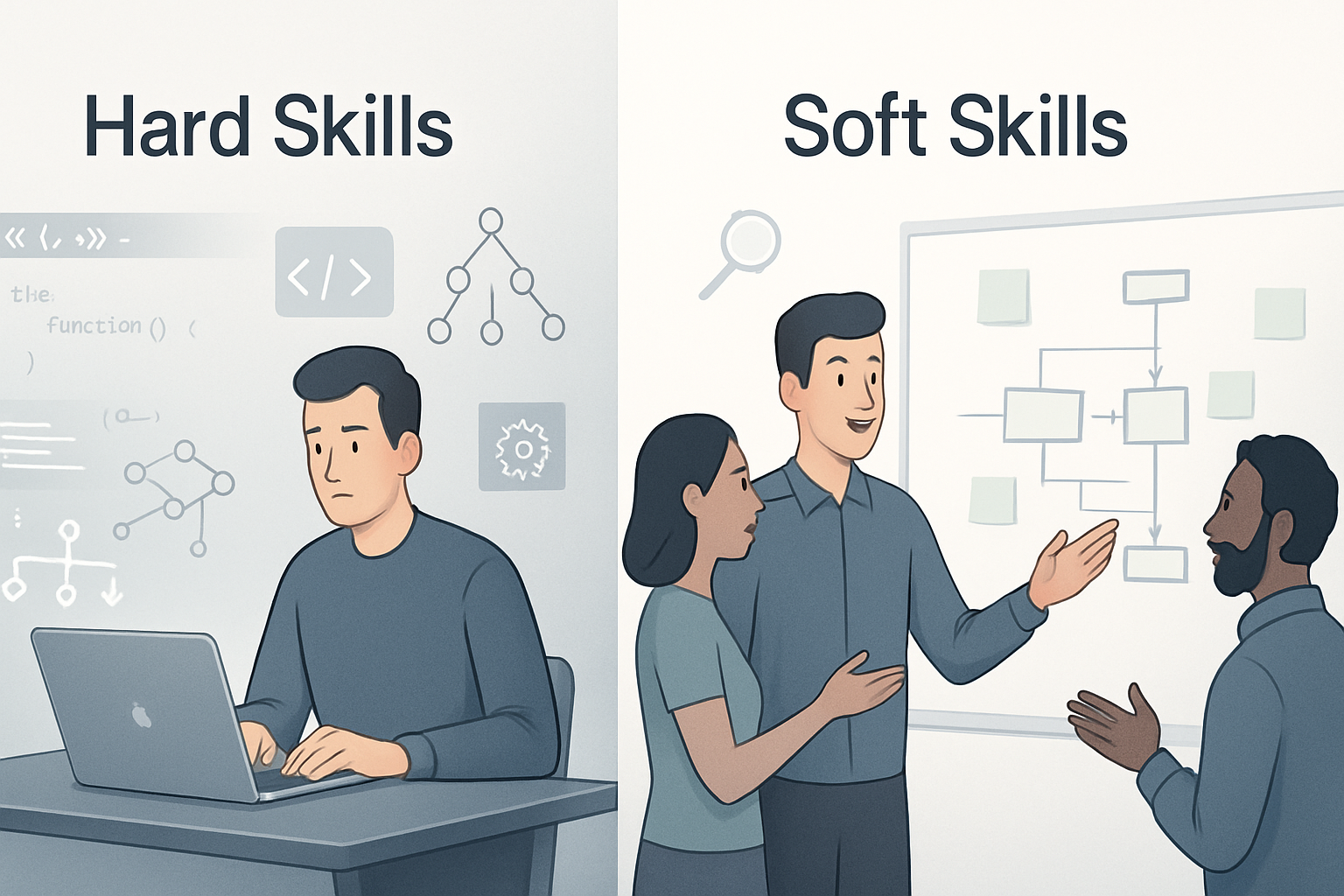
Most engineers spend hours solving problems in isolation. That helps pattern recognition. It doesn’t teach you how to think out loud, handle a whiteboard, manage time, or recover from a miss. Mock interviews do.
They map study to interview outcomes by forcing you to operate in the environment where decisions matter: timed, interactive, unclear, and human. The result? Faster calibration of what hiring teams actually evaluate - clarity of communication, tradeoff choices, and steady problem-solving under scrutiny.
A few concrete gains:
- Faster interview pacing: you learn how to move from idea to runnable plan in minutes.
- Communication polish: you practice narrating intent, a top predictor of pass/fail.
- Stress resilience: repeated exposure reduces reactive mistakes.
- Real feedback: targeted critique beats self-graded LeetCode runs.
If you want fewer surprises and more offers, treat mock interviews as the backbone of your preparation.
What mock interviews train (beyond algorithmic skill)
- Problem framing - Clarifying ambiguous requirements and restating them aloud. Essential for system design and product-focused questions.
- Time management - Breaking a 45–60 minute interview into clear milestones: clarification, approach, implementation, testing.
- Tradeoff reasoning - Choosing the right data structure or architecture given constraints.
- Communication - Explaining assumptions, complexity, and debugging steps clearly and succinctly.
- Recovery - Handling partial solutions and turning a failing implementation into a passing one.
- Tool fluency - Using CoderPad, shared screens, or whiteboards without fumbling.
All of these are assessed implicitly in interviews. Mock interviews let you practice them explicitly.
Design a competitive mock interview: step-by-step
This section shows how to design simulations that truly mimic real interviews.
- Define the role-specific blueprint
- Frontend (React/DOM/CSS): small UI algorithms, debugging exercises, performance questions, and a live pair-programming bug fix. Include a rapid whiteboard design of components.
- Full-stack: an endpoint design + SQL/noSQL modelling + one coding challenge covering back-end logic or data transformation.
- Platform/infra: systems questions, tradeoffs in design, and a concurrency or algorithmic challenge.
Write the blueprint before you choose a problem set. That keeps practice relevant.
- Choose the problem bank and time-box
- 45–60 minutes for onsite-style rounds.
- 20–30 minutes for phone-screen style rounds.
Select problems from real interview-style sources: LeetCode, HackerRank, and public repos like the Front-End Interview Handbook.
- Recreate the environment
- Use the same tool (CoderPad/CodeSandbox/IDE + screen share) the company uses when possible. CoderPad and Interviewing.io are common choices.
- Sit in the same posture, with the same lighting, and silence your phone.
- If it’s onsite, stand at a whiteboard and practice using a marker.
- Role of the interviewer
An effective interviewer plays three roles: question-asker, timekeeper, and feedback provider. They should:
- Read the prompt verbatim.
- Interrupt only to enforce time or clarify assumptions.
- Score against a rubric immediately after the session.
If you’re practicing with peers, rotate interviewers so each person learns how to ask and give feedback.
- Add pressure knobs
- Randomly assign a minor constraint mid-session (e.g., “assume memory is limited” or “add a streaming requirement”).
- Introduce a simulated interruption (phone vibration or a message) to train recovery.
- Record the session and watch it back - seeing yourself increases cognitive load and replicates stress.
A practical mock interview script (45-minute round)
- 0–3 min: Greeting, scope, and clarifying questions. (Interviewer reads the prompt.)
- 3–10 min: Candidate frames approach and high-level solution.
- 10–30 min: Implementation phase (candidate codes while thinking aloud).
- 30–38 min: Testing and edge cases; candidate walks through runtime/space complexity.
- 38–43 min: If implementation is incomplete, interviewer asks targeted questions to evaluate reasoning.
- 43–45 min: Quick debrief: interviewer gives 2 positives, 2 areas to improve.
This predictable skeleton ensures consistent scoring across practice sessions and mirrors many real interviews.
Give feedback that actually changes behavior
Good feedback is specific, timely, and actionable.
- Start with 2 strengths. That keeps the candidate receptive.
- Pick 2–3 focused improvements. Too many fixes overwhelm.
- Anchor feedback with examples: instead of “communicate more,” say “narrate each loop and variable purpose when coding.”
- Provide a short follow-up task to practice the improvement.
Use a rubric. It turns subjective impressions into objective signals.
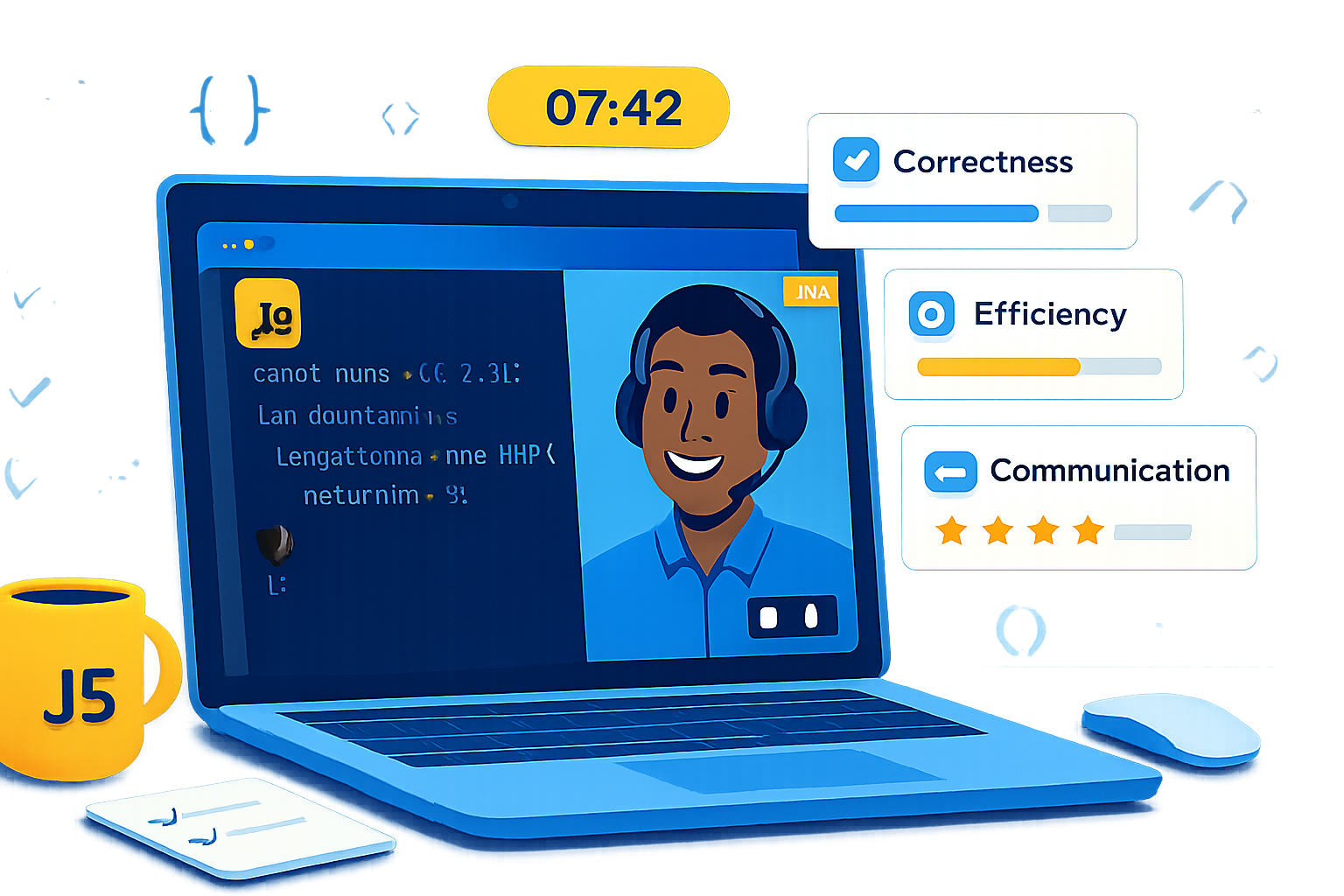
Sample rubric (0–3 scale):
Clarity of problem framing: 0 1 2 3
Approach quality (correctness + tradeoffs): 0 1 2 3
Coding fluency & correctness: 0 1 2 3
Tests & edge-case handling: 0 1 2 3
Communication & thought process: 0 1 2 3
Recovery & debugging: 0 1 2 3
Overall score: /18
Record the rubric after each mock. Track trends over weeks. Improvement on communication or recovery often correlates with offer rate increases faster than pure algorithmic improvement.
Measuring progress: metrics that matter
Track these weekly:
- Rubric average score (goal: +1 point per 2 weeks)
- Time-to-first-correct-approach (goal: reduce by 20–30%)
- Number of unforced errors (e.g., off-by-one, wrong base case) per session
- Clarity comments from interviewers (qualitative tags like “verbose”, “silent”, “good at framing”)
- Offer-related metrics (onsite invites per applied company)
Numbers reveal where to focus practice. If your score increases but offers don’t, the likely gap is role fit or system design depth.
Tools and platforms to run high-quality mocks
- Pramp - free reciprocal mock interviews with peers.
- Interviewing.io - anonymous, professional mock interviews; sometimes recorded and used to practice live company-style rounds.
- LeetCode - problems for timed practice and curated interview questions.
- CoderPad - realistic collaborative coding environment.
- HackerRank - timed challenges and environment for practice.
Each tool has tradeoffs. Use Pramp for volume and Interviewing.io for realism and experienced interviewers.
Sample 6-week mock interview schedule (for 2–3 interviews per week)
Week 1–2: Foundation
- 2 easy/1 medium per week in timed mocks.
- Focus: clean problem framing; get comfortable speaking aloud.
Week 3–4: Complexity and system design
- 1 system design + 2 medium coding mocks per week.
- Focus: tradeoffs, component boundaries, and scaling arguments.
Week 5: Interview marathon
- 3 mocks in 5 days (simulate an onsite schedule).
- Focus: stamina and recovery.
Week 6: Polish and targeted practice
- Focus on recurring weak points from rubrics.
- Do 2 mocks with senior interviewers (Interviewing.io or mentors).
This plan is aggressive but realistic; adjust cadence to avoid burnout.
Behavioral and culture-fit practice
Technical excellence alone isn’t enough. Add a weekly behavioral mock where you practice STAR-format answers to questions like:
- Tell me about a time you shipped a feature under time pressure.
- Describe a disagreement with a teammate and how you handled it.
Record one behavioral mock per week and read back to check for clarity, honesty, and focus on outcomes.
Psychological scaffolding: how to handle interview pressure
- Pre-brief: 60 seconds of breathing and a mental checklist before you start. It improves clarity.
- Scripting: Have a 15–30 second opener: “I’ll restate the problem, confirm assumptions, propose a high-level approach, then implement.” Use it every time.
- Micro-recovery: If you blank, pause (3 seconds), say “I need 30 seconds to reorganize my approach,” and sketch a plan.
These small rituals reduce the chance of panic and keep you test-savvy.
Common pitfalls and how to avoid them
- Pitfall: Practicing only solo. Fix: add human-driven mocks weekly.
- Pitfall: Feedback that’s vague. Fix: use rubrics and insist on examples.
- Pitfall: Not simulating time pressure. Fix: always time-box and simulate interruptions.
- Pitfall: Overtraining one format (algorithms) and neglecting others (design, behavioral). Fix: follow a role blueprint.
Avoiding these keeps your practice aligned with hiring realities.
Quick checklist to run an effective mock (copy this before every session)
- Role blueprint chosen and problem aligns with role.
- Interview environment (tools, webcam, microphone) tested.
- Interviewer prepared with rubric and prompt.
- Timer visible.
- Recording enabled (if consented).
- 3-minute pre-brief ritual.
Use this checklist to remove friction and make every session count.
Final word - the strategic edge
Mock interviews are the conversion layer between knowledge and offers. They don’t just teach you to solve problems; they teach you to perform under evaluation. Recruiters and interviewers hire people who can think, communicate, and deliver when it matters.
Do this correctly: simulate the pressure, get precise feedback, iterate with intention. Do this consistently: a few realistic mocks per week will outpace months of solo practice.
You won’t just be better at coding. You’ll be the candidate who stands out.
References and further reading
- LeetCode - https://leetcode.com
- Pramp - https://www.pramp.com
- Interviewing.io - https://interviewing.io
- CoderPad - https://coderpad.io
- Front-End Interview Handbook - https://github.com/yangshun/front-end-interview-handbook