· career · 5 min read
Contributing to Open Source: Why it’s Crucial for Your Growth as a JavaScript Developer
Contributing to open source is one of the fastest ways to improve as a JavaScript developer: it sharpens your skills, expands your network, and gives tangible proof of your abilities that employers respect.
Introduction - what you can achieve
Imagine shipping code that hundreds or thousands of people use. Imagine building the confidence to read any unfamiliar codebase quickly. Imagine turning that experience into interviews, mentors, and real career momentum. Contributing to open source makes all of this possible. Read on and you’ll get a practical roadmap to start contributing today, plus the reasons why it accelerates your growth as a JavaScript developer.
Why open source matters for JavaScript developers
- Real-world complexity. Libraries and frameworks expose edge cases you don’t meet in toy projects. Working on them forces you to handle real browser quirks, build-step pipelines, and cross-environment compatibility.
- Feedback loop. Public pull requests (PRs) invite code review from experienced contributors. That feedback beats solo practice.
- Visibility and signal. A history of meaningful contributions on GitHub is a stronger signal than claims on a resume.
Concrete benefits (skills, network, resume)
- Sharpened technical skills
- Reading big codebases improves comprehension. You learn patterns, module boundaries, and API design simply by reading code. This is invaluable when you face unfamiliar frameworks.
- Testing and tooling. Open source projects require tests, CI, linting, and build tools. Contributing teaches you how to write reliable tests, configure CI, and debug build failures.
- Debugging and performance. Fixing bugs in widely used packages forces you to investigate performance and edge-case bugs-and to measure your changes.
- Better code quality and design sense
- API design at scale. You’ll see how maintainers balance ergonomics, backward compatibility, and performance.
- Documentation discipline. Writing docs and examples makes your communication clearer-an underrated developer skill.
- Stronger professional network
- Interaction with maintainers and other contributors builds relationships. Those conversations convert into references, job leads, and mentorship.
- Community reputation. Consistent contributors get recognized names; that reputation opens doors.
- Resume and hiring advantages
- Verifiable work. Recruiters and hiring managers can view your PRs, issues, and commit history. That’s tangible proof of shipping code.
- Talking points for interviews. You can discuss tradeoffs you made, the performance studies you ran, and how you negotiated breaking changes with maintainers.
How to find the right project (and what to look for)
Look for projects that match your goals. Consider:
- Relevance: Does it use technologies you want to learn (React, Node, Vite, Deno, Svelte)?
- Activity: Are there recent commits, merged PRs, and active issue discussions?
- Welcoming community: Check for a CONTRIBUTING.md, a Code of Conduct (e.g., Contributor Covenant), and labels like good-first-issue.
Places to discover issues and projects:
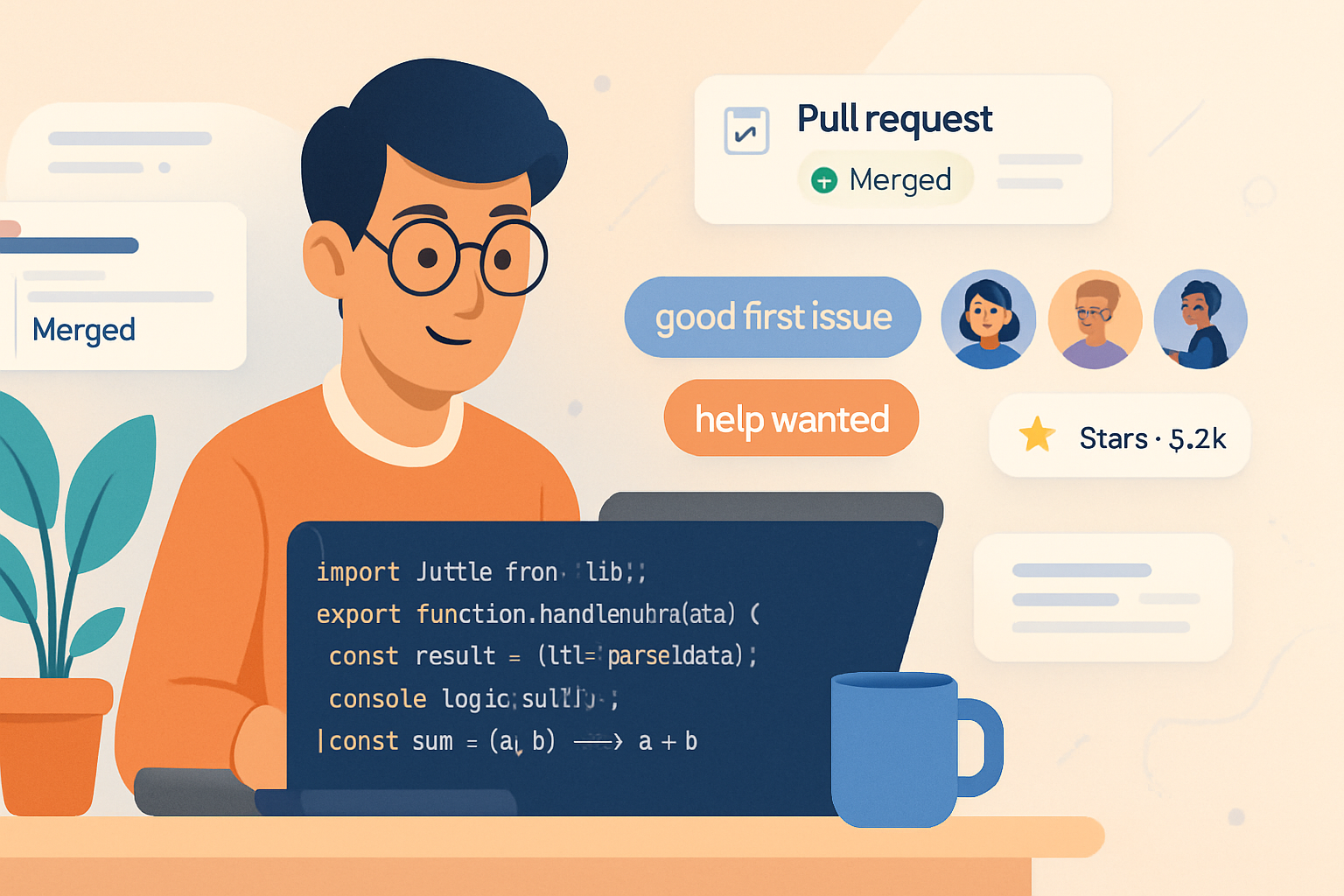
- GitHub issues and labels (search: “good first issue”, “help wanted”).
- https://www.firsttimersonly.com/ - friendly beginner resources.
- https://www.codetriage.com/ - triage issues to find small ways to help.
- Free resources and guides like this overview: https://www.freecodecamp.org/news/how-to-contribute-to-open-source/
- Official GitHub guide: https://guides.github.com/activities/contributing-to-open-source/
A practical first-week roadmap (zero to first PR)
Day 1: Scout
- Pick 1–2 projects and clone them.
- Read README, CONTRIBUTING.md, and open issues.
Day 2: Reproduce and run
- Get the project running locally. Follow install steps. Open a small issue to report any problems with setup if you hit them.
Day 3–4: Small wins
- Start with documentation fixes, typos, or small test improvements. These are low-friction and show you the workflow.
Day 5–7: First code PR
- Tackle a “good first issue” or a small bug. Create a branch, implement the change, add a clear commit message, and open a PR.
PR etiquette and an example checklist
Before opening a PR:
- Follow the contribution guide and project conventions.
- Run tests and linters locally.
- Keep the PR focused: one logical change per PR.
- Write a descriptive title and a short summary of the change. Explain the problem and your solution.
Example PR template (short):
Title: fix(parser): handle empty template strings

Summary:
- Fixes an edge case where ``parseTemplate("")`` returned undefined.
- Adds unit tests covering empty and null template inputs.

Notes:
- No breaking changes. All tests pass locally (npm test).
Handling feedback gracefully
- Expect iteration. Maintain a constructive tone.
- Ask questions when you don’t understand a review. Be concise.
- If you disagree, explain your reasoning and provide code examples or benchmarks.
What to contribute beyond code
- Documentation and examples - huge impact with low friction.
- Tests and fixtures - increases project reliability.
- Issue triage - reproduce issues, add labels, propose fixes.
- Design reviews - if you have product sense, critique APIs and UX.
How open source contributions translate into career wins
- Measurable proof of competence. Employers can read your PRs, see your test coverage, and inspect the discussions you led.
- Faster hiring path. Contributors are often fast-tracked in hiring because they’ve proven they can collaborate on public code.
- Mentorship and referrals. Regular interactions with maintainers lead to mentoring relationships and written recommendations.
From contributor to maintainer: the next level
- Start reviewing PRs once you know the codebase.
- Help maintainers with release tasks, changelogs, and triage.
- Learn project governance and decision-making-this grows leadership skills employers value.
Measuring your impact
Track simple metrics:
- Number of merged PRs and issues closed.
- The reach of the projects you contributed to (stars, downloads, users).
- New connections (mentors, fellow contributors) and any interviews or offers that reference your OSS work.
Common concerns and how to handle them
- “I don’t have time.” Do 1–2 small contributions per month. Consistency beats intensity.
- “I’m not experienced enough.” Start with docs, tests, and reproduction; these are valuable and help you learn.
- “My PR was rejected.” Use it as a learning moment. Extract the feedback and try again.
Resources and further reading
- GitHub Guides - Contributing to open source: https://guides.github.com/activities/contributing-to-open-source/
- freeCodeCamp - How to contribute to open source: https://www.freecodecamp.org/news/how-to-contribute-to-open-source/
- First Timers Only: https://www.firsttimersonly.com/
- Contributor Covenant (code of conduct): https://www.contributor-covenant.org/
- CodeTriage: https://www.codetriage.com/
- MDN Web Docs (JavaScript reference): https://developer.mozilla.org/
Final words
Contributing to open source is the fastest way to get real-world experience, build a visible track record, and join a network of developers who will help you level up. Start small. Be consistent. Ship things that matter. The skills, connections, and credibility you gain will pay dividends across your entire career-especially as a JavaScript developer navigating an ever-changing ecosystem.