· career · 6 min read
Beyond APIs: Designing the Frontend for Real-Time Interactivity
Practical patterns and system design guidance for building responsive, scalable, and resilient real-time frontends using WebSockets, SSE, WebTransport, state models, and UX patterns.
Introduction - what you’ll get from this article
You will finish this article with a clear playbook for designing frontends that feel instant and stay correct under load. Read on to learn which transport to choose, how to model and merge real-time data, how to build UX that tolerates network disruptions, and how to scale your architecture without shipping inconsistent states to users.
Why this matters now
Real-time is no longer optional for many apps: collaboration tools, trading dashboards, multiplayer games, live sports, and chat expect subsecond updates. But real-time is harder than fetching APIs. It’s state: ordering, idempotency, reconciliation, and user experience - not just messages.
Core principles (quick set of guardrails)
- Design for state, not for messages. The frontend should converge on canonical state, even if messages arrive out of order or are retried. Keep event ordering and reconciliation in mind.
- Make UX tolerant of eventual consistency. Use optimistic updates and clear affordances for pending states.
- Keep transports fungible. Architect as if the wire protocol can change (SSE ↔ WebSocket ↔ WebTransport). Abstract connection and event handling.
- Fail gracefully and keep reconciling. Offline and reconnection paths are first-class features.
Protocol choices: pick the right tool
- WebSockets - full-duplex, low-latency, widely supported. Great for 2‑way apps (chat, games, presence). See MDN’s overview: https://developer.mozilla.org/en-US/docs/Web/API/WebSockets_API
- Server-Sent Events (SSE) - simple, unidirectional, auto-reconnect in many browsers. Works well for live feeds, notifications: https://developer.mozilla.org/en-US/docs/Web/API/Server-sent_events
- WebTransport - newer, built on QUIC, supports multiplexing, unreliable datagrams, and reliable streams. Useful for high-performance needs: https://developer.mozilla.org/en-US/docs/Web/API/WebTransport
- WebRTC DataChannels - peer-to-peer low-latency data between browsers. Best for direct peer sync and media-heavy apps: https://developer.mozilla.org/en-US/docs/Web/API/RTCDataChannel
- Higher-level options - GraphQL subscriptions and gRPC streams abstract some complexity but add infrastructure choices (e.g., Apollo Subscriptions): https://www.apollographql.com/docs/react/data/subscriptions/
When to pick what
- Simple server→client feed (news, metrics): SSE or long-polling. Use SSE if you need a simple browser-native solution.
- Bidirectional, medium-complexity (chat, presence): WebSockets.
- High-performance, multiplexed comms (cloud gaming, real-time telemetry): consider WebTransport.
- Peer-to-peer collaboration without centralized throughput: WebRTC DataChannels.
Data modeling and message design
Design messages so the client can reach the correct state after retries and reorders.
- Prefer state snapshots + deltas. Snapshots let late joiners converge quickly; deltas minimize bandwidth.
- Use monotonically increasing sequence numbers or vector clocks on messages to detect and apply ordering and missing messages.
- Include an idempotency key or UUID for operations so retries don’t create duplicates.
- Keep messages small, typed, and versioned. Include a schema version or type field to let clients evolve safely.
Example message shape
{
  "type": "update",
  "resource": "document/123",
  "seq": 1023,
  "changes": {"ops": [...]},
  "snapshot": null,
  "timestamp": "2026-01-24T10:15:00Z"
}
State sync strategies
- Snapshot + incremental apply: fetch a recent snapshot on reconnect, then apply missed deltas by sequence number.
- Event sourcing on the client: replay an ordered event log to derive UI state. Useful for audit and undo.
- CRDTs and Operational Transforms for collaborative editing: CRDTs (Conflict-free Replicated Data Types) let multiple clients merge changes without a central arbiter; see CRDT primer: https://en.wikipedia.org/wiki/Conflict-free_replicated_data_type and libraries like Automerge: https://automerge.org/
- Last-writer-wins (LWV) - simple but often insufficient for user-facing conflicts.
Client-side architecture: where to put logic
- Connection layer: abstracts transport (WebSocket/SSE/WebTransport) and handles reconnection, backoff, and heartbeats.
- Message router: decodes messages and routes to domain handlers.
- Store/state layer: normalized data store (Redux, MobX, Zustand) that merges remote events with local changes.
- UI layer: subscribes to normalized store; accepts optimistic updates and listens for confirmations.
Pattern: optimistic update lifecycle
- User triggers action locally. UI updates immediately (optimistic). 2. Client emits action to server with an operation idempotency key. 3. Store marks item as pending (spinner/ghost). 4. Server acknowledges success or sends corrected state. 5a. On ack - mark as committed. 5b. On rejection - roll back and show error.
Connection resilience: reconnection, backoff, and data integrity
- Exponential backoff with jitter for reconnect attempts.
- Heartbeats and timeouts to detect half-open connections.
- On reconnect, re-authenticate quickly (use short-lived tokens or cookie-based auth depending on constraints).
- On reconnect, rehydrate state via snapshot + requesting missed seq ranges. Avoid relying on the server to resend everything by default.
Minimal reconnection example (WebSocket)
function connect(url) {
  let ws;
  let attempts = 0;

  function tryConnect() {
    ws = new WebSocket(url);
    ws.onopen = () => {
      attempts = 0; /* rehydrate state */
    };
    ws.onmessage = e => handleMessage(JSON.parse(e.data));
    ws.onclose = () => setTimeout(tryConnect, backoff(++attempts));
  }

  tryConnect();
}
UX patterns for responsiveness and clarity
- Optimistic UI with clear pending states - don’t hide the fact something hasn’t been confirmed.
- Progressive enhancement - show partial results quickly (skeletons, placeholders) and patch with deltas.
- Conflict visibility - surface conflicts to users where automatic merging isn’t safe.
- Rate-limit or debounce UI updates when the stream spikes. Update the store at full fidelity, but coalesce rendering events (e.g., requestAnimationFrame or 250ms batching) to keep UI smooth.
Security and privacy
- Always use TLS. Never send auth tokens in query strings; prefer Authorization headers or secure cookies.
- Authenticate the initial handshake, then refresh short-lived credentials over a secure channel.
- Validate and authorize server-side for every operation. Never trust the client for capability checks.
- Be cautious with SSE: same-origin rules and CORS control behavior differently than XHR/WebSocket handshakes. See MDN SSE notes: https://developer.mozilla.org/en-US/docs/Web/API/Server-sent_events
Scaling real-time backends
Challenges: fan-out, sticky sessions, and stateful connections.
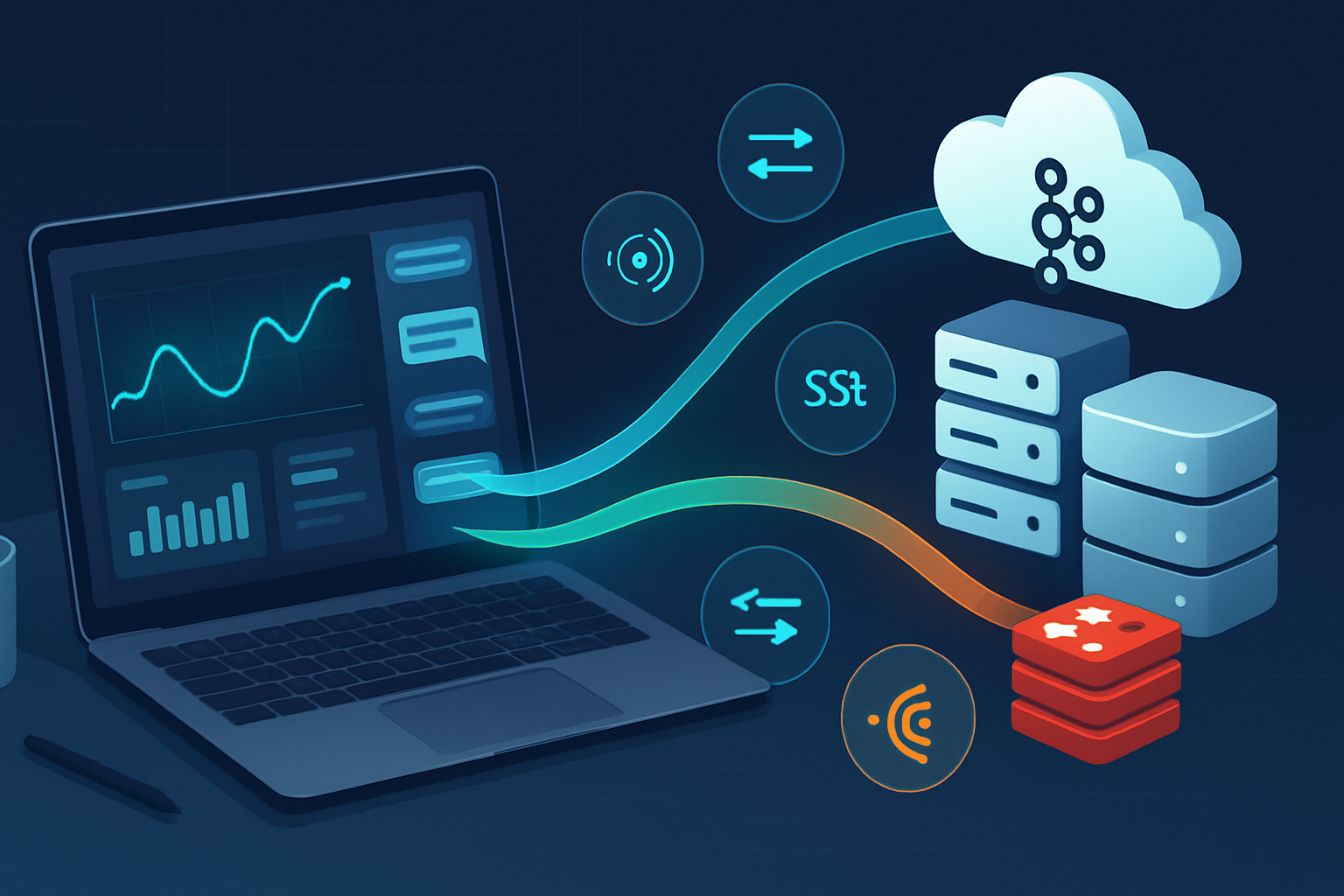
- Horizontal scaling: run multiple real-time servers behind a load balancer. Use a message broker (Redis, Kafka) for pub/sub to fan out events to all servers: https://redis.io/docs/manual/pubsub/ and https://kafka.apache.org/
- Sticky sessions vs stateless gateways: use sticky sessions if your server keeps in-memory state per connection; otherwise, separate connection handling from state by using a central store or stickyless gateways.
- Gateways and proxies: make sure your LB supports WebSocket and protocol upgrades (NGINX, Envoy). See NGINX guidance: https://www.nginx.com/blog/websocket-nginx/
- Serverless: managed WebSocket services (AWS API Gateway WebSocket, Pusher, Ably) remove connection management but make fan-out patterns and latency characteristics different.
Routing and topics best practices
- Use hierarchical topics: application:resource:id or rooms:user:123. Keep topic names predictable.
- Limit topic fan-out by applying server-side filters - send only what each client needs.
- Avoid broadcasting to all clients unless every client truly needs the data.
Observability and testing
- Instrument both client and server for connection lifecycle events (connect, disconnect, reconnect, error) and message counts.
- Use synthetic clients in load tests to measure end-to-end latency and server CPU under fan-out.
- Simulate network conditions (latency, packet loss) during QA (Chrome DevTools Network Throttling, tc/netem).
Recipes: common real-time patterns
- Chat / presence
- Transport: WebSockets. - Model: message events with seq + message IDs. - UX: optimistic sending with local echo, delivery/read receipts. - Scale: presence state in Redis, message fan-out via pub/sub.
- Live dashboard (metrics)
- Transport: SSE or WebSockets. - Model: snapshots at intervals + aggregated delta stream. - UX: smoothing charts, throttle render updates. - Scale: aggregate server-side and push pre-aggregated deltas.
- Collaborative text editor
- Transport: WebSocket or WebRTC (P2P augmentation). - Model: CRDT or OT with operational logs and snapshots. - UX: show cursors, merge indicators, undo working locally. - Libraries: Automerge (CRDT) or ShareDB (OT).
When to introduce