· career · 8 min read
Elevating Your Mock Interview Game: Real-World Scenarios Every JavaScript Engineer Should Practice
Practice realistic, high-impact JavaScript scenarios that employers care about. Learn specific prompts, expected approaches, and sample answers to level up your mock interviews and impress hiring teams.

Introduction
By the end of this article you’ll have a focused, repeatable practice plan that mirrors the real problems JavaScript engineers face daily. You’ll get concrete mock interview prompts, step-by-step approaches to solve them, pitfalls to avoid, and small sample solutions you can use in live coding sessions or take-home exercises. Ready to practice in a way that actually transfers to the job? Let’s go.
Why practice real-world scenarios (not just puzzles)
Interviews are increasingly “job-like.” Companies want to know not only that you can write an algorithm, but that you can design resilient features, diagnose production issues, and collaborate under uncertainty. Practicing real scenarios:
- Aligns your thinking with product trade-offs.
- Reveals habits (good and bad) you’ll carry into code reviews.
- Boosts confidence in pair-programming and system-design rounds.
How to use this article
- Treat each scenario as a mini-interview: 20–40 minutes.
- Start by explaining your assumptions and constraints out loud.
- Sketch high-level approaches first; then implement or pseudo-code.
- Use the rubric at the end to self-score and iterate.
Core scenarios every JavaScript engineer should practice
- Asynchronous behavior & the event loop
Why it matters
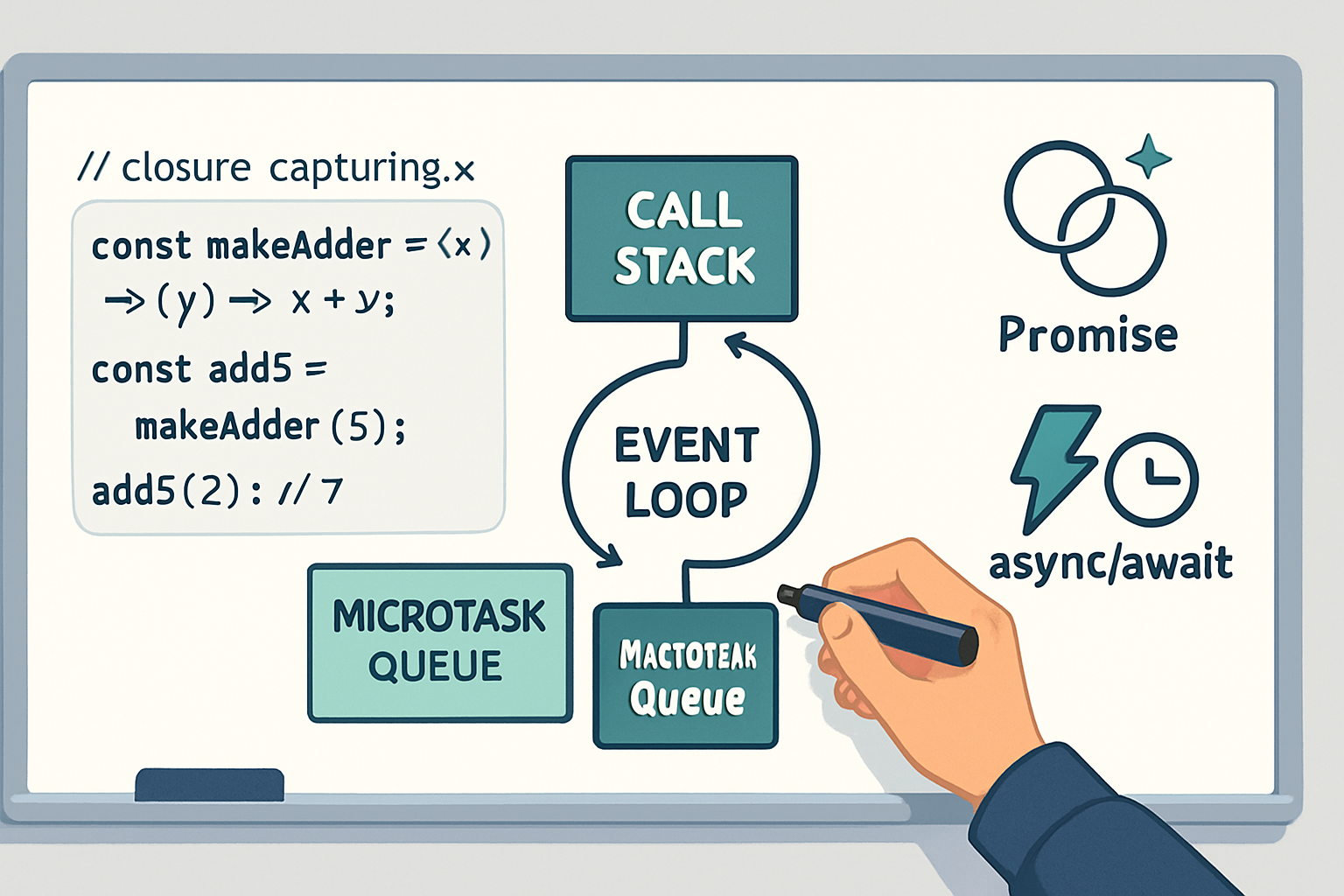
JavaScript’s async model underpins UI responsiveness and server throughput. Interviewers probe whether you truly understand microtasks vs. macrotasks, promise scheduling, and how to avoid subtle race conditions.
Mock prompt
“You have code that mixes setTimeout, Promise.then, and async/await. Explain the execution order, then modify the code to ensure an operation always runs after all currently scheduled microtasks complete.”
Expected approach
- Explain microtasks (Promise reactions, MutationObservers) vs macrotasks (setTimeout, I/O). Cite the event loop semantics.
- Show a short example and the corrected pattern (e.g., await Promise.resolve() to schedule a microtask, or use setImmediate/queueMicrotask depending on environment).
Quick sample
console.log('start');
setTimeout(() => console.log('timeout'), 0);
Promise.resolve().then(() => console.log('promise'));
console.log('end');
// Order: start, end, promise, timeout

// Force code to run after microtasks but before macrotasks:
await Promise.resolve();
// or explicitly queue a microtask
queueMicrotask(() => doAfterMicrotasks());
Pitfalls to discuss
- Misunderstanding of when async/await yields to the event loop.
- Assuming setTimeout(fn, 0) places callbacks before Promise.then handlers.
References: MDN on the event loop: https://developer.mozilla.org/en-US/docs/Web/JavaScript/EventLoop
- Promises, cancellation, and race conditions
Why it matters
Network calls race with UI updates and retries. Employers want engineers who can orchestrate concurrency safely.
Mock prompt
“Implement a function fetchWithTimeout(url, ms) that fetches a URL but rejects if the fetch doesn’t complete within ms. Then show how you’d avoid a race between a slow fetch and a later cancellation request.”
Expected approach
- Use AbortController when available to cancel fetches.
- Implement timeout via AbortController + setTimeout, and clear timers.
Sample implementation
async function fetchWithTimeout(url, ms) {
  const controller = new AbortController();
  const id = setTimeout(() => controller.abort(), ms);
  try {
    const res = await fetch(url, { signal: controller.signal });
    clearTimeout(id);
    return await res.json();
  } catch (err) {
    if (err.name === 'AbortError') throw new Error('timeout');
    throw err;
  }
}
What to communicate in an interview
- Explain cleanup (clearing timers) and idempotency of handlers.
- Discuss why cancellation matters for resource usage and UX.
- Memory leaks & performance tuning
Why it matters
Small leaks accumulate. Slow render paths make users unhappy. Interviewers want people who can find and fix hot spots using profiling tools.
Mock prompt
“Your single-page app shows rising memory usage over time while the user navigates. How do you triage, identify, and fix the leak?”
Expected approach
- Reproduce with a deterministic scenario.
- Use browser DevTools (Performance & Memory snapshots) to compare heap snapshots.Chrome DevTools guide
- Look for retained DOM nodes, large closures, global arrays, or forgotten event listeners.
- Show a code example of a broken and fixed pattern (e.g., removeEventListener in cleanup).
Sample bug/fix
// Bug: adding event listeners on mount without cleanup
function mountComp() {
  window.addEventListener('resize', onResize);
}

// Fix: remove listener on unmount
function unmountComp() {
  window.removeEventListener('resize', onResize);
}
Pitfalls to mention
- Circular references in closures can retain large objects in some environments.
- Overuse of frameworks’ global caches without eviction policies.
- DOM updates, rendering and batching
Why it matters
Inefficient DOM updates cause jank. Interviewers look for knowledge of reflows/repaints and techniques like debouncing, batching, and requestAnimationFrame (rAF).
Mock prompt
“You need to animate a list of 500 items whose positions change frequently. How do you implement it to avoid layout thrashing?”
Expected approach
- Minimize forced synchronous layouts.
- Use transform and opacity where possible (GPU-accelerated properties).
- Batch DOM reads and writes; use rAF for animations.
- Consider virtualization (windowing) for large lists.
Small snippet
// Batch reads then writes
let positions = [];
function update() {
  positions = items.map(el => el.getBoundingClientRect().top); // read
  requestAnimationFrame(() => {
    items.forEach(
      (el, i) => (el.style.transform = `translateY(${positions[i]}px)`)
    ); // write
  });
}- Data modeling, immutability, and state management
Why it matters
A good engineer models state to keep code maintainable and performant. Interviewers will probe trade-offs between mutable vs immutable updates, normalization, and memoization.
Mock prompt
“Given a nested todo list with many items, design a fast reducer or update function that toggles an item’s completed flag, keeping updates efficient for large lists.”
Expected approach
- Normalize state (use a map by id) to avoid deep copies.
- Use structural sharing on updates.
Example
// Normalized state
const state = {
  todosById: { a: { id: 'a', done: false }, b: { id: 'b', done: true } },
  list: ['a', 'b'],
};

function toggle(state, id) {
  return {
    ...state,
    todosById: {
      ...state.todosById,
      [id]: { ...state.todosById[id], done: !state.todosById[id].done },
    },
  };
}- API design, error handling, and retries
Why it matters
Clients and servers interact over unreliable networks. Interviewers value engineers who design for idempotency, exponential backoff, and clear error semantics.
Mock prompt
“Design fetchWithRetry that retries on network errors with exponential backoff and jitter. Explain idempotency concerns if the server has non-idempotent endpoints.”
Expected approach
- Show backoff with jitter (e.g., randomized delay within doubling window).
- Discuss using safe HTTP verbs (GET is idempotent; POST may not be) or server-side idempotency keys.
Sample backoff sketch
async function fetchWithRetry(url, opts, maxRetries = 3) {
  let attempt = 0;
  while (attempt <= maxRetries) {
    try {
      return await fetch(url, opts);
    } catch (err) {
      if (attempt === maxRetries) throw err;
      const jitter = Math.random() * 100;
      const delay = Math.pow(2, attempt) * 200 + jitter;
      await new Promise(r => setTimeout(r, delay));
      attempt++;
    }
  }
}- Security fundamentals (XSS, CORS, authentication)
Why it matters
Security bugs are career-making or -breaking. Interviewers will want to hear about input validation, output escaping, and safe auth flows.
Mock prompt
“A page renders user-submitted HTML. How would you prevent XSS while allowing simple formatting like and ?”
Expected approach
- Prefer not to render raw HTML; use a safe subset sanitizer.
- Mention libraries (e.g., DOMPurify) and server-side sanitization.
- Explain CORS basics and why it isn’t a security boundary for a server.
References: OWASP XSS: https://owasp.org/www-community/attacks/xss
- Testing & debugging under pressure
Why it matters
Good tests and debugging skills speed up feature delivery. Interviewers may ask you to write unit tests or debug a broken component live.
Mock prompt
“Write unit tests for a function that merges two config objects, where the second overrides the first, but arrays should be concatenated instead of replaced.”
Expected approach
- Write deterministic, small unit tests using a testing framework (e.g., Jest).
- Show edge cases: undefined values, nested objects, and array concatenation.
Test sketch (Jest)
// mergeConfigs.js
function merge(a, b) {
  /*...*/
}

// mergeConfigs.test.js
test('arrays are concatenated and values overridden', () => {
  const a = { list: [1], val: 1 };
  const b = { list: [2], val: 2 };
  expect(merge(a, b)).toEqual({ list: [1, 2], val: 2 });
});
Debugging tips to explain live
- Reproduce with minimal steps.
- Add logging or breakpoints strategically.
- Use source maps to map transpiled code back to the original.
- Build tooling, bundling, and CI considerations
Why it matters
Delivering features requires predictable builds, small bundles, and reliable pipelines. Interviewers will ask about tree-shaking, code-splitting, and source maps.
Mock prompt
“A route’s initial bundle is huge and slows first paint. What strategies do you apply to reduce its size and improve Time to Interactive?”
Expected answers
- Code-splitting (dynamic import()).
- Lazy-loading non-critical components.
- Tree-shaking, minimizing polyfills, analyzing bundle with tools (webpack-bundle-analyzer).
- Enable gzip/Brotli and caching headers.
- Real-time data & synchronization conflicts
Why it matters
Collaborative apps and live dashboards demand correct reconciliation strategies and minimal bandwidth.
Mock prompt
“Design a simple strategy to sync a user’s offline edits to a server and resolve conflicts.”
Expected approach
- Use optimistic UI and queue updates locally while offline.
- On sync, perform server merge with last-write-wins or version vectors depending on requirements.
- Provide visual conflict resolution for complex merges.
Practice prompts you can run in a mock interview
- Live coding: “Implement debounce(fn, wait) that always calls the last invocation with correct ‘this’ binding and arguments. Consider cancellation.” (10–15 min)
- System-design-lite: “Design the front-end architecture for a newsfeed that supports infinite scroll, real-time updates, and offline reading.” (30–40 min)
- Debugging/diagnosis: Present a small app with a memory leak and ask the candidate to triage using DevTools (30 min).
- Take-home: Build a small CRUD app with tests and a CI pipeline that runs lint and tests on push (3–6 hours).
Debounce sample (live-coding friendly)
function debounce(fn, wait) {
  let timer = null;
  return function (...args) {
    const ctx = this;
    clearTimeout(timer);
    timer = setTimeout(() => fn.apply(ctx, args), wait);
  };
}
What interviewers are scoring (rubric)
- Communication (30%): Clear assumptions, trade-offs, and stepwise plan.
- Correctness (30%): Solution works and covers edge cases.
- Robustness & production-readiness (25%): Cleanup, error handling, performance considerations.
- Style & maintainability (15%): Readable code and tests.
30/20/10 minute session decomposition
- 0–5m: Read prompt, ask clarifying questions, state assumptions.
- 5–15m: High-level design or outline of algorithm. Discuss alternatives.
- 15–30m: Implement the core; leave extension points described.
- Final 5m: Summarize, run through edge cases, and propose tests.
How to make mock interviews most effective
- Record and review: listen for unexplained leaps in logic.
- Use a real editor and browser for debugging rounds.
- Alternate roles: sometimes play interviewer; it improves your questioning and code-review sensitivity.
- Track improvements with the rubric; iterate on weak spots.
Resources to cite while practicing
- MDN Event Loop: https://developer.mozilla.org/en-US/docs/Web/JavaScript/EventLoop
- Chrome DevTools docs: https://developer.chrome.com/docs/devtools/
- OWASP XSS: https://owasp.org/www-community/attacks/xss
Closing (what you can achieve quickly)
Practice these focused, realistic scenarios three times each and you’ll notice two things: you think in production trade-offs faster, and you communicate solutions more clearly under pressure. Those are the exact signals interviewers look for.