· frameworks · 6 min read
Controversial Opinions: Why You Might NOT Want to Use Nuxt.js in Your Next Project
Nuxt.js is powerful - but it’s not always the right choice. This post explains the performance, complexity, and architectural reasons to avoid Nuxt in certain projects, and offers practical alternatives and mitigations.
What you’ll get out of this article
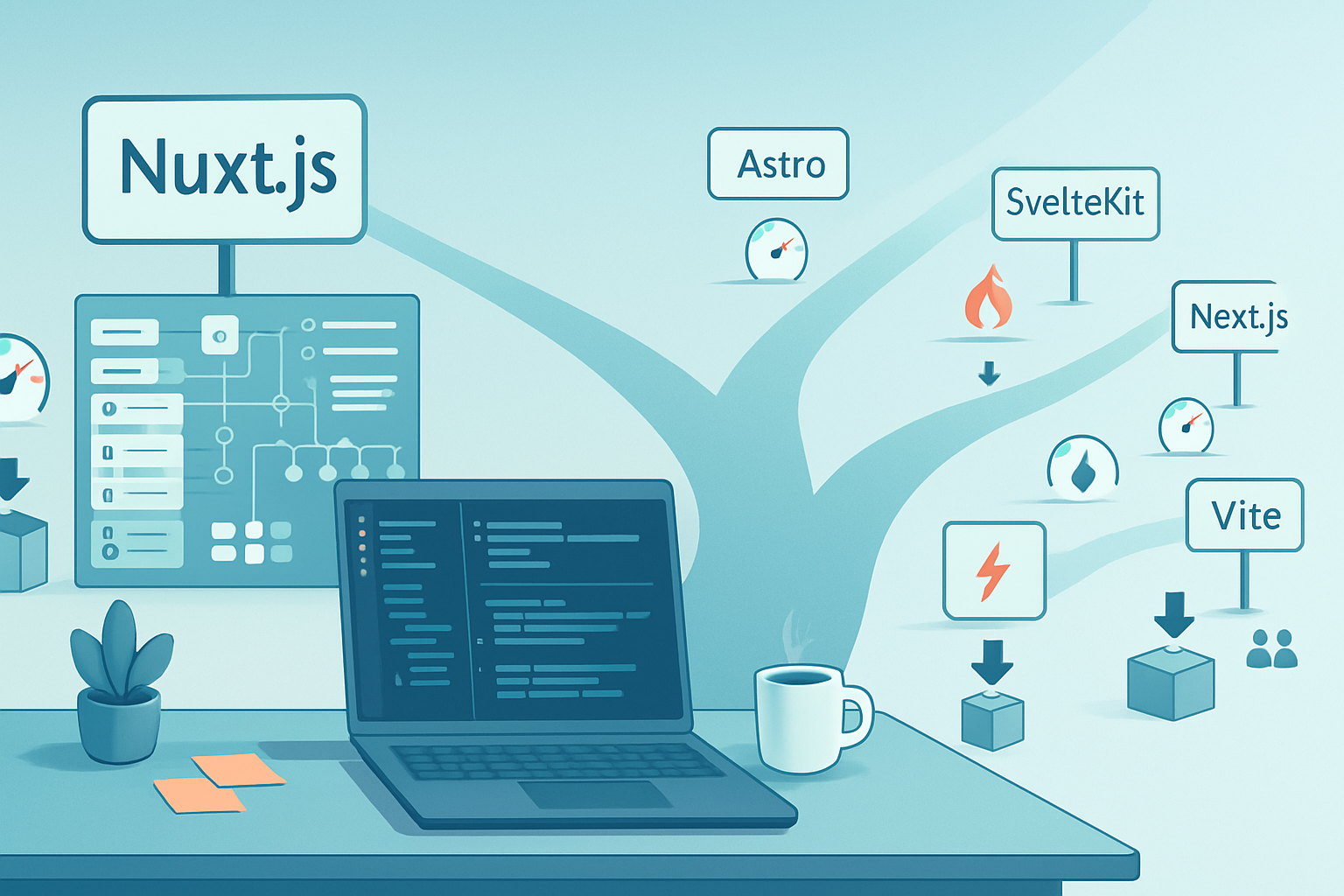
You’ll finish this post able to decide-quickly and confidently-whether Nuxt.js is the right choice for your next project. You’ll know the common performance pitfalls, where Nuxt’s complexity can cost you time and money, what trade-offs you can mitigate, and which alternatives might serve your needs better.
Short answer up front: Nuxt is excellent for Vue-based SSR apps and feature-rich sites, but it’s not the right default for every project. Read on to learn why.
Quick verdict
- Pick Nuxt when you need a Vue-first full-stack framework with SSR/SSG, a rich module ecosystem, and conventions that speed up large teams.
- Avoid Nuxt when you need extreme runtime minimalism, tiny bundles, micro-frontends, or when your team isn’t invested in Vue. In those cases a lighter approach or a different framework can save time and cost.
What Nuxt gives you (so we’re fair)
Nuxt is popular because it solves many problems out of the box:
- Convention-driven routing, server routes, and data fetching.
- Built-in SSR, SSG, and hybrid rendering strategies.
- An ecosystem of modules (auth, image optimization, analytics, etc.).
- Tight Vue integration and an ergonomic developer experience.
If those map perfectly to your requirements, Nuxt will often speed development dramatically. See Nuxt’s official docs for how it works: https://nuxt.com
Why you might NOT want to use Nuxt
Below are the most common, concrete reasons teams regret choosing Nuxt for a project. Each point is actionable and relates to real cost: developer time, runtime cost, performance, or maintenance debt.
1) Performance overhead and runtime characteristics
Nuxt provides a lot of features by default. That convenience costs runtime size and complexity.
- Server-side rendering and server middleware increase cold-start time in serverless environments. If you deploy to AWS Lambda / Vercel Serverless functions, cold starts can add latency and cost. (Edge deployments mitigate this but require different setup.)
- The framework adds layers at runtime (Nitro server, SSR renderer, module hooks) that make the smallest footprint larger than a simple SPA or pre-rendered site.
- Automatic hydration and client-side runtime added on top of markup can increase initial JavaScript payloads. For content-heavy sites where only a little interactivity is needed, this is wasteful.
If your top priority is minimal bytes and the fastest possible Time-to-Interactive on a low-bandwidth connection, Nuxt’s defaults can work against you.
2) Complexity and developer cognitive load
Nuxt’s conventions are powerful. But they also hide behavior.
- Magic (auto-imports, implicit routing, convention-based file behavior) speeds up simple use-cases, but makes debugging harder when something unusual is required.
- Nuxt projects can grow opinionated folder structures and conventions that new developers must learn before they can contribute.
- Upgrading major Nuxt versions (e.g., Nuxt 2 -> Nuxt 3) can be a non-trivial migration, especially if your code relies on community modules that lack parity.
If your team prefers explicit configuration over convention, or if you have many developers unfamiliar with Vue/Nuxt, this will cost time.
3) Build times and developer feedback loop
Large Nuxt apps with many modules and server routes can suffer from slow builds and longer cold dev-server restarts.
- Bigger projects mean longer asset bundling and SSR build steps.
- If you favor very fast iteration (small components, rapid prototyping), a leaner tool like Vite + plain Vue or Svelte may be noticeably snappier.
4) Opinionated architecture that might not match your needs
Nuxt’s “do it for you” approach assumes certain server and rendering architectures.
- If your architecture is micro-frontends or you rely on a custom CDN/edge strategy, Nuxt’s integrated approach may fight you.
- If you need extreme control over routing/data fetching patterns for complex caching or streaming scenarios, more explicit frameworks or lower-level libraries can be easier to reason about.
5) Ecosystem and lock-in
Nuxt modules are convenient but introduce coupling.
- Many modules assume Nuxt’s runtime-migrating away later can require rewriting integrations.
- Not all community modules are maintained; depending on dozens of small modules can become a maintenance risk.
6) Team language / framework mismatch
If your team has deep React or Svelte expertise and limited Vue knowledge, choosing Nuxt forces learning costs. Often it’s more efficient to pick a framework your team already knows well.
Alternatives (and when they’re better)
Below are common alternatives and the scenarios where they shine.
- Next.js (https://nextjs.org): If your team is React-first and you need SSR/ISR with a mature platform and Vercel integration. Best for complex apps with React-centric ecosystems.
- Remix (https://remix.run): When you want fetch-on-the-server semantics, fewer client-side abstractions, and strong routing + data-loading ergonomics focused on user experience.
- Astro (https://astro.build): For content-heavy sites or marketing websites that need the smallest client JavaScript payloads. Astro favors partial hydration and islands architecture.
- SvelteKit (https://kit.svelte.dev): When you want minimal runtime overhead and extremely small bundles; Svelte’s compile-time optimizations yield very small client bundles.
- Vite + Vue SPA (https://vitejs.dev + https://vuejs.org): If you only need a single-page app with no SSR/SSG, this is the simplest route-fast builds and low runtime complexity.
Choose the tool that matches your constraints, not the most popular framework this week.
Practical checklist: Is Nuxt the right choice for this project?
Answer these quickly. If you have mostly “no” responses, reconsider Nuxt.
- Do you need server-side rendering or hybrid rendering? (Yes = Nuxt remains attractive.)
- Do you need many Nuxt modules (auth, image, i18n) that would otherwise take effort to wire? (Yes = Nuxt helps.)
- Is your team comfortable with Vue 3 and composition API? (Yes = lower ramp.)
- Is minimal client JS payload and fast cold start critical? (Yes = consider Astro/SvelteKit/SSG.)
- Are you deploying to constrained serverless environments where cold starts matter? (Yes = evaluate Nitro edge or rethink SSR.)
How to mitigate the common problems if you still choose Nuxt
If your use-case still points to Nuxt but you worry about the issues above, here are concrete mitigations:
- Prefer SSG / pre-rendering for pages that don’t need per-request data. Nuxt’s hybrid modes let you choose per-route rendering.
- Use Nitro/edge or an optimized server runtime to reduce cold-starts. Deploy to providers with warm instances (or edge runtimes) for better latency.
- Audit and reduce client bundles: code-split aggressively, lazy-load heavy components, and avoid unnecessary global libraries.
- Avoid excessive community modules; prefer only well-maintained and necessary ones.
- Monitor build times and split your repo (monorepo or micro-frontends) if builds become too large.
- Measure before optimizing. Use Lighthouse and real user metrics to prioritize improvements.
For Nuxt-specific performance tips, start at the official guide: https://nuxt.com/docs
Real-world examples
- Content marketing site: Astro or a statically generated site will usually outperform Nuxt for initial load because Astro ships minimal JS by default.
- Dashboard-heavy internal app: If it’s internal and uses Vue, Nuxt is reasonable for rapid feature delivery since SSR might not be essential and the team can accept some overhead.
- Multi-tenant SaaS with heavy server-side personalization: Consider Next.js or Remix if your team is React-focused; otherwise plan Nuxt + caching carefully to control costs.
TL;DR and final recommendation
Nuxt is a powerful framework that accelerates Vue-based SSR and full-stack apps. But it is not a one-size-fits-all solution. If your priorities are minimal client JS, tiny serverless cold starts, extremely fast builds, or your team doesn’t use Vue, pick a lighter or different framework instead.
Choose the right tool for constraints, not by momentum. Nuxt is a great tool-when the project’s shape matches its strengths. When it doesn’t, the cost shows up in performance, developer velocity, or long-term maintenance.
Make your decision intentionally. The best architecture is the one that fits your constraints and people, not the one with the nicest shine.