· career · 6 min read
Why Chasing Trends Can Sabotage Your JavaScript Career
Chasing every new framework will give you short-term buzz but long-term fragility. Prioritize JavaScript fundamentals, disciplined learning, and selective adoption to build a resilient, future-proof career.

Outcome-first: read this and you’ll leave with a clear plan to stop reacting to every shiny JS release and start building a resilient, high-growth JavaScript career. You’ll know which fundamentals to own, how to keep current without burning out, and a practical checklist for when a new framework actually deserves your time.
Why this matters - fast
Trend-chasing feels productive. You have a new badge on your resume. You can name-drop the latest framework in interviews. You feel current. But that feeling is temporary. The work you do-ship features, fix bugs, scale systems-depends on understanding core concepts. When you master the fundamentals, learning any framework becomes an order-of-magnitude easier. Mastery compounds. Trend-hopping does not.
The real pitfalls of chasing frameworks
- Superficial knowledge: You can follow tutorials, but you can’t fix subtle bugs or design growth-friendly architecture. Framework APIs change. The problems don’t.
- Fragile resumes: A list of 20 frameworks signals breadth but not depth. Interviewers and hiring managers look for problem-solving and fundamentals.
- Technical debt accumulation: Rewriting to the new hotness creates migration cost and often introduces bugs that stem from misunderstanding, not from the framework.
- Cognitive overload: Constant context switching prevents deep work. Productivity and satisfaction drop.
- False security: New frameworks hide complexity. When the abstraction leaks (it will), a weak foundation leaves you stranded.
These are not theoretical. Companies rewrite stacks often and hire external consultants because in-house teams lacked the underlying skills to adapt safely.
What “fundamentals” actually means for JavaScript developers
Mastering fundamentals is not just knowing syntax. It’s owning core concepts and the environment that runs your code.
- JavaScript language essentials: scoping, closures, prototypes, hoisting,
this, coercion rules. Read and practice from reliable sources like MDN Web Docs. - The runtime model: the event loop, microtasks vs macrotasks, call stack. Understand how async behavior behaves under the hood. MDN and the WHATWG/TC39 resources are useful references.
- Core APIs and patterns: Promises, async/await, modules (ESM), destructuring, iterators, generators.
- Platforms: browser DOM APIs, fetch/XHR, service workers, and Node.js basics (streams, event emitters, buffers) - see Node.js docs.
- Toolchain fluency: bundlers (what they do), transpilers, linters, test runners, and source maps. Know when and why a tool exists.
- Computer science basics: data structures, algorithms, complexity. You don’t need a PhD. You need applied knowledge for everyday engineering trade-offs.
- Testing, debugging, and profiling: writing reliable tests and using devtools and profilers to find performance bottlenecks.
For a deep dive into the JS language, Kyle Simpson’s You Don’t Know JS is an excellent free resource: https://github.com/getify/You-Dont-Know-JS
A concrete example: fundamentals beat magic
A common bug: scheduling a callback inside a for loop. Beginners copy-paste framework solutions but trip over scoping.
// Surprise: prints 5 five times in ES5 var world
for (var i = 0; i < 5; i++) {
  setTimeout(() => console.log(i), 100);
}

// Fixes when you understand closures and block scope
for (let i = 0; i < 5; i++) {
  setTimeout(() => console.log(i), 100);
}
If you understand closures and event loop timing, these are trivial. If you only know a framework’s lifecycle hooks, debugging this is painful.
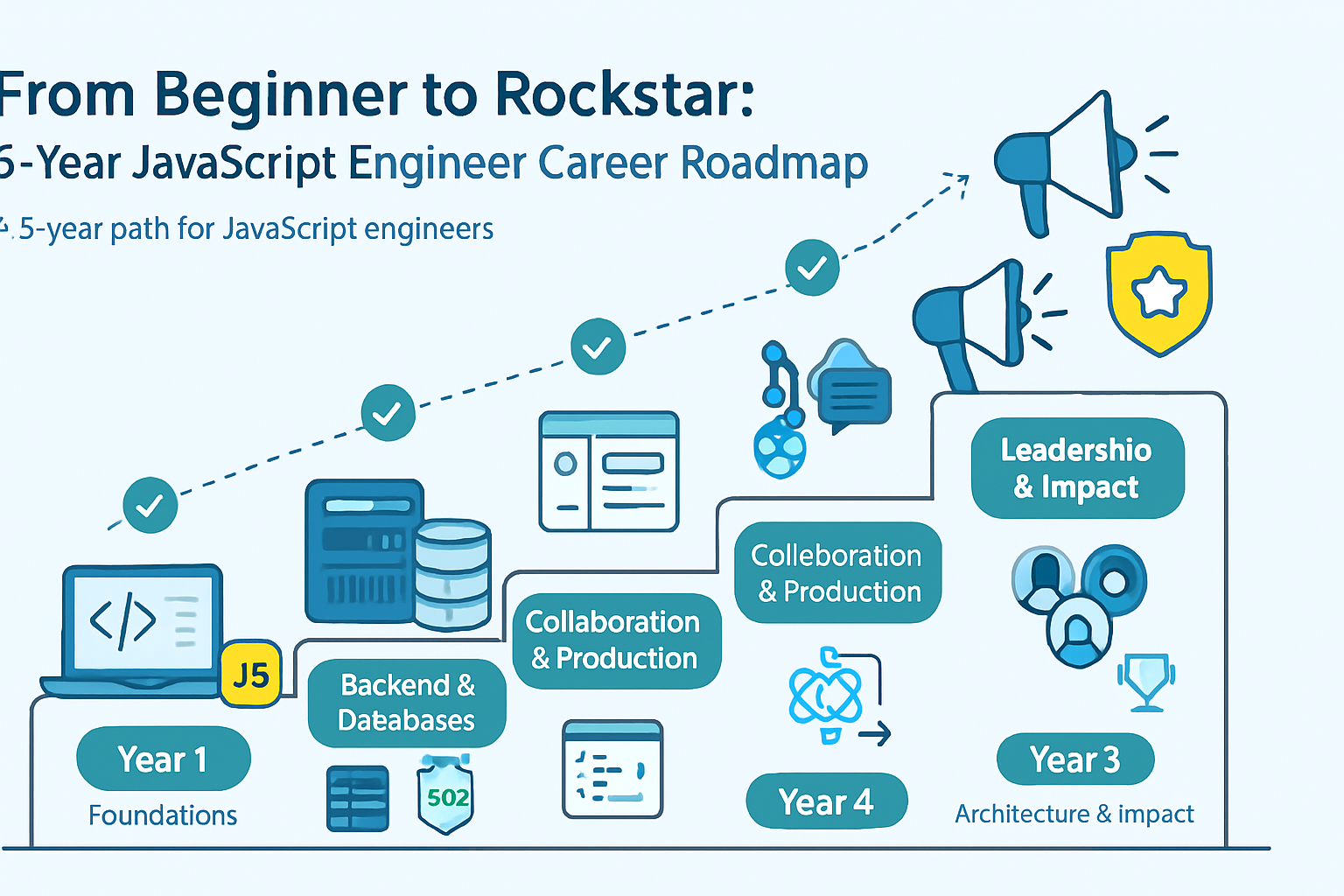
A prioritized learning strategy (what to learn first)
- JavaScript core: scoping, closures, prototypes,
this, async fundamentals - 30–60 days of focused practice. - Runtime and platform: event loop, DOM, Node basics - next 30 days.
- Tooling and testing: bundlers, transpilers, Jest/Playwright, linters - next 30 days.
- System design and performance: caching, memory leaks, profiling - next 30 days.
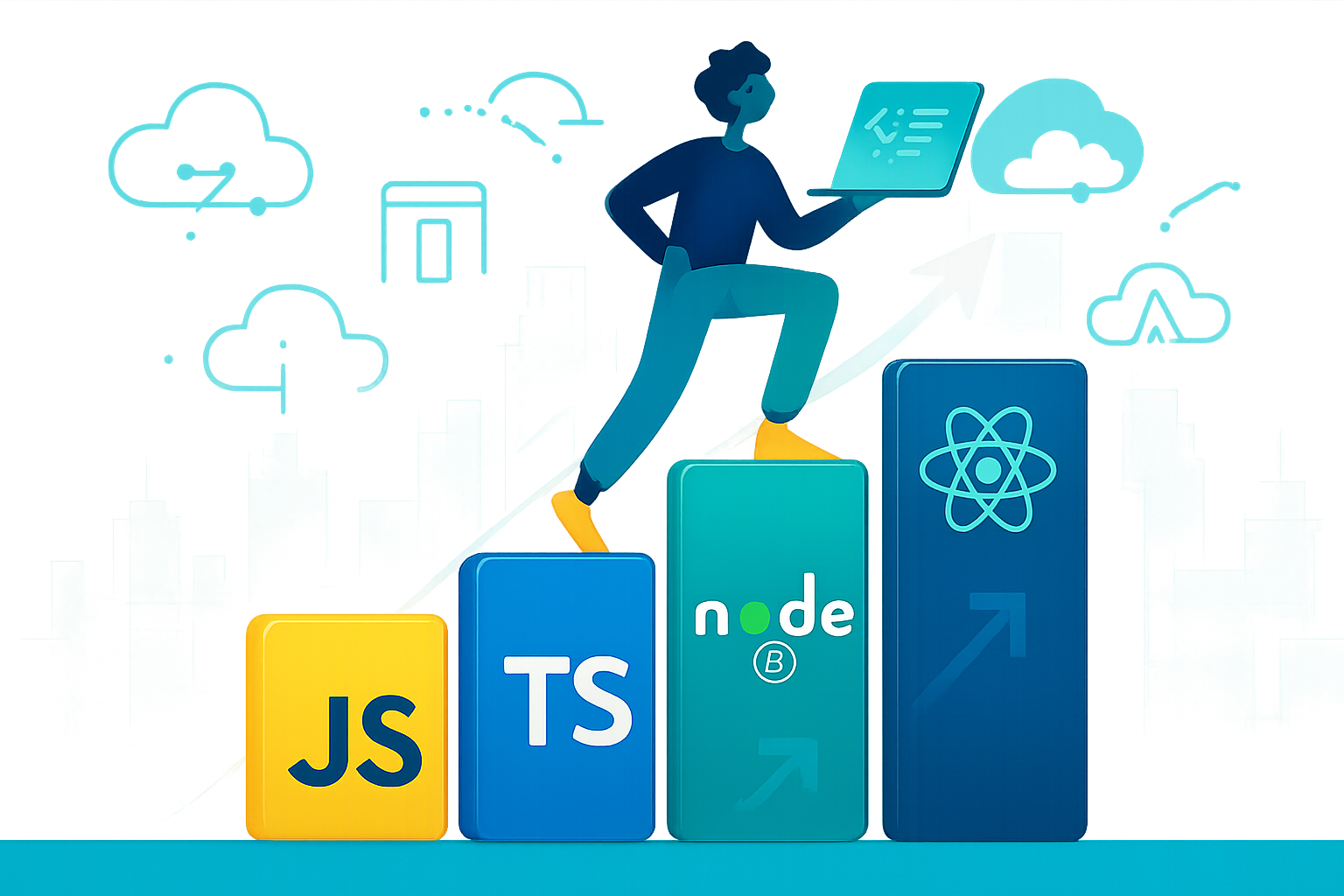
- One framework deeply: pick one (React, Vue, Svelte, Angular) and use it to build multiple real apps - months.
Do projects, not tutorials. Real constraints teach you trade-offs. Build an app you care about: a small e-commerce store, a collaborative note app, or a dashboard with real data.
A 90-day practical plan (sample)
- Week 1–4: Intensive JS fundamentals. Daily drills (30–60 minutes) + one small project (a to-do list with custom components, no framework).
- Week 5–8: Runtime and browser APIs. Add networking, localStorage, and service workers. Read articles and MDN references.
- Week 9–12: Tooling, testing, and one framework. Migrate your small project to the framework and write tests.
Keep a learning journal. Note what you broke and how you fixed it. That’s your evidence of growth.
How to stay current without being a trend-hopper
- Curate your sources: follow a handful of high-signal resources (MDN, State of JS reports, TC39 updates, official docs). Avoid endless Twitter/Reddit chasing.
- State of JS: https://stateofjs.com
- MDN: https://developer.mozilla.org/
- Use time-boxed experiments: allocate a weekly or monthly “explore” window (e.g., 4 hours/week or one weekend/month) to probe a new technology. Build something throwaway.
- Prioritize adoption criteria (see checklist below). If a framework passes the checklist, invest deeper.
- Focus on transferable knowledge: patterns, architecture, performance principles - these survive framework change.
- Keep one or two frameworks reasonably current, rather than ten superficially known.
A checklist: when to seriously adopt a new framework or library
Before committing to a rewrite or adding a dependency to production, ask:
- Does it solve a real, recurring problem we currently have?
- Is it stable and well-maintained? Check GitHub activity and release cadence.
- Is the ecosystem healthy? Are there testing, routing, and state management options? Are common integrations supported?
- Will it reduce long-term maintenance cost or increase it? Think migration effort.
- Can the team ramp up given current obligations? Who will champion training, code reviews, and architecture changes?
- Is there measurable performance or developer-productivity gain?
If you can’t answer these, treat the tech as experimental, not production-ready.
Building career capital: beyond technical knowledge
- Communication: explain design trade-offs, not only code. Write design docs. Teach others.
- Problem decomposition: practice breaking large features into small, testable pieces.
- Shipping and ownership: prioritize delivered value over “purity.” Employers prize people who finish.
- Mentoring and code reviews: these reveal and reinforce your depth.
These second-order skills multiply the impact of your technical foundation.
Practical habits that compound
- Read primary sources: official docs and specs. Secondary tutorials are fine but use them to reinforce not replace primary reading.
- Versioned learning: re-evaluate your knowledge every 6–12 months. Refresh fundamentals first.
- Contribute to open source: even small PRs show you how others structure code and communicate.
- Teach or write: explaining concepts will expose weak spots faster than reading alone.
Final checklist to stop sabotaging your career
- Stop collecting frameworks like trophies. Start collecting solved problems.
- Invest in language and runtime mastery before ecosystem breadth.
- Use small, time-boxed experiments to vet trends.
- Build and maintain a portfolio that highlights problem-solving, not just library names.
If you want a career that scales, let the fundamentals be your foundation and use new frameworks as tools - not as a resume strategy. Fundamentals compound. Trends do not.