· frameworks · 8 min read
Remix vs. Next.js: The Showdown - Which Framework Reigns Supreme in 2023?
A pragmatic, in-depth comparison of Remix and Next.js in 2023 - routing, data loading, rendering models, performance, DX, hosting, and real-world recommendations to help you pick the right framework for your next React project.
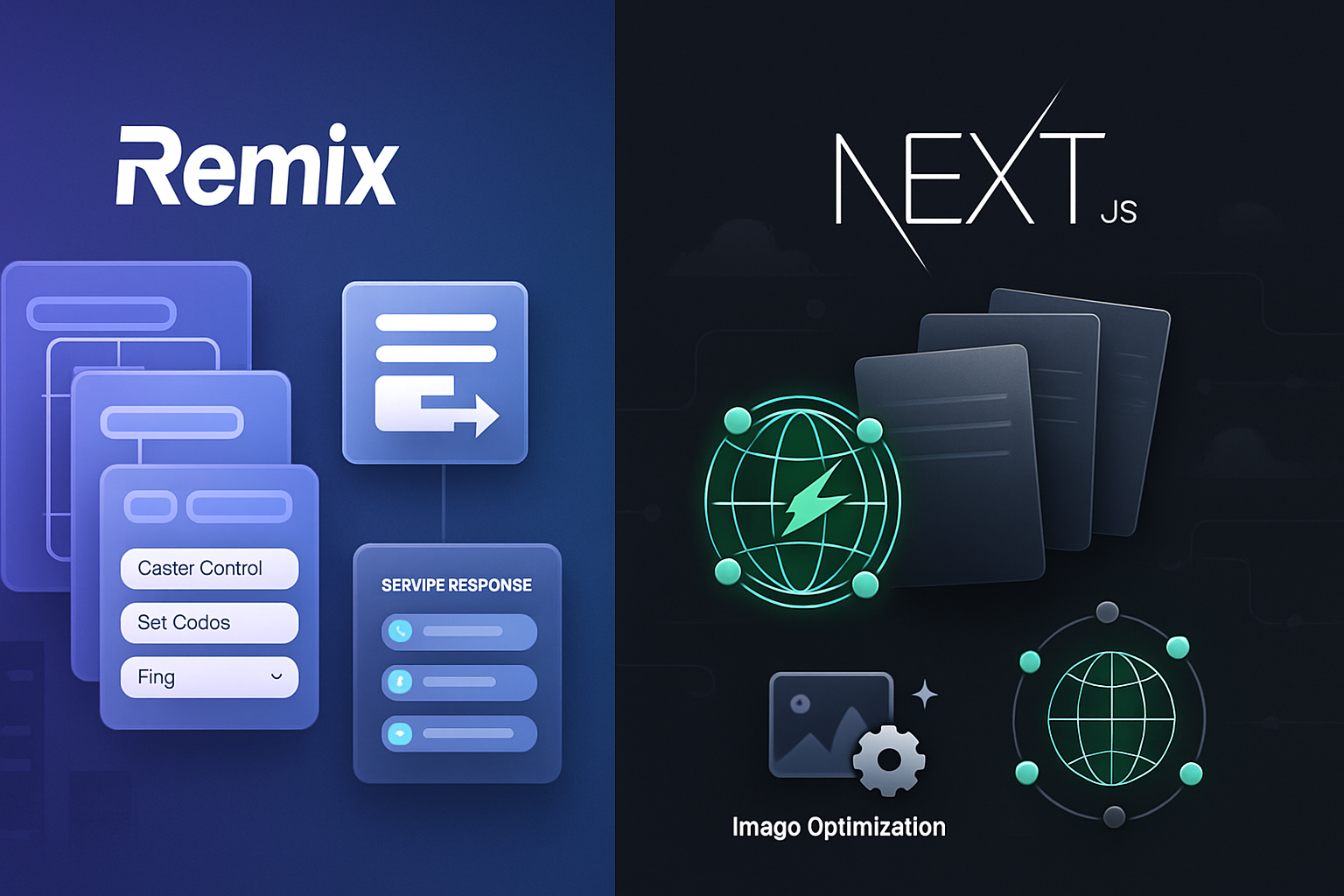
Outcome first: after reading this you’ll be able to pick between Remix and Next.js with confidence and justify that choice to your team.
You’ll know which framework moves faster for developer iterability. You’ll know which one gives you better control over caching, which one shines for server-driven UIs, and which one saves time when deploying to the edge. Simple. Practical. Actionable.
Quick summary - TL;DR
- Use Remix if you want a network-centric, form-friendly framework that treats the web’s HTTP semantics (caching, status codes, redirects, forms) as first-class citizens.
- Use Next.js if you want a flexible ecosystem with mature static generation, strong image/asset optimizations, robust edge and serverless options, and a large community and plugin ecosystem.
- Both are excellent. The right pick depends on priorities: control and predictable data flow (Remix) vs. broad ecosystem and feature breadth (Next.js).
Why this comparison matters
React is just the view layer. The framework you choose determines routing, data fetching, caching, deployment surface, and often the mental model for building apps. Those choices affect performance, DX (developer experience), and long-term maintenance.
This article walks through the core areas you care about: routing, data loading, rendering models, caching & performance, developer experience, ecosystem & deployment, and real-world recommendations.
Routing - file-based, nested, and predictable
Both Remix and Next.js use file-based routing, but they differ in philosophy and capabilities.
Remix
- Nested routes are a cornerstone. You build parent/child routes that each load their own data and render into shared layouts. That leads to small, focused loaders and declarative UI composition.
- Routing maps closely to the UI hierarchy, which makes it easier to reason about partial UI updates and progressive enhancement.
- Dynamic params and outlets feel natural; you compose routes instead of threading props down for partial updates.
Docs: https://remix.run/docs
Next.js
- Mature file-based routing with support for dynamic routes, nested folders, and optional catch-all routes.
- Historically, nested UI composition required layout patterns or third-party helpers. Since Next.js 13 (app router), nested layouts and server components are first-class, moving Next closer to Remix’s mental model.
- Two routing systems now exist (pages router and app router), which can be a source of complexity when upgrading.
Docs: https://nextjs.org/docs
Verdict on routing: If nested route-driven UIs are core to your app, Remix’s model is straightforward. Next.js app router narrows the gap but introduces multiple ways of doing things across versions.
Data loading and mutations - different mental models
Data fetching models often determine the mental overhead of a framework.
Remix
- Remix introduces
loaderfunctions for fetching data server-side for a route andactionfunctions for handling mutations (form submissions). These functions run on the server and return responses with HTTP semantics (status codes, headers). - This model encourages colocating data and UI; each route fetches exactly what it needs.
- Forms are a first-class citizen: progressive enhancement is easy because form submissions map naturally to
actionhandlers. - You control caching via response headers, so you get fine-grained cache control out of the box.
See: https://remix.run/docs/en/v1/guides/data-loading
Next.js
- Next.js has evolved several data strategies:
getStaticProps,getServerSideProps,getInitialProps(older), and the newapprouter with React Server Components and async server components that fetch data directly. - Mutations are typically handled via API routes or by calling remote APIs; there’s no built-in
actionequivalent that is as tightly coupled to forms as Remix’s approach. You can implement similar patterns, but it’s more manual. - The app router’s server components reduce client bundle size by moving fetching and rendering to the server, improving performance for many patterns.
Docs: https://nextjs.org/docs/pages
Verdict on data loading: Remix’s model is explicit and aligns with HTTP semantics, giving you predictable behavior for incrementally updating UI. Next.js’s options are more numerous and flexible - powerful, but with a steeper surface area and some fragmentation across versions.
Rendering modes, SSR, SSG, and streaming
Both frameworks support server-side rendering (SSR) and static site generation (SSG), but they make different trade-offs.
Next.js: Very strong SSG story with incremental static regeneration (ISR). Great for content-heavy sites that need fast static pages with occasional updates. Next also has well-developed streaming support and first-class Edge Runtime APIs for running on the edge.
Remix: Focuses on server rendering with strong streaming and progressive enhancement capabilities. Remix intentionally leans into server logic and lets you control caching and streaming for each route.
If you rely heavily on ISR or need the tight Vercel integration for static exports, Next.js has the edge. If you want semantics-first server rendering and precise cache control, Remix shines.
Caching, performance, and control
Remix treats HTTP caching and status codes as primitives. Each loader returns a response and you set cache headers directly. That makes predictable, efficient caching possible without a separate CDN strategy.
Next.js provides strong performance tooling (image optimization, automatic static optimization, ISR, revalidation windows). But caching behavior often depends on deployment (Vercel/CDN setup) and the route strategy you choose.
- Want fine-grained control over cache and conditional revalidation? Remix is more explicit.
- Want an out-of-the-box static-optimized pipeline with helpers like Image and built-in analytics? Next.js provides more batteries-included features.
Forms, mutations, and progressive enhancement
This is an area where Remix intentionally diverges from the SPA-first mindset.
- Remix: Forms are native. You can build fully enhanced HTML forms that work without JavaScript and then progressively enhance them - the framework’s
actionhandlers work naturally with this approach. - Next.js: Forms are commonly handled via client-side fetch calls or API routes. You can achieve the same behavior, but it requires more wiring.
If progressive enhancement and semantic forms matter to you (accessibility, resilience), Remix gives you a simpler path.
Developer Experience (DX)
DX is subjective, but here are the typical trade-offs developers report:
- Remix: Minimal conventions, clear mental model, fast feedback loop. The loader-action-router pattern is straightforward once learned. Good error boundaries per route and predictable behavior. Smaller community compared to Next, but highly focused.
- Next.js: Extensive features, many examples, massive community and third-party integrations. More “magic” in some areas (automatic routing, optimizations), which can speed up development - but can also become confusing across router versions.
Both frameworks have excellent TypeScript support. The learning curve for Remix can be short for devs who appreciate HTTP semantics; Next.js can be faster to start with if you rely on prebuilt components and integrations.
Ecosystem, community, and plugins
Next.js has a larger ecosystem. Many integrations, plugins, UI kits, and middleware target Next.js first because of its widespread adoption and Vercel backing.
Remix’s ecosystem is smaller but growing. The framework’s emphasis on web fundamentals means it composes well with many libraries. Because Remix is framework-light (fewer abstractions), it’s often easier to integrate with any backend or data layer you prefer.
If ecosystem and off-the-shelf plugins matter a lot, Next.js is the safer choice. If you prefer a modern, web-first framework with a focused core, Remix is compelling.
Deployment and hosting
- Next.js: Tight integration with Vercel, but runs on most platforms (Netlify, AWS, Cloudflare Workers via adapters). The app router introduced new edge-friendly runtimes.
- Remix: Designed to be runtime-agnostic - you can deploy to Vercel, Fly, Cloudflare Workers, Node servers, and more. Remix provides adapters and examples for many hosting targets.
If you plan to deploy to the edge (Cloudflare Workers, Fastly Compute), both frameworks can work; check current adapter support and runtime limitations (Edge Runtime differences in APIs).
Real-world scenarios - which to choose?
Content-driven marketing site with occasional updates, image-heavy pages, and strong CDN benefits: Next.js (SSG + ISR + Image optimizations) is likely faster to implement and scale.
Complex SaaS app with nested UI, many forms, and need for precise caching and HTTP semantics: Remix will reduce cognitive load around actions/loaders and caching rules.
Team with invested Next.js expertise, Vercel infrastructure, and many third-party plugins: Stick to Next.js for speed of delivery and ecosystem benefits.
Product that must work well without JavaScript (search engine crawlers, no-JS devices) and needs robust progressive enhancement: Remix makes that pattern natural.
Migration and long-term maintenance
- Next.js: Because of its popularity, hiring developers with Next experience is typically easier. Upgrading between major versions can require effort (especially moving from pages to app router), but many resources exist.
- Remix: Smaller talent pool than Next, but the API surface is small and stable. Fewer ways to do the same thing can mean less maintenance mental load.
Cost considerations
Frameworks themselves are open source; costs come from hosting and architecture choices. Next.js apps that rely on ISR and serverless functions can incur request costs. Remix’s server-driven model can be cost-effective when deployed to a persistent server or compute platform, but edge deployments might be more expensive depending on provider.
Security and error handling
Both frameworks encourage server-side logic and therefore enable you to centralize validation and authentication. Remix’s route-level actions simplify centralizing form validation. Next.js provides similar capabilities via API routes or by using server components and middleware.
Error boundaries are explicit in Remix per route; Next.js offers error pages and boundaries too, with differences across router APIs.
Final decision guide - practical checklist
Pick Remix if:
- You want explicit, predictable data loading via loaders/actions.
- Your app benefits from nested routes and partial UI updates.
- You want first-class support for progressive enhancement and resilient forms.
- Fine-grained HTTP caching and status control are important.
Pick Next.js if:
- You need a mature ecosystem, lots of plugins, and Vercel-first features.
- You rely heavily on static generation and image optimizations out of the box.
- Your team already has Next.js experience and you need rapid onboarding.
- You want flexible deployment options with built-in ISR and edge functions.
Closing thoughts
Both Remix and Next.js are modern, capable frameworks that will serve most React apps well. The choice isn’t about “which is objectively better” - it’s about trade-offs.
Remix rewards you with predictability, HTTP-first thinking, and elegant nested routing. Next.js rewards you with breadth: a large ecosystem, mature tooling for static sites, and deep Vercel integration.
Pick the tool that matches your app’s priorities. If you want control and semantics, choose Remix. If you want ecosystem and out-of-the-box optimizations, choose Next.js. Either way, you’ll be building on a solid foundation.
References
- Remix docs: https://remix.run/docs
- Next.js docs: https://nextjs.org/docs
- Vercel (platform & blog): https://vercel.com/blog