· career · 7 min read
The Full-Stack Myth: Why Being a JavaScript Engineer Doesn’t Mean You Have to Do It All
Being labeled a “full-stack” JavaScript engineer doesn't mean you must personally own every layer. This post explains why specialization matters, how to collaborate with backend teams effectively, and practical patterns that let you ship quickly without stretching yourself thin.
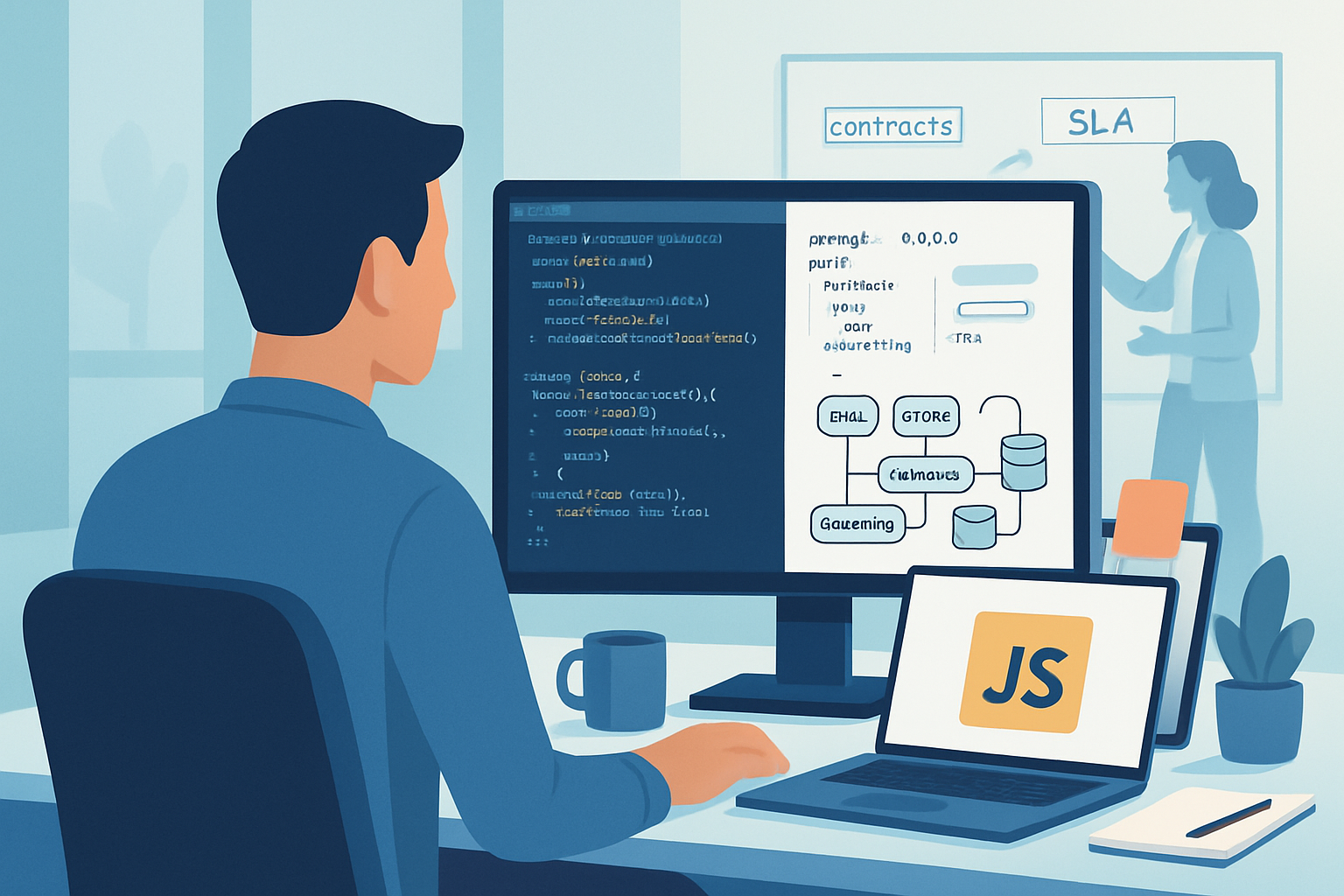
Outcome first: by the time you finish this piece you’ll know how to stop treating “full‑stack” as a job description that forces you to do everything, and instead make it a set of collaboration skills that let you deliver better products faster.
Why read this? Because you can stay in JavaScript, keep owning the parts you do best, and still move fast on features - with less stress, fewer regressions, and healthier teams.
The myth, stated plainly
People say “full‑stack” and imagine a single engineer who controls UI, client logic, servers, databases, infra, monitoring, CI/CD and sometimes mobile. The implication: to be a modern JavaScript developer you must master all of those. That’s the Full‑Stack Myth.
Short truth: full‑stack means awareness and capability, not complete ownership. You can be a strong JavaScript engineer - focused on frontend or runtime JavaScript (Node) - without being the systems engineer, DBA, security specialist, and SRE all at once.
Why the myth persists
- Buzz and job listings. Companies want versatile hires and use “full‑stack” as shorthand for “flexible.”
- Tooling convergence. Frameworks like Next.js, Node, and serverless blur lines. One repo can contain client, server, and infra. Easy to conflate breadth with required ownership.
- Small teams. Early-stage startups often need generalists who do many things. The expectation becomes a cultural norm.
But the presence of an overlap doesn’t make total ownership the right approach in larger teams or complex domains.
Why trying to do it all is harmful
- Surface‑level coverage. Shallow knowledge across layers leads to fragile systems and slower debugging when deep expertise is needed.
- Cognitive load and burnout. Context switching between UX details, database schemas, deployment pipelines and observability kills focus.
- Slower delivery. When one person is the gatekeeper for many responsibilities, they become a bottleneck.
- Hidden technical debt. Quick fixes outside your zone of expertise often create long‑term pain.
Depth matters. A focused engineer who ships high‑quality UI and client logic, or a backend engineer who owns reliable APIs, will achieve more for users than an exhausted person trying to do both imperfectly.
Specialization without silos: the pragmatic middle path
Specialize. Collaborate. Own outcomes.
- Specialize: pick primary areas (frontend, Node services, platform, data) and be excellent in them.
- Collaborate: build clear contracts and workflows with other specialists so your boundaries are reliable.
- Own outcomes: don’t abdicate responsibility. Even if you don’t manage the DB, ensure your feature works end‑to‑end in production.
This model keeps velocity and quality high while allowing engineers to deepen skills and avoid burnout.
Practical ways JavaScript engineers can collaborate with backend teams
Below are pragmatic patterns and practices that let frontend‑oriented JavaScript engineers work effectively with backend teams - without needing to become database admins.
1) API contract first: make the contract the shared source of truth
Specify APIs in OpenAPI (Swagger) for REST or in GraphQL schema for GraphQL. Contracts reduce ambiguity and enable parallel work.
- OpenAPI: https://swagger.io/specification/ - defines endpoints, request/response shapes, status codes, and examples.
- GraphQL: https://graphql.org/ - schema-first designs the shape of data clients can request.
Example: a tiny OpenAPI snippet (simplified)
openapi: 3.0.0
paths:
  /orders:
    get:
      summary: List orders for a user
      responses:
        '200':
          description: OK
          content:
            application/json:
              schema:
                type: array
                items:
                  $ref: '#/components/schemas/Order'
components:
  schemas:
    Order:
      type: object
      properties:
        id:
          type: string
        total:
          type: number
Contracts let frontend engineers mock responses and start integration tests before the backend is production‑ready.
2) Use API mocking and local backends
If the backend isn’t ready or is highly volatile, mock it. Tools and strategies:
- Mock servers from OpenAPI or GraphQL schemas.
- MSW (Mock Service Worker) for frontend tests and development.
- Lightweight local backends: a small Node express server or serverless emulator.
Mocking accelerates UI development and keeps CI fast.
3) Consumer‑driven contracts and contract testing
Consumer‑driven contracts (CDC) let clients define expectations. The backend runs verification so changes don’t break consumers.
- Pact: a popular CDC tool set - https://docs.pact.io/
Workflow: frontend writes consumer expectations -> backend runs verification tests -> CI fails if API changes break the consumer contract.
4) Agree on versioning and evolution rules
Define API lifecycle rules: how to add fields, deprecate endpoints, and remove behavior. Good rules prevent explosions of client work.
- Additive, non‑breaking changes by default.
- Decorate with feature flags for behavioral changes.
- Deprecation windows and clear migration docs.
5) Error contracts and client ergonomics
API design shouldn’t be just data shapes. Define error formats, retry hints, and status semantics. A predictable error contract makes frontend logic cleaner and safer:
- Use structured error bodies with codes.
- Include machine‑readable retry-after or idempotency hints.
Example JSON error body:
{
  "error": {
    "code": "CARD_DECLINED",
    "message": "Card declined by issuer",
    "retryable": false
  }
}
6) Shared observability and SLAs
Agree on monitoring and SLOs for critical user flows. If the login API is flaky, the frontend team should be first to know.
- Shared dashboards, trace IDs in logs, and propagation of correlation IDs across requests.
- Use OpenTelemetry or similar to instrument cross‑service traces.
7) Security and auth responsibilities
Define where authentication and authorization logic lives. Who validates tokens? Who enforces scopes?
Common patterns:
- Frontend handles presentation; backend enforces access control.
- Auth tokens (JWT) issued by auth service; backend validates and checks permissions.
Document exact failure modes so the UI can surface helpful messages to users rather than generic errors.
8) Development ergonomics and deployments
Shared CI pipelines and preview environments cut friction. Some recommended practices:
- Feature branches deploy to preview environments automatically.
- Frontend can consume preview backend instances via stable URLs or API gateways.
- Local tooling (Docker Compose, lightweight mocking) that reproduces production contracts.
9) Define ownership, not heroics
Document who is the primary owner for each layer and feature. But also define a “who to ping” map for when things go wrong.
Ownership should be about responsibility and communication, not rigid gatekeeping.
Communication: concrete phrases and rituals that work
- “I’ll mock this endpoint and open a PR for contract tests.” - shows initiative and keeps backend aware.
- “We need a deprecation window for removing field X; can we align on dates?” - pushes for stability.
- “When this error happens, what should the UI display?” - aligns UX with backend semantics.
Rituals:
- Weekly API syncs for teams working on dependent services.
- API changelog PRs and a lightweight review checklist (backwards compatibility, docs, telemetry).
When (and how) to expand your stack responsibilities
You might want to broaden your scope. Do it deliberately:
- Start with a small, well‑bounded area (e.g., caching layer, background jobs for a feature).
- Pair with an owner from the other discipline for a few weeks.
- Add automated tests and runbooks so knowledge scales.
Learning is great; forced ownership of everything is not.
Career framing: full‑stack as a branding choice, not an expectation trap
- If you love breadth: seek roles that value generalists (early startups, infrastructure teams, platform engineering with broad remit).
- If you want depth: be explicit. Market yourself as a Senior Frontend or JavaScript Performance Engineer. Companies will pay for deep expertise.
- If you want both: be a T‑shaped engineer - deep in one area, horizontal awareness across others.
Your career progress will be faster if you can show impact: shipped features, reduced outages, improved metrics - not a long list of technologies used once.
Tooling cheat‑list (quick references)
- OpenAPI / Swagger - https://swagger.io/specification/
- GraphQL - https://graphql.org/
- Pact (consumer‑driven contract testing) - https://docs.pact.io/
- Mock Service Worker (MSW) - https://mswjs.io/
- Twelve‑Factor App (deployment and config practices) - https://12factor.net/
- MDN Web Docs (JavaScript fundamentals) - https://developer.mozilla.org/en-US/docs/Web/JavaScript
Final note: stop measuring value by the number of layers you touch
Teams win when responsibilities map to outcomes, not to titles or buzzwords. Specialization reduces risk. Contracts and collaboration reduce friction. Together they let you ship faster and sleep better.
You don’t need to do everything. Be excellent where you add the most value, and build contracts that make everyone else excellent too. A focused JavaScript engineer who drives clear APIs, reliable UX, and resilient client code will always beat a lone “full‑stack” hero trying to hold the whole system together.