· career · 6 min read
The Coding Challenge Dilemma: Preparing for Realistic Scenarios vs. Theoretical Problems
A practical guide to balancing algorithmic puzzles and real-world engineering. Learn why both matter, what most interview training misses, and a concrete plan + resources to prepare for the messy reality of production code.

What you’ll get from this article
You’ll leave with a clear understanding of why algorithm puzzles and real-world problems feel so different, a practical plan to prepare for both, and a curated list of resources you can start using today to close the gap between interview practice and production work.
Short outcome. Big impact.
The dilemma in one line
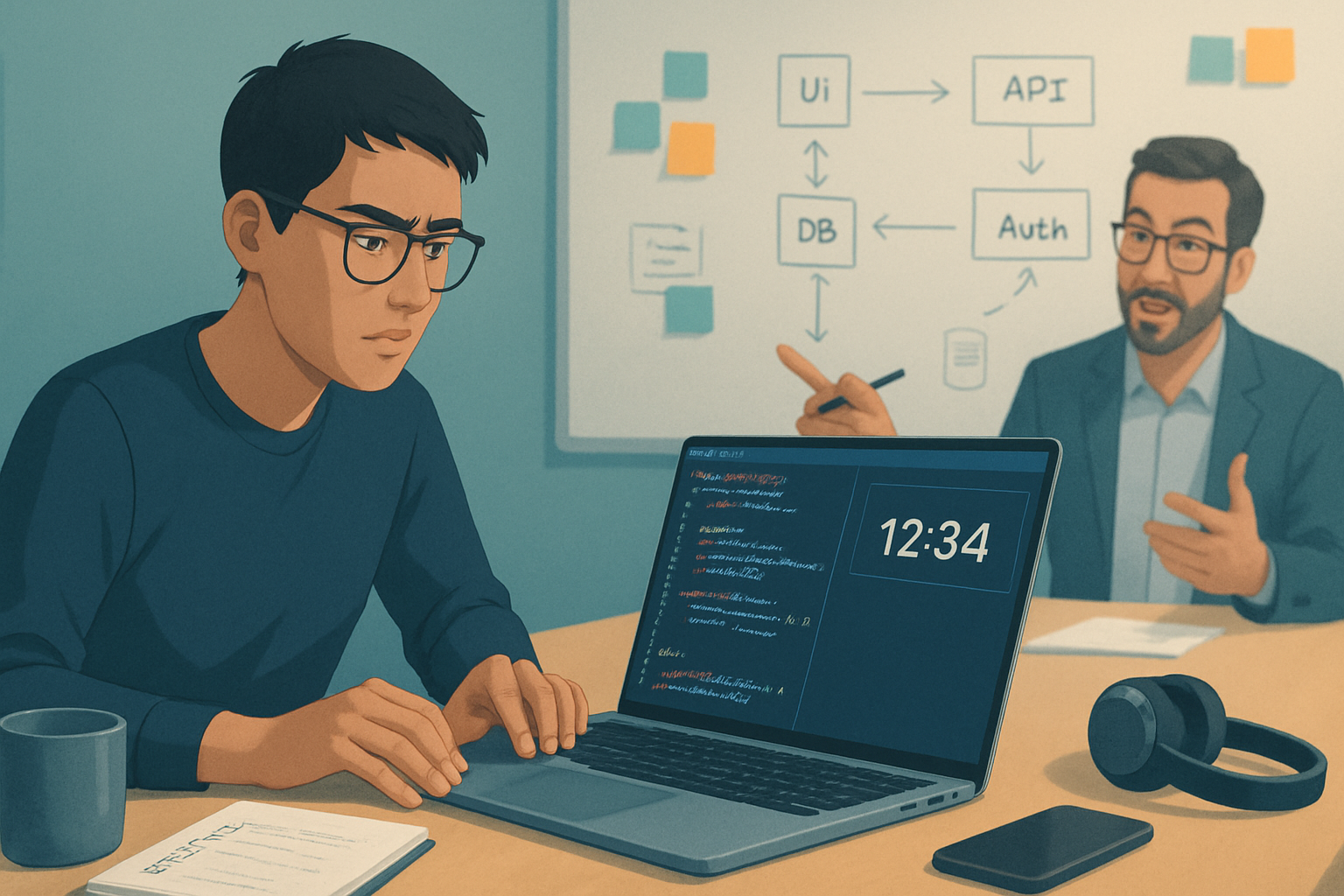
Algorithmic problems test problem-solving under idealized conditions. Real-world engineering tests communication, trade-offs, context, and the ability to ship. Both matter - but they require different muscles.
Where theory and practice diverge
Here are the main differences that make a coding-challenge feel like a different sport from day-to-day engineering:
Problem scope and constraints
- Theoretical: small, well-defined, single-function inputs and outputs.
- Real-world: ambiguous requirements, multiple stakeholders, and non-functional constraints (scalability, latency, reliability).
Code lifetime
- Theoretical: correctness for one run is enough.
- Real-world: code must be maintainable, testable, and evolve over months or years.
Environment and tooling
- Theoretical: local function, sometimes a single file.
- Real-world: build systems, CI/CD, databases, infra, containers, cloud providers.
Collaboration
- Theoretical: solo exercise.
- Real-world: peer reviews, design meetings, and cross-team dependencies.
Observability and debugging
- Theoretical: you see test failures immediately.
- Real-world: you diagnose from logs, metrics, traces, and user reports.
Non-functional priorities
- Theoretical: asymptotic complexity matters.
- Real-world: reliability, operability, security, and cost often matter more than a theoretical O(log n).
Why algorithmic practice still matters
Don’t throw out your LeetCode account. Here’s what puzzles strengthen:
- Problem breakdown and modeling. Puzzles teach decomposition and pattern recognition.
- Complexity awareness. Knowing what is O(n) vs O(n^2) helps when constraints scale.
- Edge-case hygiene. Good for thinking through boundary conditions.
Algorithms are foundational. But they’re only one part of professional readiness.
Why practicing real-world scenarios is crucial
If you train only on puzzles you’ll be surprised by day-one engineering tasks. Real-world practice builds different, essential skills:
- System thinking: how components interact and fail.
- Communication: how to write a clear design doc, explain trade-offs, and negotiate scope.
- Maintainability: writing tests, documenting, and anticipating future changes.
- Operability: monitoring, alerting, and responding to incidents.
- Pragmatism: making trade-offs when ideal algorithms or unlimited time aren’t available.
Companies hire engineers who can ship safe, maintainable features under constraints - not just those who can memorize solutions.
How to practice realistic coding (practical techniques)
Below are concrete activities you can adopt today. Mix and match them with algorithm practice.
Build end-to-end features
- Pick a small product idea (e.g., URL shortener, notes app, simple message queue). Ship it. Include persistence, auth, and a basic UI or API.
- Focus on deployability: automated tests, CI pipeline, and a deployment target (Heroku, Vercel, or a simple Docker image).
Work with legacy code
- Read an unfamiliar repository and try to add a small feature or fix a bug.
- Practice making minimal, well-tested changes and opening a clean pull request.
Write production-style tests
- Unit tests, integration tests, and a couple of end-to-end tests.
- Add fixtures, mocks, and a test matrix for environments where appropriate.
Add observability
- Add meaningful logs, metrics (request counts, latencies), and a basic healthcheck.
- Simulate a failure and use logs/metrics to diagnose.
Do design and trade-off exercises
- Write a one-page design doc for a feature (goals, non-goals, API sketch, data model, capacity estimates, failure modes).
- Review and iterate with a peer where possible.
Practice debugging sessions
- Given a failing service (your own small app), reproduce the bug, bisect if necessary, and fix it with a minimal patch.
Pair program and code review
- Pair on a feature for a few sessions to practice live communication and joint ownership.
- Volunteer to review code. Practice giving and receiving constructive feedback.
Simulate time and resource constraints
- Timebox feature work and practice shipping a minimal, safe version first.
- Use an intentionally limited stack (e.g., no external caches) and design within those constraints.
How to bring these practices into interview prep
Companies vary. Some emphasize algorithms; others want system or product skills. Here’s how to prepare strategically:
- Identify the role and company profile. Apply more algorithms if the role is platform/infra-focused; emphasize systems and product if you’ll own services.
- Prepare for multiple formats: whiteboard puzzles, pair-programming live sessions, take-home projects, and system design interviews.
- For take-home projects: treat them as real code. Write tests, a README, and clear deployment instructions. The extra polish matters.
- For pair-programming: practice thinking aloud, asking clarifying questions, and making small iterative progress.
- For system design: practice end-to-end diagrams, sizing, data models, and failure modes. Be explicit about trade-offs.
An 8-week balanced study plan (sample)
Aim: be interview-ready across algorithms and real-world engineering.
Week 1–2: Fundamentals and setup
- Daily: 45–60 minutes of algorithm practice (easy/medium problems).
- Build: scaffold a small web API and deploy it once.
Week 3–4: Tests, CI, and feature delivery
- Add unit and integration tests to your project.
- Set up CI and simple deployment pipeline.
- Weekend: contribute a small fix to an open-source project or a friend’s repo.
Week 5–6: Observability and debugging
- Add logging and metrics.
- Run a fault-injection exercise: bring a dependency down and recover.
- Practice debugging two real bugs from your project.
Week 7: System design and take-home prep
- Write two short design docs.
- Implement a small take-home-style feature under a timebox.
Week 8: Mock interviews and review
- Do 2–3 timed mock interviews: one algorithm, one pair-programming, one design review.
- Iterate on weak areas.
Adjust pacing for full-time engineers or students. The key is steady, mixed practice.
Practical micro-exercises you can do in a day
- Convert a single-function coding challenge into an HTTP endpoint that validates inputs and logs requests.
- Take a GitHub project labeled “help-wanted” and fix a bug or add a unit test.
- Given a small dataset, prototype an API that paginates and caches responses; measure latency before/after cache.
- Read a failing test and fix it without running the whole test suite (practice local fast feedback).
Tools and resources
Algorithm practice
- LeetCode - https://leetcode.com/ (great for pattern practice and timed contests)
- HackerRank - https://www.hackerrank.com/
Real-world practice platforms
- Exercism - https://exercism.org/ (mentored code practice with feedback)
- Frontend Mentor - https://www.frontendmentor.io/ (deliverable-driven front-end projects)
- Open Source issues: Up For Grabs - https://up-for-grabs.net/ and First Timers Only - https://www.firsttimersonly.com/
Pairing / mock interviews
- Pramp - https://www.pramp.com/
- interviewing.io - https://interviewing.io/
System design and architecture
- System Design Primer (GitHub) - https://github.com/donnemartin/system-design-primer
- “Designing Data-Intensive Applications” by Martin Kleppmann - https://dataintensive.net/
Engineering craft
- “Clean Code” by Robert C. Martin - https://www.pearson.com/us/higher-education/program/Robert-C-Martin-Clean-Code-A-Handbook-of-Agile-Software-Craftsmanship/PGM77655.html
- “The Pragmatic Programmer” - https://pragprog.com/titles/tpp20/the-pragmatic-programmer-20th-anniversary-edition/
DevOps, observability, and infra
- Docker docs - https://docs.docker.com/
- CI/CD with GitHub Actions - https://docs.github.com/actions
- Prometheus for metrics - https://prometheus.io/
Practice take-homes & project ideas
- Build an opinionated notes service (auth, API, sync, search).
- Implement a mini job-queue with retries and backoff.
- Create a small analytics pipeline ingesting events and writing aggregates to a DB.
Common pitfalls and how to avoid them
- Pitfall: Practicing only puzzles. Fix: Add one production-style task per week.
- Pitfall: Over-optimizing contrived solutions. Fix: Favor readability and tests in take-homes.
- Pitfall: Ignoring communication. Fix: Record yourself explaining design decisions and review for clarity.
How hiring teams can help bridge the gap
If you’re hiring, give candidates at least one realistic exercise: a short take-home, a paired session with a real problem from your backlog (sanitized), and a code-review conversation. That reveals quality that puzzles can’t.
Final checklist before your next interview or production task
- Can you explain the trade-offs of your approach in one paragraph?
- Have you written at least one test and a README for any sample project you might show?
- Can you demonstrate a simple observability story for your app (a log and a metric)?
- Have you practiced a short, structured design doc and walked it through with a peer?
Do these four things and you’ll signal that you can not only solve the problem, but also own it.
Closing thought
Algorithm puzzles sharpen your mind. Real engineering tests your judgement, communication, and craft. Train both. Build systems, write tests, ship features - and practice puzzles to keep your problem-solving blade sharp. Together they make you the engineer companies actually need: someone who can think deeply and ship reliably under real constraints.