· frameworks · 7 min read
Breaking the Mold: How to Use Remix for Non-Traditional Applications
Explore unconventional ways to use Remix - from real‑time dashboards and multiplayer games to edge‑native, desktop, and IoT apps - with architecture patterns, code snippets, and practical tradeoffs.
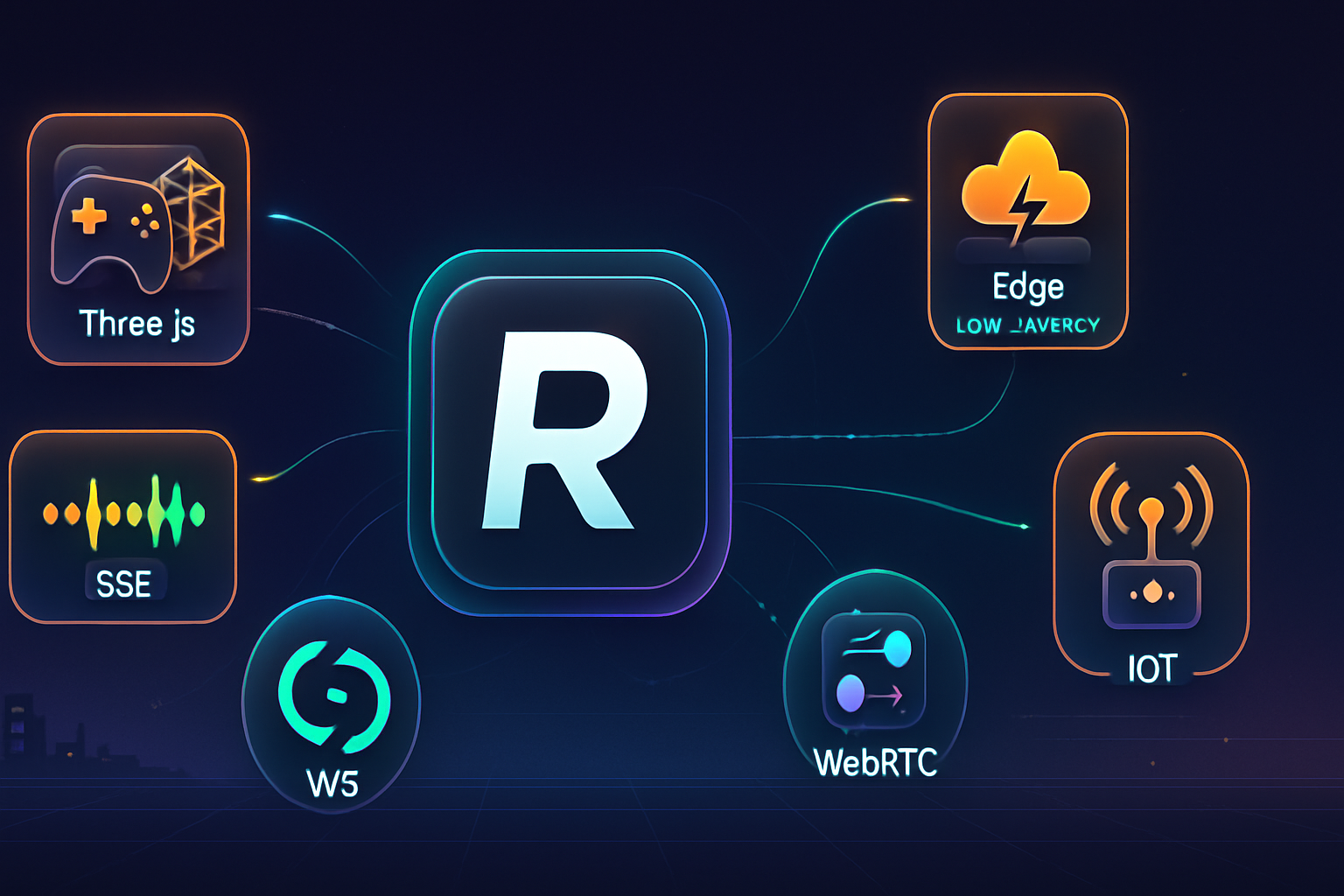
Outcome first: by the end of this post you’ll know how to use Remix as the control plane for real‑time systems, a shell for game UIs, a signaling server for WebRTC, and a delivery layer for edge‑native apps - not just a typical CRUD web app.
Why Remix? Because it gives you a predictable routing model, strong data loading primitives (loaders, actions, and fetchers), streaming-friendly responses, and a progressive enhancement approach that plays nicely with client‑side real‑time techniques. Use those strengths as building blocks, and Remix becomes a platform for many non‑traditional applications.
What makes Remix useful outside classic web apps
- Predictable routes backed by loaders and actions - perfect for small, focused control endpoints (matchmaking, signaling, telemetry ingest).
- Built‑in form handling and fetchers for optimistic UX and discrete mutation endpoints.
- Streaming responses and the ability to return custom Response objects - critical for SSE and streaming assets.
- A server/edge surface you control, so you can host WebSocket endpoints, WebRTC signaling, or bridge to pub/sub systems.
Together, these let you keep server‑authoritative logic near your UI, while delegating low‑latency transports to purpose‑built layers.
Use case: Real‑time dashboards and collaboration
Outcome: low‑latency live data, collaborative cursors, presence indicators, and conflict‑resistant updates.
Two common transports:
- Server‑Sent Events (SSE) for simple, one‑way updates (server → client).
- WebSockets for full‑duplex, bi‑directional real‑time.
SSE is easy to implement within a Remix route because you can return a streaming Response. WebSockets often require a separate server/worker layer (or a platform that supports upgrades), but Remix routes are excellent for serving auth and negotiating socket tokens.
Example: SSE route (server)
// app/routes/telemetry.stream.server.jsx (Node/Cloud platform that supports streaming)
import { json } from '@remix-run/node';

export const loader = async ({ request }) => {
  // Set up a ReadableStream that periodically pushes events.
  const stream = new ReadableStream({
    start(controller) {
      const encoder = new TextEncoder();
      const interval = setInterval(() => {
        const data = JSON.stringify({ t: Date.now(), value: Math.random() });
        controller.enqueue(encoder.encode(`data: ${data}\n\n`));
      }, 1000);
      // cleanup when closed
      return () => clearInterval(interval);
    },
  });

  return new Response(stream, {
    headers: {
      'Content-Type': 'text/event-stream',
      'Cache-Control': 'no-cache',
    },
  });
};
Client consumption is straightforward with EventSource:
const es = new EventSource('/telemetry.stream');
es.onmessage = e => {
  const payload = JSON.parse(e.data);
  // update UI
};
For bi‑directional needs, use WebSockets (or a managed real‑time product). Use Remix to authenticate and return a short‑lived socket token, then connect the client to the WebSocket server (same host or a separate real‑time service).
Reference: MDN’s SSE guide: https://developer.mozilla.org/en-US/docs/Web/API/Server-sent_events/Using_server-sent_events
Use case: Multiplayer and game UIs
Outcome: a Remix shell delivers the UI, assets, and matchmaking, while game loops and latency‑sensitive syncing happen in specialized layers.
Pattern:
- Use Remix routes to serve the game’s session page, assets, and configuration.
- Use a dedicated real‑time server (WebSocket server, UDP game server, or WebRTC data channels) for fast state updates and physics.
- Use Remix as the signaling server for WebRTC (peer discovery and exchange of SDP/ICE), and as a fallback UI for pages and leaderboards.
Why split responsibilities? The game loop typically requires very low jitter and optimized binary protocols. Remix excels at the management plane: routing, auth, matchmaking, leaderboards, and the in‑browser UI where Three.js or WebGL does the rendering.
Practical tips:
- Render heavy graphics with Three.js or WebGPU on the client. Remix stays responsible for levels, saved state, and social features.
- Offload deterministic server logic to a native/compiled service - e.g., Rust-based authoritative server or WebAssembly module running on the server or in a worker.
- Use Redis or a real‑time pub/sub (e.g., NATS, Ably, Supabase Realtime) for presence and quick fan‑out.
Three.js: https://threejs.org
Use case: Signaling and peer connections (WebRTC)
Outcome: low‑latency, peer‑to‑peer streams for voice/video/data with Remix handling signaling and ICE relay coordination.
Remix is a great place to host small JSON endpoints that accept SDP offers and return answers - the signaling layer. Because these endpoints are short‑lived and transactional, they fit the loader/action model well.
A minimal signaling flow:
- Client A POSTs an SDP offer to /signaling/session
- Server (Remix route) stores the offer (or forwards to the target) and returns a session ID
- Client B fetches the offer, creates an answer, and POSTs it back
- Remix notifies Client A (via SSE/WebSocket) or Client A polls for the answer
Reference: WebRTC basics: https://developer.mozilla.org/en-US/docs/Web/API/WebRTC_API
Use case: Edge‑first and low‑latency apps
Outcome: push compute and caching to the edge, using Remix for routing and as an API gateway.
Edge platforms (Cloudflare Workers, Fly, Vercel Edge Functions) let you run Remix at minimal network distance from users. But be aware of limits:
- Some edge runtimes restrict long‑lived TCP connections or WebSocket upgrades. Use platform features (e.g., Cloudflare Durable Objects or Workers + WebSocket support) to manage connections.
- Push compute to the edge for personalizing pages, and keep heavy, long‑running sessions in specialized backends.
Cloudflare Workers: https://developers.cloudflare.com/workers/ Cloudflare Durable Objects (for presence/state): https://developers.cloudflare.com/workers/learning/using-durable-objects
Use case: Desktop and embedded UIs (Electron / Tauri)
Outcome: build a desktop app that uses Remix as the renderer and route manager.
Remix can run inside Electron or Tauri: use it as a local server that drives the UI. Advantages:
- Use the same routes and loaders/actions for both web and desktop.
- Integrate native capabilities (file system, serial/USB, Bluetooth) through the desktop runtime.
Tauri (Rust) is particularly attractive because it produces smaller binaries and provides secure APIs for hardware access.
Tauri: https://tauri.app Electron: https://www.electronjs.org
Use case: IoT control planes and telemetry
Outcome: the device fleet reports telemetry to a Remix endpoint; the same app serves dashboards and control commands.
Patterns:
- Devices publish to MQTT (lightweight, efficient). Bridge MQTT → HTTP via a small worker or edge function that exposes authenticated REST endpoints for management and a pub/sub layer for live UI updates.
- Use SSE or WebSockets to stream telemetry to the dashboard.
- Keep binary protocols on the device side; use JSON for admin/control over Remix APIs.
When devices are many, offload high‑frequency ingest to specialized ingestion pipelines (Kafka, Kinesis) and use Remix for control and aggregated views.
Patterns and architecture recommendations
- Keep authoritative state in a single place (a database or Durable Object) - don’t rely on in‑memory state in a single Remix process unless you’re building a single‑instance app.
- Use pub/sub (Redis, NATS, Kafka) to fan‑out events to many consumers.
- Use optimistic UI via Remix fetchers and transitions for fast, responsive UX.
- For multiplayer or high‑frequency updates, use binary protocols or WebRTC data channels; use JSON for lower‑frequency sync.
- Secure your channels with short‑lived tokens and origin checks. Never trust raw client input.
Practical code patterns
- Using Remix fetchers for an optimistic update
// client component
import { useFetcher } from '@remix-run/react';

export default function LikeButton({ postId, liked }) {
  const fetcher = useFetcher();
  const current = liked;
  return (
    <fetcher.Form method="post" action={`/posts/${postId}/like`}>
      <button type="submit">{current ? '❤️' : '🤍'}</button>
    </fetcher.Form>
  );
}
Remix actions handle the authoritative mutation and you can immediately update UI with client state while the action completes.
- Minimal WebSocket setup (server + client pattern)
- Server: run a dedicated WebSocket server alongside your Remix app. Use cookies or JWTs issued by Remix to authenticate socket connections.
- Client: connect, then use messages to sync fast updates; use Remix fetchers for durable commits.
- Using WebAssembly for heavy compute
- Compile physics or simulation code to WASM. Run it in the browser or on the server (Node or a worker that supports WASM). Remix provides the UI and session management.
Reference for WASM: https://developer.mozilla.org/en-US/docs/WebAssembly
Pitfalls and tradeoffs
- Long‑lived connections are hard to scale on serverless platforms. Know your host’s limits.
- Real‑time systems require careful monitoring for backpressure, memory leaks, and message storms.
- Debugging distribution (clients + edge + backend) requires observability: logs, traces, and metrics.
- Avoid mixing too many responsibilities into Remix: it’s the glue, not necessarily the high‑performance loop. Keep compute‑heavy tasks in services designed for them.
A small end‑to‑end example: Remix as signaling + Peer connection
- Client opens /game/:id (Remix route) - Remix serves the HTML, assets, and a small script.
- Client A POSTs offer to /game/:id/signaling via a Remix action.
- Remix stores the offer in a short lived store (Redis or in‑memory if single instance) and publishes a notification (SSE/WebSocket) to the other participant.
- Client B obtains the offer, creates an answer, POSTs to /game/:id/signaling.
- Remix forwards the answer to Client A via the notification channel.
This keeps the signaling simple and uses Remix for what it does best: request/response, routing, auth, and small transactional endpoints.
Final checklist when you break the mold
- Choose the right transport: SSE for server→client, WebSocket/WebRTC for bidirectional.
- Use Remix for routing, auth, and the management plane; use specialized services for low‑level loops.
- Architect with pub/sub and an authoritative source of truth.
- Keep observability and security central.
Remix isn’t a one‑trick pony. Use it as the control plane, the UI shell, and the auth gatekeeper, and you’ll discover many non‑traditional apps it can run - from multiplayer matchmakers to edge‑first dashboards to desktop hybrids. Remix gives you the structure; you bring the real‑time magic.