· career · 7 min read
From Senior to Staff: A Roadmap for JavaScript Engineers
A practical, step-by-step roadmap that takes a Senior JavaScript engineer through the technical, leadership, and organizational changes needed to reach Staff Engineer - with concrete artifacts, timelines, and metrics you can use today.
Outcome first: by following this roadmap you’ll build the technical depth, cross-team influence, and measurable impact that companies reward with a Staff title - without leaving your engineering identity.
Why this matters. Senior engineers focus on shipping features and mentoring teammates. Staff engineers do that too - but at a different scale: they shape systems, remove cross-team friction, and increase the delivery capacity of others. This guide gives you the concrete steps, artifacts, and behaviors that help you make that jump.
Who is a Staff Engineer (and how they differ from Senior)
- Senior Engineer: owns components, mentors peers, writes solid code, drives medium-sized projects.
- Staff Engineer: shapes system architecture, leads cross-team initiatives, removes systemic blockers, builds technical strategy and practices that scale.
Think of Senior as owning a lane. Staff owns the highway.
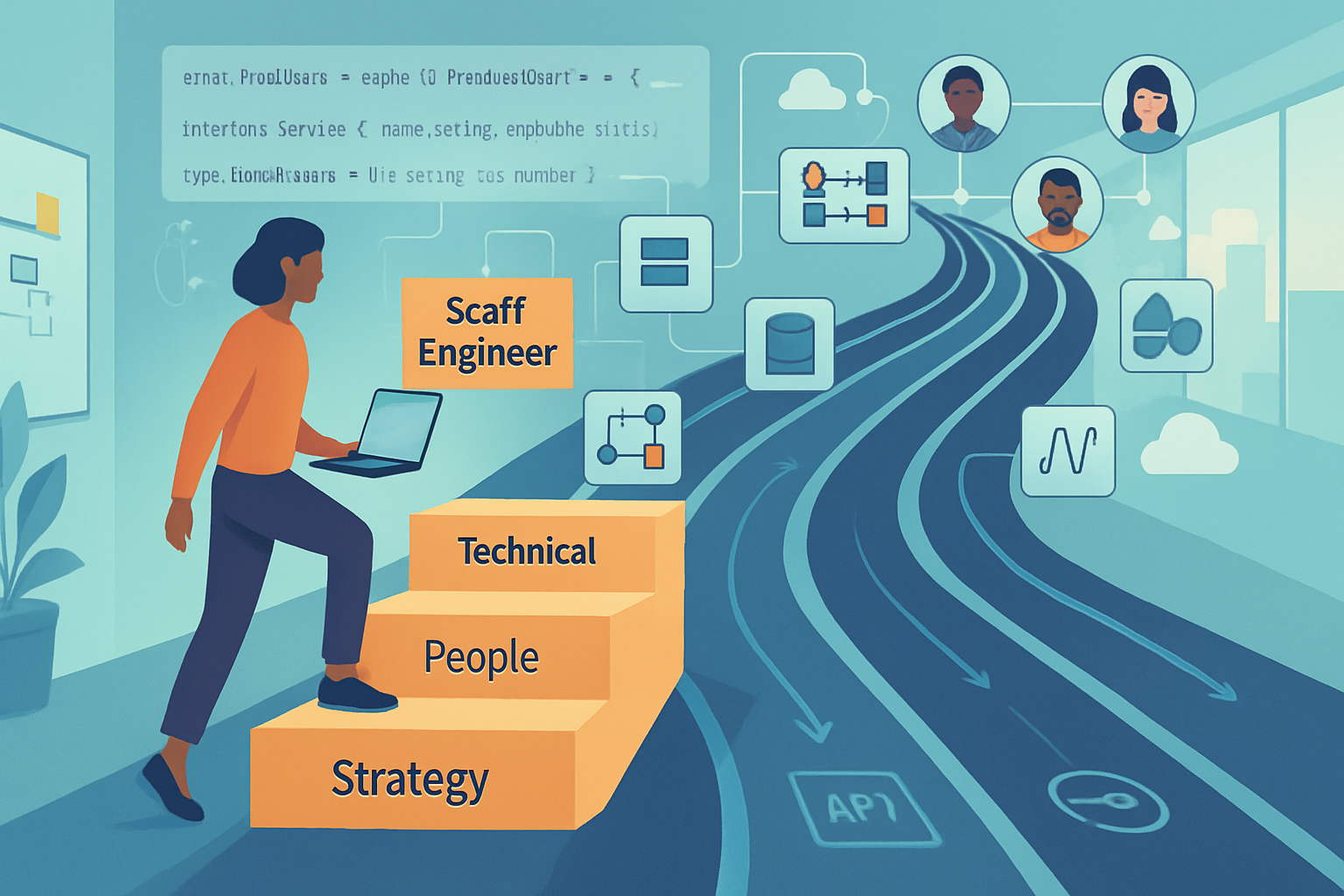
The three pillars you must develop
- Technical mastery and architectural thinking
- Multiplying impact (people + process)
- Organizational influence and strategy
You’ll need all three. Excelling at one won’t get you a Staff role.
Pillar A - Technical mastery & systems thinking
What to master:
- Deep JavaScript and TypeScript fluency (types, runtime behavior, memory model, event loop). See MDN and TypeScript docs for brushing up: https://developer.mozilla.org/en-US/docs/Web/JavaScript, https://www.typescriptlang.org/
- Node.js server internals and async patterns: https://nodejs.org/en/docs/
- System design: scalability, fault-domains, failure modes, capacity planning.
- Architecture patterns: microservices vs. monolith, APIs, message-driven systems, CQRS, event-sourcing where appropriate.
- Observability (logs, metrics, traces) and SLOs - measure reliability and set targets; Google’s SRE book is an excellent reference: https://sre.google/sre-book/table-of-contents/
- Security and privacy basics relevant to your stack (OWASP top 10, dependency risk).
- CI/CD, test automation, and release strategies (feature flags, canaries, rollbacks).
Artifacts you should produce:
- High-quality design documents / RFCs (problem statement, options considered, trade-offs, migration plan).
- Architecture diagrams (system boundaries, data flow, failure modes).
- Prototypes or PoCs that validate assumptions (load-tested when relevant).
How to demonstrate this at scale:
- Lead a cross-team refactor that improves latency or operational cost by measurable amounts.
- Design a service boundary change that reduces cascading failures.
Pillar B - Multiplying impact (people + process)
Staff engineers make others more effective.
Key behaviors:
- Mentorship: adopt a mentor-of-mentors mindset - teach other mentors how to coach.
- Code review culture: set standards, write clear review guidelines, reduce triage time.
- Processes: introduce reproducible postmortems, standardize deployment checks, or create a shared component library.
- Hiring and onboarding: help define job bar, participate in interviewing, remove onboarding friction.
Deliverables that show multiplication of impact:
- A shared pattern library, component system, or internal tooling that saves X engineering hours/month.
- Documentation and workshops that reduced onboarding time by Y%.
- A measurable increase in code review turnaround or reduction in production incidents.
Pillar C - Organizational influence & strategy
Staff engineers are visible beyond their team.
Skills to develop:
- Influence without authority: build relationships with PMs, product, infra, SRE, and legal.
- Roadmap thinking: align technical initiatives with company goals and OKRs.
- Stakeholder management: clarify trade-offs and costs, get buy-in, and negotiate timelines.
- Communication: concise executive summaries, technical storytelling, and persuasive decision-making.
How to show this:
- Own a multi-quarter initiative that maps to a company OKR.
- Run architecture reviews and influence vendor/technology choices.
- Present technical strategy to execs or leadership reviews.
A step-by-step roadmap (0–12+ months)
Each stage has practical goals and artifacts you can point to during promotion conversations.
Stage 0: Self-assessment (weeks 0–2)
- Map your current strengths to the three pillars.
- Ask your manager: what does Staff mean at this company? Get examples.
- Collect feedback from peers, direct reports (if any), and cross-team partners.
Deliverable: a one-page gap analysis listing 3 highest-impact gaps and a plan to close them.
Stage 1: Build cadence and visibility (months 0–3)
Goals:
- Own a medium cross-team project (bug fix or performance improvement that touches multiple squads).
- Publish a concise design doc or RFC.
- Mentor at least two engineers and run a technical brown-bag.
Deliverables:
- RFC + review thread.
- Mentorship notes or curriculum.
- Measurable outcome (reduced latency, cheaper infra, fewer incidents).
Stage 2: Scale influence (months 3–6)
Goals:
- Lead a project that requires coordination across 3+ teams.
- Improve an engineering process (e.g., code-review template, CI optimization) that saves time.
- Start running architecture or incident postmortem reviews.
Deliverables:
- Cross-team plan, timeline, and risk mitigation.
- Dashboard showing impact (deploy frequency, MTTR, test pass rates).
Stage 3: Cement strategic impact (months 6–12)
Goals:
- Own a multi-quarter initiative that maps to company goals.
- Influence roadmap decisions through technical strategy.
- Build repeatable artifacts (libraries, infra tooling) used by several teams.
Deliverables:
- Project retrospective showing measurable business impact (e.g., 30% reduction in infra cost, 40% fewer P1 incidents).
- A promotion write-up: concise, quantified accomplishments tied to Staff expectations.
Stage 4: Preparation for promotion / role transition (months 9–12+)
- Collect endorsements from managers and cross-team leads.
- Consolidate artifacts: RFCs, diagrams, postmortems, metrics dashboards, letters from PMs.
- Practice the narrative - tell the story of problems you solved at scale and how you multiplied others’ output.
Concrete artifacts that matter in promotion conversations
- Design docs / RFCs (with decision log and rollback plan).
- Metrics before/after change (latency, throughput, deployment frequency, incident frequency, cost).
- Postmortem write-ups showing blameless learning and systemic fixes.
- Mentorship impact: mentees’ promotions, concrete improvements in team performance.
- Cross-team endorsements that mention influence and outcomes.
Quantify everything. Numbers tell the story faster than adjectives.
How to influence without controlling (practical tactics)
- Lead by example: ship small, high-quality changes that others copy.
- Ask questions to expose assumptions in meetings; then synthesize and propose options.
- Use async communication: well-structured docs let people absorb and comment.
- Run lightweight experiments: canary a change, measure, iterate.
- Frame technical trade-offs in business terms: risk, cost, time-to-market.
Interview and promotion prep (what to expect)
Technical topics:
- System design at scale (trade-offs, partitioning, data consistency).
- Debugging incidents and preventing recurrence.
- Language/runtime specifics when it matters (V8 optimizations, GC, memory leaks in Node).
Behavioral topics:
- Cross-team conflict resolution examples.
- Times you changed a process or introduced a tool.
- Evidence of mentoring and amplifying others.
Format tips:
- Use the STAR framework for stories - Situation, Task, Action, Result - but emphasize measurable results.
- Bring artifacts: link to RFCs, dashboards, postmortems.
Common pitfalls and how to avoid them
- Doing too much hands-on IC work and not delegating. Delegate and create systems that run without you.
- Confusing busyness with impact. Prioritize initiatives with measurable outcomes.
- Over-engineering solutions. Prefer incremental, iterated changes that prove value.
- Being the only keeper of tribal knowledge. Document and teach.
Sample promotion bullet points (write these for your manager)
- Led refactor of payment ingestion pipeline reducing mean latency by 45% and infrastructure cost by 22%; shipped across 3 teams and maintained <1% error rate post-rollout.
- Authored RFC to standardize internal component library; adoption across 6 squads reduced duplicate UI code by 70% and cut onboarding time for new frontend hires by two weeks.
- Ran quarterly architecture reviews and postmortems; introduced SLOs and deploy automation that reduced P1 incident MTTR from 5 hours to 45 minutes.
Short. Specific. Measured.
Industry best practices for the Staff Engineer mindset
- Aim for high leverage: pick work where you affect many people.
- Prioritize observability: if you can’t measure it, you can’t improve it.
- Embrace blameless learning: postmortems must lead to change.
- Standardize and automate repetitive work.
- Keep learning: follow core sources (JS/TS docs, system design material, SRE practices) and adapt patterns rather than copying them blindly.
References to continue study:
- JavaScript (MDN): https://developer.mozilla.org/en-US/docs/Web/JavaScript
- TypeScript: https://www.typescriptlang.org/
- Node.js docs: https://nodejs.org/en/docs/
- Google SRE book (on SLOs and reliability): https://sre.google/sre-book/table-of-contents/
- The Staff Engineer perspective and patterns (search for contemporary essays and books on staff/lead IC careers).
Final checklist (use this weekly)
- Did I ship work that changed the way other teams operate this week? Yes / No
- Did I mentor or coach someone and track their progress? Yes / No
- Did I document a decision or tidy up a shared pattern? Yes / No
- Did I measure impact and update dashboards or RFCs? Yes / No
If you answered “No” more than once, pick one small, high-leverage task and ship it this week.
Becoming a Staff Engineer is less about a specific number of years and more about multiplying impact: across systems, people, and strategy. Start small. Make measurable changes. Tell the story clearly. Do that repeatedly. The rest follows.