· career · 7 min read
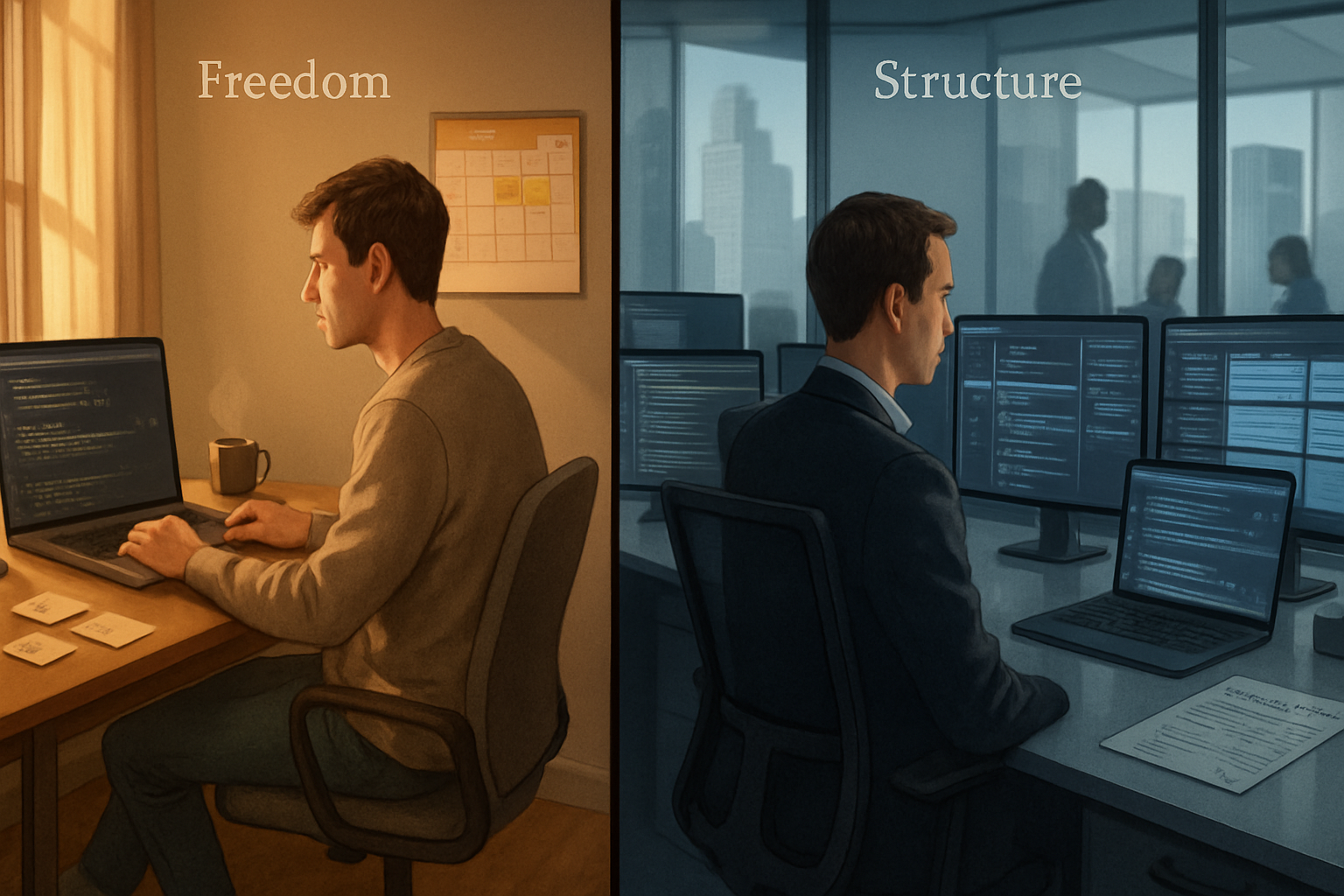
Big Tech: The Illusion of Stability-Is Freelancing the Future?
Big tech no longer guarantees a lifetime of security. This article breaks down how layoffs, burnout, and shifting corporate expectations have changed the calculus - and shows a practical path for engineers, designers, and product people who are thinking about whether freelancing could be a more resilient career.

What you’ll get from this article
You’ll leave with a clearer answer to one question: can freelancing realistically replace the perceived security of a big tech job - and if so, how do you get there? Read on for a reality check, a decision framework, and an actionable transition playbook.
The promise that used to be: stability in big tech
For years, “big tech” meant generous pay, cushy perks, steady career ladders, and predictable benefits: health insurance, 401(k) matches, parental leave. That promise created a powerful psychological safety net. You didn’t have to think about clients, invoices, or health insurance. You could focus on craft. You could plan long-term.
But pay, perks, and perceived permanence are not the same as true, unconditional stability. Two trends exposed that difference.
- Corporations run on capital efficiency, not paternalism.
- External shocks (macro downturns, product pivots) can quickly change headcount math.
When layoffs ripple through your Slack channel at 2 a.m., the illusion collapses.
(If you want data on the scale of recent tech cuts, see reporting from major outlets documenting waves of job reductions across the industry CNBC and global analyses of independent work trends from McKinsey.)
What’s changing: layoffs, burnout, and workplace expectations
- Layoffs are no longer rare. Companies that once swore “no layoffs” have reduced headcount during downturns.
- Burnout is a systemic issue. Longer hours, blurred home/work boundaries, and perpetual urgency have eroded many people’s tolerance for unstable environments. See Gallup’s research on burnout for context.
- Job roles are fluid. Your job may be redefined or de-prioritized as business priorities shift.
Taken together, these trends make “stability” a conditional, rather than absolute, attribute of big tech employment.
Freelancing: what it really buys you
Freelancing offers control. You pick clients, set rates, and can design your schedule. You own your portfolio. You diversify income across multiple sources. You can scale by hiring subcontractors or productizing services.
But freelancing also brings volatility. Work ebbs and flows. You take on all the administrative burdens: taxes, health insurance, sales, contracts, and collections. The safety net you gave up - employer benefits - must be rebuilt piece-by-piece.
The question isn’t whether freelancing is better. It’s whether it fits your tolerance for unpredictability and your willingness to manage the business side of your skills.
(Trends and numbers on the growth of independent work: Upwork’s “Freelancing in America” reports and McKinsey’s independent work analysis.)
A framework to compare “stability”
When evaluating options, compare these dimensions rather than the vague idea of “security.” Score each on a scale of 1–5 for your personal situation.
- Income predictability: Is your monthly revenue steady?
- Benefits & safety net: Do you have health insurance, disability, and retirement access?
- Upside & growth: Can your income scale materially?
- Control & autonomy: How much say do you have over what you work on and when?
- Emotional cost: How sustainable is the role for your mental health?
Example: a big-tech senior engineer may have high income predictability and benefits but low autonomy when re-orgs hit. A freelance UX designer may have lower predictability but higher autonomy and upside.
Practical pros and cons, side-by-side
Pros of big tech
- Predictable paycheck and employer benefits.
- Mentorship, structured career ladders, and access to expensive tooling.
- Less time spent on non-craft tasks like sales.
Cons of big tech
- Vulnerability to mass layoffs and strategic pivots.
- Limited control over work scope and compensation velocity.
- Cultural stressors and the risk of burnout.
Pros of freelancing
- Autonomy and the potential for multiple income streams.
- Ability to choose clients and projects aligned with your priorities.
- Faster income upside if you find a high-value niche.
Cons of freelancing
- Income volatility and administrative overhead.
- Responsibility for benefits and taxes.
- Sales, negotiation, and client management are required skills.
Financial checklist before you go independent
You don’t need a perfect runway - but you do need a plan.
- Emergency runway: 6–12 months of personal expenses is ideal. If you have less, keep some form of part-time safety net.
- Debt and fixed costs: Reduce high-interest debt and quantify monthly fixed expenses.
- Price your time: Know your break-even hourly/day rate after taxes and business costs.
- Insurance: Research health insurance options (marketplace, spouse/partner plans, trade associations, or private brokers). See Kaiser Family Foundation resources on employer coverage for context about what you’ll be losing.
- Retirement savings: Learn about SEP IRAs, Solo 401(k)s, and how to replicate an employer match through higher savings. The IRS has resources on one-participant 401(k)s.
- Taxes: Plan for self-employment tax and estimated quarterly payments.
How to build a freelancing career (practically)
Step 1 - Validate demand
- Talk to people inside and outside your network. Offer a small paid pilot.
- Build a simple portfolio that shows impact (metrics > features).
Step 2 - Create a pricing strategy
- Anchor on value, not just time. If your work drives revenue, price for outcomes.
- Offer multiple engagement models: hourly support, fixed-price projects, and retainer relationships.
Step 3 - Contracts, scope, and payments
- Use clear contracts. Define deliverables, milestones, payment terms, and IP ownership.
- Require deposits for new clients (commonly 20–50%).
- Include late payment fees and dispute resolution terms.
Step 4 - Find consistent clients
- Mix inbound (content, referrals, portfolio) with outbound (targeted outreach, cold email, LinkedIn).
- Build retainer relationships for baseline predictability.
Step 5 - Systemize and scale
- Automate invoicing and bookkeeping (tools like QuickBooks, FreshBooks).
- Consider subcontractors for delivery peaks.
- Create products (tutorials, templates, micro-SaaS) to de-risk income.
Resources: Freelancers Union has practical guides on contracts and benefits: https://www.freelancersunion.org/
Hybrid strategies that reduce risk
You don’t need to choose binary extremes. A hybrid approach gives optionality:
- Moonlighting or part-time freelancing while employed to validate demand.
- Consulting gigs during parental leave or sabbaticals.
- Building products or passive income while keeping a payroll job.
These approaches let you test market fit and build runway before a full leap.
Mental health and work-life balance: the real currency
Stability isn’t only financial. Burnout ruins savings, productivity, and relationships. Freelancing can improve balance if you design it intentionally - or make it worse if you trade clarity for constant hustle.
Check these guardrails:
- Boundaries: set work hours and client response windows.
- Community: join peer groups for accountability and referrals.
- Time off: schedule vacations and mental health days.
Gallup and other studies show that systemic improvements in job design and support meaningfully reduce burnout. If mental health is your primary goal, job shape matters more than employer logo. See Gallup on burnout.
Quick decision guide: which path fits you?
Choose big tech if:
- You prioritize minimal administrative overhead.
- You value steady benefits and a predictable paycheck.
- You learn best in structured environments and want formal mentorship.
Choose freelancing if:
- You want autonomy and the ability to craft your income mix.
- You tolerate income variability and enjoy selling your skills.
- You have a niche skill that businesses will pay a premium for.
Choose hybrid if:
- You want to reduce risk while testing independence.
- You need time to build a pipeline without burning savings.
Practical checklist for the next 90 days (if you’re considering the shift)
- Save or secure 3–6 months of runway.
- Take one paid pilot or consulting project part-time.
- Build or update a portfolio emphasizing impact metrics.
- Draft a simple contract template and set payment terms.
- Join one freelancer community and one client-focused network.
- Plan health insurance and set up a retirement savings vehicle.
Complete these steps and you’ll be in a position to make a measured decision rather than an anxious leap.
Final thought
Big tech offered a comforting narrative: join us, and you’ll be safe. That narrative has frayed. Companies reorganize. Markets change. People burn out.
Freelancing is not an automatic cure. It’s a different set of risks - ones you can control if you prepare. The modern answer to “stability” looks less like a single employer and more like diversified agency: multiple income streams, contingency savings, and a career that treats your mental health as part of the balance sheet.
If you want stability that lasts, build it yourself. Make your income resilient. Build community. Own your work. Those are things a paycheck alone can’t guarantee.